

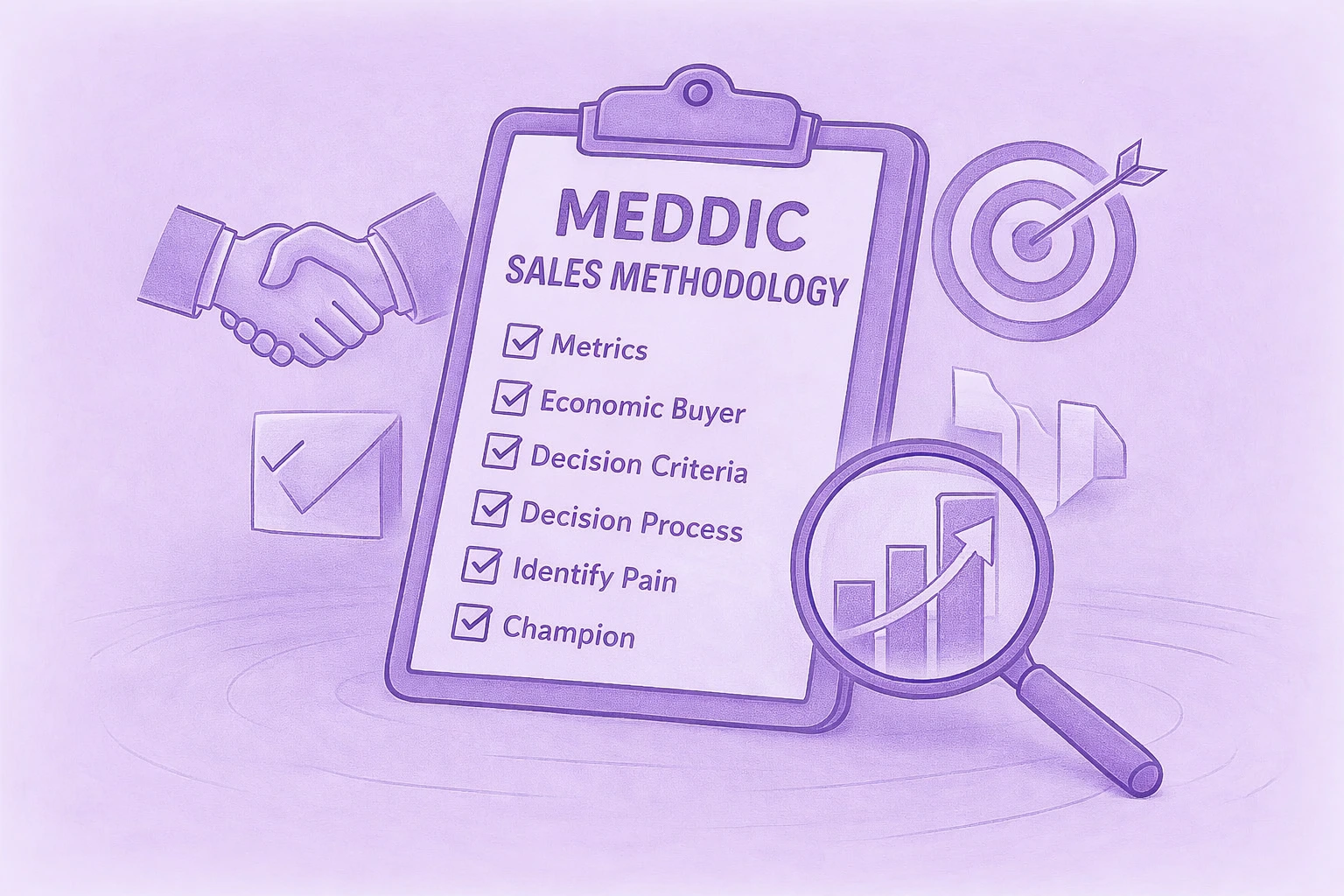

MEDDIC is a B2B sales qualification methodology built around six elements: Metrics, Economic Buyer, Decision Criteria, Decision Process, Identify Pain, and Champion. It was developed at Parametric Technology Corporation in the 1990s and is now used by enterprise sales teams like Salesforce, Google Cloud, and PTC to qualify complex, high-value deals.
Unlike lighter frameworks like BANT, MEDDIC is designed for long sales cycles with multiple stakeholders, internal approval chains, and strategic buyers. This guide explains how each MEDDIC component works, how to implement it across your sales team, how it compares to MEDDPICC, MEDDICC, SPIN, and Challenger, and how to use meeting data to apply it consistently.
MEDDIC at a glance
- MEDDIC stands for Metrics, Economic Buyer, Decision Criteria, Decision Process, Identify Pain, Champion.
- It's a B2B sales qualification methodology for long, complex, multi-stakeholder deals.
- Developed at PTC in the 1990s; now used across enterprise SaaS and consulting.
- Variations: MEDDPICC adds Paper Process and Competition; MEDDICC adds Competition only.
- Best for: enterprise deals, buying committees, high ACV. Less useful for short transactional sales.
What is the MEDDIC sales methodology?
The MEDDIC methodology is a sales qualification framework designed to help teams focus on high-quality opportunities and improve deal outcomes.
It was developed in 1996 by Dick Dunkel at Parametric Technology Corporation, a fast-growing software company that needed a more reliable way to manage complex sales cycles and hit ambitious revenue targets. By introducing a structured approach to deal qualification, the company improved its ability to forecast revenue and scale its sales efforts, eventually growing from around $300 million to $1 billion in revenue.
Since then, the MEDDIC sales qualification framework has been widely adopted by sales organizations, especially those selling high-value solutions in enterprise environments.
At its core, MEDDIC helps answer a simple but important question:
Is this deal truly qualified, or are we spending time on the wrong opportunity?
Unlike simpler sales qualification methodologies, MEDDIC is built for:
- long sales cycles
- multiple stakeholders and buying committees
- complex internal approval process
- high-value or strategic deals
That makes it especially useful for SaaS companies, enterprise vendors, and consulting firms.
What does MEDDIC stand for?
The MEDDIC sales framework is built around six key components:
- Metrics
- Economic buyer
- Decision criteria
- Decision process
- Identify pain
- Champion
These are important components you need to understand in every deal.
When applied consistently, they give your sales team a deeper understanding of:
- The customer’s business
- How decisions are made
- What drives the final purchasing decision
- Whether the opportunity is worth pursuing
How does the MEDDIC sales process work?

Metrics
Metrics define the measurable business impact your solution delivers. More specifically, they quantify the economic benefit a customer can expect, based on both their current situation and the results they are trying to achieve.
Strong sales reps do not rely on general claims. They connect their value proposition to outcomes that matter to the customer, such as increasing revenue, reducing costs, improving efficiency, or minimizing risk.
For example, instead of saying your solution improves productivity, you quantify it in concrete terms. This could mean reducing manual work by 25%, saving several hours per week per employee, or increasing conversion rates across the sales funnel.
To do this effectively, sales teams often rely on structured questions and tools. This can include using customer data in ROI calculators or projection models to estimate the financial impact of the solution. These insights help turn abstract benefits into clear, business-driven outcomes.
Metrics are one of the most important parts of the MEDDIC framework because they translate your solution into tangible value. This is what resonates most with economic buyers and senior stakeholders, who are ultimately responsible for justifying the investment. It is also one of the reasons why organizations that apply MEDDIC effectively often see higher close rates compared to more traditional sales approaches.
Economic buyer
The economic buyer is the person who has authority over the budget and can approve the purchase. In most cases, this is a senior executive focused on financial outcomes and broader business goals, not someone involved in day-to-day product use.
One of the most common mistakes in the sales process is investing too much time in contacts who cannot influence the final purchasing decision. The MEDDIC sales framework addresses this by pushing sales reps to identify early on who controls the budget, who signs off on the deal, and who has the power to approve or block it.
Identify the economic buyer as early as possible. They care about high-level outcomes and the broader objectives of the company. This person is less interested in features and more focused on strategic impact, such as revenue growth, cost savings, or long-term efficiency. Without access to that perspective, it becomes difficult to position your solution in a way that supports the company’s broader objectives.
Once identified, tailor your communication accordingly. Instead of product details, conversations should focus on outcomes, ROI, and how your solution fits into the customer’s business priorities. In deals involving multiple stakeholders, understanding how the economic buyer interacts with other decision-makers is key to moving the opportunity forward.
Decision criteria
The decision criteria define how a potential customer evaluates solutions.
These criteria vary between organizations, but typically include:
- pricing and ROI
- compatibility with the current tech stack
- integration with existing systems
- ease of use and onboarding
- security, compliance, and support
One of the most common mistakes in sales conversations is presenting every feature instead of focusing on what matters most.
A strong MEDDIC approach means aligning your sales pitch directly with the customer’s priorities. When you understand their decision criteria, you can position your solution as the best fit for their specific needs.
Decision process
The decision process outlines how the customer moves from evaluation to purchase. It includes both the formal and informal steps, milestones, and individuals involved in the buyer’s procurement process.
This typically includes the steps involved in evaluation, the timeline for decisions, the key stakeholders involved, the internal approval process, and any procurement or legal requirements that need to be completed before a contract is signed.
Mapping out the decision process means understanding the full journey from initial evaluation to final contract signature. This can involve several stages, including problem recognition, information search, evaluation of alternatives, purchase decision, and post-purchase evaluation.
In many deals, delays happen because this process is unclear or underestimated. Without visibility into how decisions are made internally, sales teams struggle to anticipate roadblocks or move the deal forward efficiently.
Understanding the decision process early allows your team to guide next steps more effectively, align with the customer’s timeline, and reduce friction throughout the sales cycle.
Identify pain
If there is no real problem, there is no reason to buy.
The goal of this stage is to clearly identify pain and understand the impact it has on the customer’s business. In MEDDIC, this focuses on uncovering the core, urgent problems that create a real need for a solution, including the cost of doing nothing.
Strong sales professionals look at challenges such as operational inefficiencies, lost revenue opportunities, time wasted on manual processes, or risks and compliance gaps. Identifying pain requires understanding how those issues affect the business and why they matter now.
To do this effectively, sales reps need to ask specific questions and connect the answers directly to their value proposition. This means exploring not only the problem itself, but also its consequences. For example, how much revenue is being lost, how productivity is affected, or what risks the company is exposed to if the issue remains unresolved.
The clearer and more urgent the pain, the easier it is to position your solution as necessary rather than optional. When customer pain points are tied to measurable impact, it becomes much easier to justify the investment and move the deal forward.
Champion
A champion is someone inside the prospect’s organization who supports your solution and helps move the deal forward internally. They are not always the economic buyer, but they play a critical role in influencing outcomes.
A strong champion is genuinely invested in solving the problem your product addresses. They understand the value of your solution and have enough credibility within the organization to influence other key stakeholders, share insights about internal dynamics, and help you navigate the business decision-making process.
Identifying a champion requires careful observation and the right questions during your interactions. Typically, this is someone who is directly affected by the problem, actively engaged in discussions, and willing to help you connect with others involved in the decision.
Once identified, the relationship needs to be developed over time. This means equipping them with the right information, sharing relevant data and talking points, and supporting them so they can confidently advocate for your solution internally.
Why does MEDDIC work better than traditional sales qualification?
The strength of the MEDDIC sales methodology comes from its structured approach to qualification.
Instead of treating all leads equally, it helps sales teams focus on qualified prospects, develop a deeper understanding of the buying process, align their sales approach with real customer needs, and gain better visibility across the sales pipeline.
For sales leaders, this results in more accurate forecasting and more predictable outcomes. For sales reps, it means spending less time on deals that are unlikely to close and more time on opportunities that can actually generate revenue.
How do you implement MEDDIC on a sales team?
To get real value from the MEDDIC sales process, it needs to be embedded into how your team actually works, not treated as a one-time framework or sales training program.
1. Start with your current sales qualification process
Before rolling out MEDDIC, take a close look at how your team currently handles lead qualification.
Where do deals typically stall? Are reps missing the economic buyer? Is the decision process unclear? Are you progressing deals without fully understanding the customer’s business?
Answering these questions helps you identify gaps and shows where the MEDDIC framework can bring more structure and clarity.
2. Align sales and marketing teams
MEDDIC works best when both sales teams and marketing teams operate with the same definition of a qualified lead.
Marketing should focus on generating high-quality leads, while sales ensures those leads are properly qualified using MEDDIC criteria. When both teams share the same language around pain points, stakeholders, and the buying process, it creates consistency across the entire sales funnel.
This alignment is especially important for improving handoffs and avoiding wasted sales efforts.
3. Build MEDDIC into your CRM and workflow
For MEDDIC to scale, it needs to be part of your existing systems.
This means adding MEDDIC-related fields into your CRM, tracking relevant customer data, and making sure each opportunity includes key qualification details before moving forward in the sales pipeline.
When done correctly, this gives sales managers better visibility into deal quality and helps teams identify risks earlier in the process.
4. Focus on practical training, not just theory
Understanding MEDDIC is one thing. Applying it in real conversations is another.
The most effective teams go beyond basic MEDDIC sales training and use hands-on methods like workshops, deal reviews, role-playing, and real-world simulations. These help sales reps practice how to uncover decision criteria, validate assumptions, and navigate stakeholder dynamics.
During discovery, reps should also learn how to define clear ROI metrics. Instead of speaking in general terms, they need to quantify impact using real numbers tied to the customer’s goals. This makes the value proposition much stronger and more relevant.
5. Reinforce the process with ongoing coaching
One-time training is not enough. Sales leaders need to run regular deal reviews using the MEDDIC framework, coach sales reps based on real opportunities, and reinforce best practices consistently over time. This is what ensures adoption sticks and ultimately improves overall sales efforts.
Over time, this also helps teams spot patterns, improve their sales approach, and refine how they qualify and prioritize deals.
6. Use tools to capture and apply insights consistently
MEDDIC relies on detailed information from customer interactions, including pain points, stakeholder roles, objections, and the internal approval process.
Capturing all of this manually is difficult and often inconsistent, especially as teams grow. Without a reliable system, important details get lost, and deal qualification becomes uneven across the team.
Using the right sales enablement tools helps ensure that insights are captured, shared, and applied consistently, making it easier to move deals forward with confidence.
Using MeetGeek to support the MEDDIC sales process
Applying MEDDIC consistently depends on how well your team captures and uses information from meetings. In practice, this is where most teams struggle. Sales reps are expected to listen, ask the right questions, and take notes at the same time. Important details about customer pain points, the decision process, or the economic buyer often get lost or never make it into the CRM.
MeetGeek removes that friction by handling the entire capture process automatically.
Once connected to tools like Zoom, Google Meet, or Microsoft Teams, MeetGeek joins calls, records them, and generates full transcripts and AI-powered summaries. Instead of relying on memory, your team gets a complete, searchable record of every conversation.
%20(1).webp)
What makes this especially useful for the MEDDIC sales process is how those conversations are turned into structured insights. You can quickly identify what matters in each deal, understand stakeholder roles, review sales objections, and identify next steps, without digging through notes or recordings manually.
For example, after a call, your team can easily:
- Review exactly how a prospect described their pain points
- Spot mentions of the economic buyer or other key stakeholders
- Understand how the decision-making process works inside the organization
- Track commitments, concerns, and changes across multiple meetings
- Extract clear action items and follow-ups that keep things moving and lead to closing deals
Because everything is searchable and shareable, sales managers can also review calls, coach reps using real examples, and identify gaps in deal qualification much faster.
.webp)
Instead of adding another tool to manage, MeetGeek fits into your existing workflow and strengthens it. It turns everyday customer interactions into reliable data that supports your sales pipeline, improves consistency, and helps your team apply MEDDIC the way it is meant to be used.
On top of that, MeetGeek is built with security in mind. It supports SOC 2, HIPAA, and GDPR compliance, uses encryption both in transit and at rest, offers regional data hosting, and follows a zero-training data policy, making it suitable for teams handling sensitive business conversations.
What does a MEDDIC qualification look like in practice? MEDDIC sales qualification examples
Understanding the MEDDIC sales process conceptually is useful, but it becomes much clearer when you see how it applies to a real deal.
Example 1: SaaS company selling a CRM platform
Imagine a software company selling a CRM solution to a mid-sized enterprise.
- Metrics: The prospect wants to increase pipeline conversion rates by 20 percent and reduce manual reporting time
- Economic buyer: The Chief Revenue Officer is responsible for approving the budget
- Decision criteria: Integration with the current tech stack, ease of onboarding, and reporting capabilities
- Decision process: Includes a product demo, internal evaluation, IT review, and final executive approval
- Identify pain: The sales team is struggling with fragmented tools and inaccurate forecasting
- Champion: A sales operations manager who is directly impacted by these inefficiencies and wants a better system
By mapping all of this, the sales team gains a clear picture of how to move the deal forward. They can tailor their sales pitch, involve the right stakeholders, and anticipate blockers before they happen.
Example 2: Consulting firm selling a transformation project
Now consider a consulting firm offering a large digital transformation project.
- Metrics: Reduce operational costs and improve efficiency across multiple departments
- Economic buyer: A senior executive such as a Chief Transformation Officer
- Decision criteria: Proven track record, strategic alignment, and long-term business impact
- Decision process: Includes multiple executive reviews, budget approvals, and a formal procurement cycle
- Identify pain: Outdated processes and lack of alignment across teams
- Champion: A department leader responsible for driving change internally
In this case, the deal involves multiple stakeholders, a long approval process, and significant investment. Without a structured framework like MEDDIC, it would be difficult to manage.
What's the difference between MEDDIC, MEDDPICC, and MEDDICC?
In many cases, especially in enterprise environments, closing a deal involves more than just understanding the buyer’s needs. It requires navigating internal approvals, procurement workflows, legal reviews, and competitive pressure. That is why variations like MEDDPICC and MEDDICC have become increasingly common.
MEDDPICC: extending version of MEDDIC
The MEDDPICC framework builds on the original MEDDIC methodology by adding two additional components: the paper process and competition.
The paper process refers to everything that happens after a deal is agreed in principle but before it is officially signed. This includes procurement procedures, contract negotiations, compliance requirements, and the legal review process. In many sales environments, this stage can delay deals for weeks or even months if it is not understood early.
For example, a deal may appear ready to close from a sales perspective, but if the customer’s organization requires multiple approvals, security reviews, or vendor onboarding steps, the timeline can quickly extend. By factoring the paper process into the MEDDIC sales process, teams can anticipate these delays and manage expectations more effectively.
The second addition, competition, reflects the reality that most potential customers are evaluating multiple vendors at the same time. Understanding who else is involved, how they are positioned, and what differentiates your solution is a must for maintaining a strong value proposition throughout the sales cycle.
In practice, MEDDPICC is particularly useful in:
- enterprise sales with multiple stakeholders and layered approval structures
- industries with strict compliance or procurement requirements
- deals where competition is strong and differentiation is essential
MEDDICC: a lighter variation focused on competition
Another variation, MEDDICC, places more emphasis on competition without always treating the paper process as a separate category.
This approach is often used by sales teams that operate in highly competitive markets where multiple vendors are offering similar solutions. In these cases, understanding how your offering compares to alternatives can have a direct impact on whether the deal moves forward.
While MEDDICC does not fundamentally change the structure of the MEDDIC framework, it reinforces the importance of positioning and differentiation throughout the sales process.
When to use MEDDIC vs MEDDPICC
Choosing between MEDDIC and its variations depends on the complexity of your sales process and the type of deals your sales team is working on.
MEDDIC is typically sufficient for standard B2B scenarios where the deal involves some complexity but does not require extensive procurement or legal coordination.
MEDDPICC becomes more relevant when deals involve:
- long and formal approval processes
- detailed procurement and contract requirements
- multiple layers of decision-making authority
- strong competition between vendors
In these situations, adding visibility into the paper process and competitive landscape can significantly improve your ability to move deals forward.
MEDDIC vs BANT, SPIN, Challenger, and NEAT: what's the difference?
MEDDIC is especially effective in B2B complex sales environments with multiple stakeholders, as it offers a structured way to understand both customer needs and how decisions are made, something many other methodologies do not fully address.
Here’s how other popular sales methodologies compare to the MEDDIC process:
| Methodology | What it is | Best for | Key difference vs MEDDIC |
|---|---|---|---|
| BANT (Budget, Authority, Need, Timing) | A simple framework to quickly qualify leads based on basic criteria | Transactional sales and short sales cycles | Faster but more surface-level; does not fully capture complex buying processes |
| SPIN Selling | A questioning-based approach focused on Situation, Problem, Implication, and Need-payoff | Discovery calls and uncovering customer needs | Strong for conversations, but does not structure deal qualification like MEDDIC |
| Challenger Sales | A methodology that focuses on teaching, tailoring, and taking control of the sales conversation | Complex sales where influencing the buyer is key | Focuses on influencing decisions, while MEDDIC focuses on qualifying and managing them |
| NEAT (Needs, Economic impact, Access to authority, Timeline) | A modern qualification framework that builds on BANT with more focus on impact | Mid-level complexity sales | More flexible than BANT, but still less detailed than MEDDIC |
What are the most common challenges with MEDDIC adoption?
One common issue is complexity. For newer sales representatives, the framework can feel overwhelming at first.
Another challenge is the level of detail required. Gathering information about the customer’s organization, stakeholders, and processes takes time, which can slow down early-stage deals.
Inconsistent adoption is also common. If some reps follow MEDDIC and others do not, the sales pipeline becomes difficult to manage.
Finally, some teams fall into overanalysis. Instead of using MEDDIC to guide decisions, they treat it as a checklist and delay moving deals forward.
The key is to use MEDDIC as a guide, not a rigid system.
What are the pros and cons of MEDDIC?
The MEDDIC sales methodology is designed to improve how teams qualify and manage deals, but it works best in the right context. Here’s a quick look at where it helps and where it can fall short.
Pros of MEDDIC:
- Improve lead qualification: Helps sales teams focus on qualified prospects and avoid wasting time on low-fit opportunities
- Better forecasting: A clearer view of the economic buyer and decision process leads to more accurate pipeline predictions
- Deeper customer understanding: Emphasis on identifying pain points improves alignment with real customer needs
- More predictable outcomes: A structured approach makes it easier to track deal progress and spot risks early
Cons of MEDDIC:
- Not ideal for simple sales: Can feel too heavy for transactional sales or short sales cycles
- Requires training and consistency: Sales reps need time and coaching to apply it effectively
- Can slow things down if overused: Treating it as a rigid checklist may delay deals instead of moving them forward
MEDDIC discovery checklist: key questions to ask
Use this MEDDIC checklist during discovery calls to make sure you’re capturing the information needed to properly qualify a deal and move it forward.
| MEDDIC element | Questions to ask in discovery |
|---|---|
| Metrics | What specific outcome are you trying to achieve? How are you measuring success today? What would improvement look like in numbers? |
| Economic Buyer | Who is responsible for approving the budget? Have we involved them in the conversation? What do they care about most? |
| Decision Criteria | What are the top criteria you’re using to evaluate solutions? How important are factors like ROI, integration, or security? |
| Decision Process | What are the steps from where you are today to a signed agreement? Who needs to be involved at each stage? |
| Identify Pain | What problem are you trying to solve? What happens if this isn’t addressed in the next 3 to 6 months? |
| Champion | Who internally is driving this initiative? Do they have influence with other stakeholders? Can they advocate for this solution? |
Final thoughts
MEDDIC gives you a clearer view of what is actually happening inside a deal. Once you know who is involved, what matters to them, and how decisions are made, it becomes much easier to prioritize the right opportunities and move them forward with confidence.
The impact shows up in how your team works day to day. Less time spent on uncertain deals, more focus on opportunities that have real potential, and better visibility across the entire sales pipeline.
To make that work in practice, your team needs a reliable way to capture insights from every conversation. If you want to apply MEDDIC more consistently and turn meetings into actionable data, try MeetGeek for free and see how it increases your team's productivity and results.
Frequently asked questions
What types of sales teams benefit most from MEDDIC?
The MEDDIC sales methodology is most effective for teams handling enterprise deals, longer sales cycles, and opportunities involving multiple stakeholders. It works particularly well in B2B environments where understanding the customer’s organization and decision-making structure is critical to closing deals.
How does MEDDIC improve sales forecasting accuracy?
MEDDIC improves forecasting by relying on concrete data rather than intuition. By clearly defining elements like the economic buyer, decision process, and decision criteria, sales leaders can better assess which deals are likely to close and when, leading to more accurate revenue predictions.
Can MEDDIC help disqualify bad leads faster?
Yes. One of the key strengths of the MEDDIC framework is that it helps sales teams quickly identify deals that are unlikely to move forward. By uncovering gaps in areas like stakeholder access or unclear pain points, teams can avoid wasting time and focus their sales efforts on high-quality opportunities.
Why is mapping the decision process so important in MEDDIC?
Understanding the customer’s decision-making process allows sales teams to identify the exact steps required to close a deal and anticipate potential delays. A clear map of the process helps reps know when to act, which stakeholders to involve, and how to address roadblocks before they impact the outcome.
Does MEDDIC actually increase win rates?
Many companies report significantly higher win rates after adopting MEDDIC, with some seeing double-digit improvements. This improvement comes from focusing on well-qualified opportunities, aligning with real customer needs, and managing deals more strategically throughout the sales cycle.




.avif)