

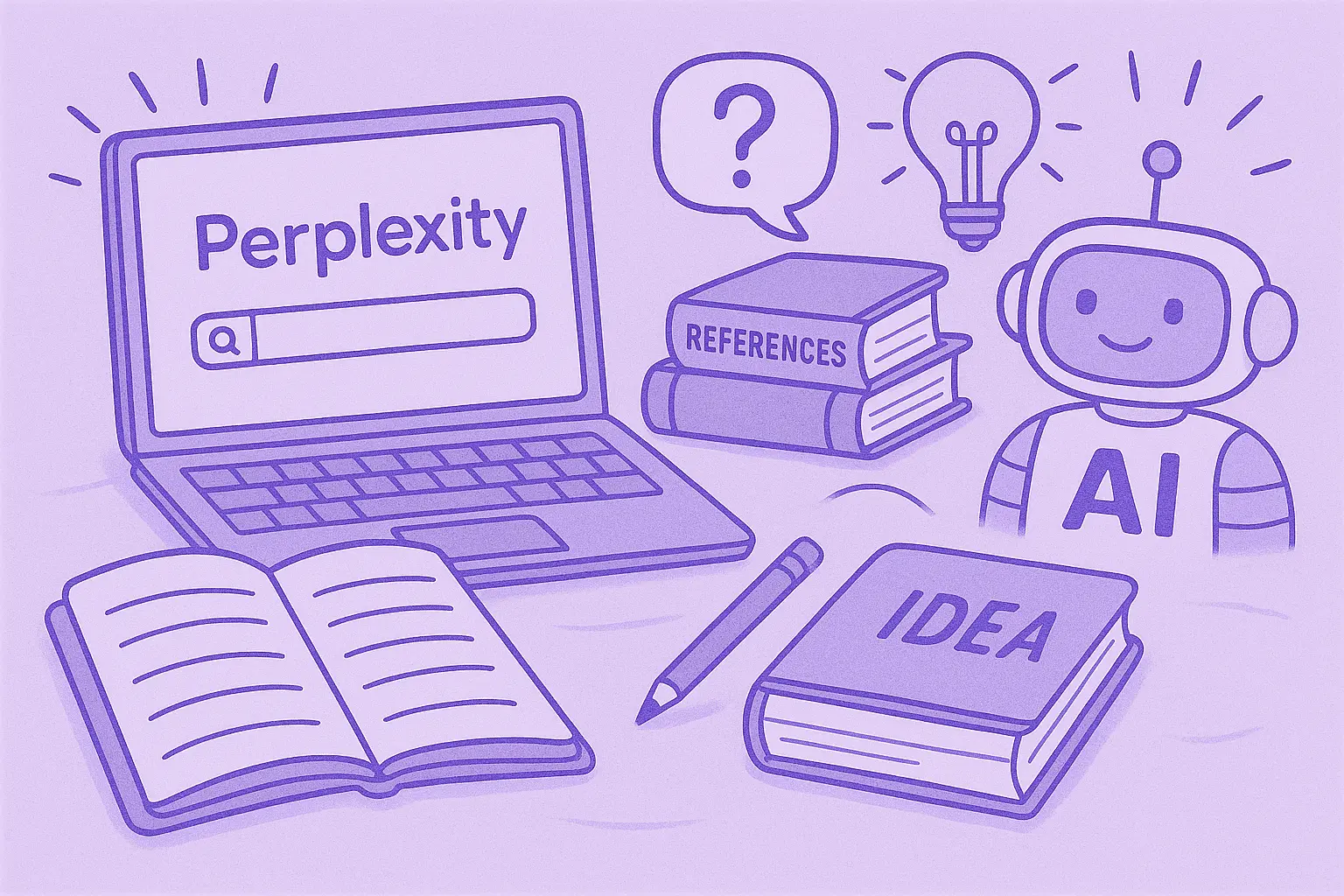

Artificial intelligence has changed nearly every part of our digital routines. We use it to organize emails, summarize documents, write content, plan ideas, and even manage daily tasks.
Yet one area remained surprisingly slow to evolve. That area was an online search. For years, search engines relied on the same basic structure: you enter a search term, you wait for a list of links, and you manually explore each page until you find the information you want.
Perplexity AI breaks that pattern. Instead of making you sort through results, it gives you direct, useful, citation-backed answers in a conversational format. Many people now refer to it as an AI-powered search engine that sits somewhere between a research assistant and a question answering tool.
If you have seen others talk about Perplexity or you have already tested it and want a more complete understanding of what it does, this article will walk you through everything you need to know.
We will look at how Perplexity AI works, what makes it different from traditional search engines, how its new Comet browser changes the experience, what strengths and limitations it has, and where it fits into the growing world of AI tools.
Understanding what Perplexity AI really is
At its simplest, Perplexity AI is a search engine that uses artificial intelligence to answer questions directly. Instead of giving you a long list of articles to explore, it retrieves relevant information from online sources, summarizes the key details, and presents the findings in a clear, structured response.

It is built to handle follow-up questions as well, which means you can continue the conversation and dive deeper into a topic without starting over each time.
Perplexity calls itself an answer engine, but the experience feels closer to having a knowledgeable AI assistant that works with real-time data. You ask a question, Perplexity evaluates the intent behind your request, searches across multiple sources, applies advanced AI models, and generates responses supported by citations.
While other AI platforms can generate responses too, most rely heavily on training data that may not reflect up-to-date information. Perplexity fills that gap with real-time web searches, which help it pull in recent news articles, research papers, market trends, sports scores, and other sources that update frequently.
How Perplexity AI works behind the scenes
To understand what makes Perplexity different, it helps to look at its process for answering questions. The workflow is surprisingly intuitive and can be viewed in a few clear stages.
Stage 1: Interpreting the user query
Perplexity starts by analyzing your initial question from the search bar. It identifies the main topic, the intention behind the question, and any related concepts that could shape the answer.
This is where natural language processing and machine learning come in. The platform does not rely on perfect phrasing or rigid search terms. Instead, it evaluates meaning and context to understand what the user is trying to find.
This step is essential for nuanced answers. Whether the question is broad, specific, or layered, Perplexity uses its language models to identify what matters most.
Stage 2: Retrieving information from the web
Once Perplexity understands the question, it performs a real-time web search. This part sets it apart from many other AI tools. Perplexity looks across online sources, including:
- News sites
- Research papers and academic databases
- Reputable publications
- Blogs and industry reports
- Web content that reflects recent updates
It does not simply copy the content. Instead, it evaluates which pieces of information are relevant and trustworthy, then prepares the source material for the next step.
Stage 3: Generating the answer
Perplexity uses advanced AI models to synthesize the information it found. It summarizes the key points, compares different perspectives, and organizes the details into a response that feels logical and easy to read.
This is where the platform’s conversational capabilities become clear, as it gives human-like responses. It remains factual but avoids the dense jargon that often makes research difficult to digest.
Here’s how it answers a question about itself:
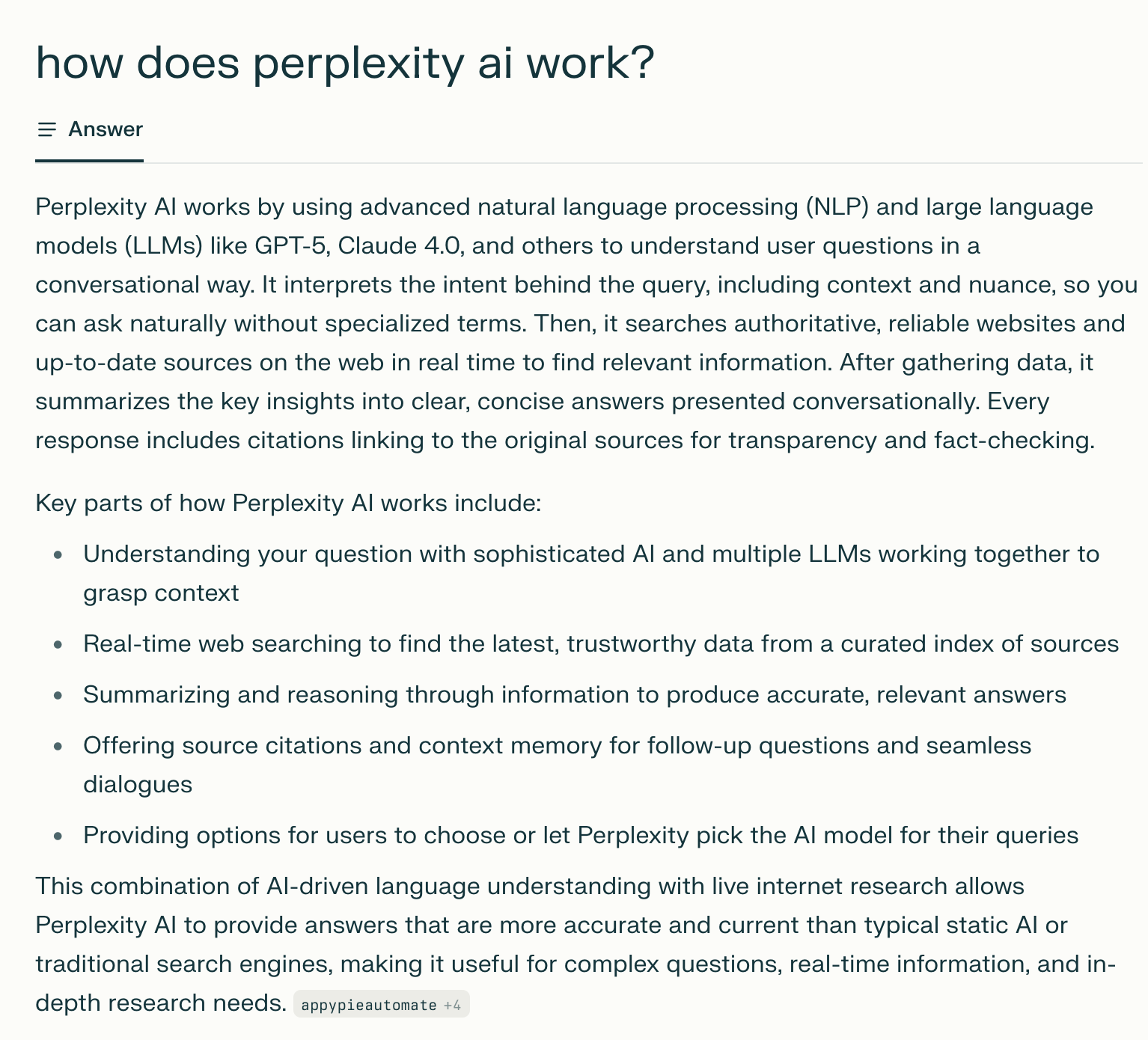
The generated answer is shaped by the type of search you selected. Perplexity offers several options to match different needs:
- Quick Search provides fast, surface-level answers.
- Pro Search offers more targeted and detailed information.
- Research mode delivers deeper, more analytical results, often similar to a long-form report.
- Labs experiments with structured outputs such as slide-style summaries or document-style answers.
These search types help Perplexity adjust to casual users and serious researchers alike.
Stage 4: Displaying source citations
Perplexity lists exactly where it found each piece of information. This approach builds trust and allows users to verify accuracy easily, as well as dig deeper if they wish.
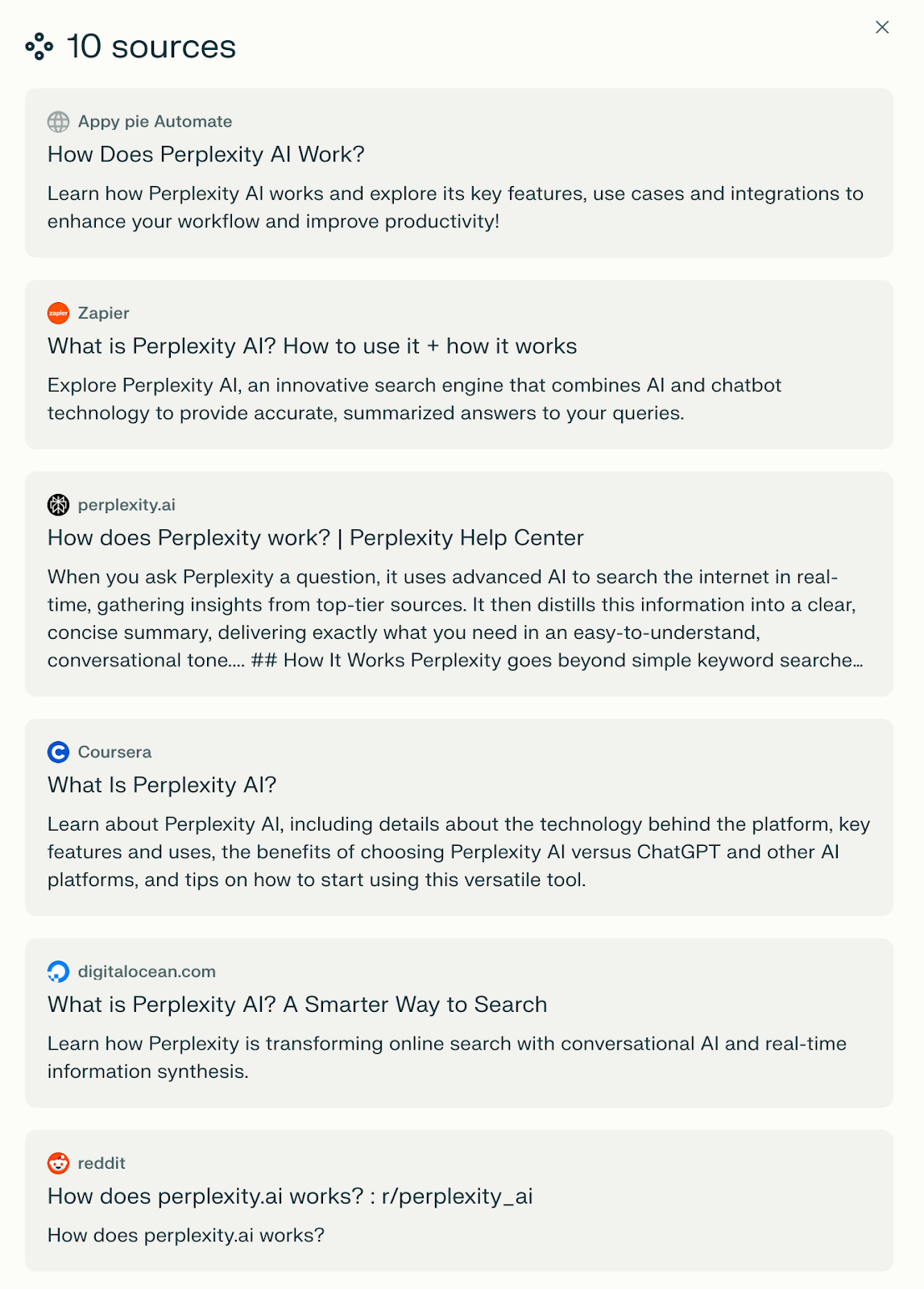
Instead of feeling unsure about the origin of a statement, you can click directly into the cited source. This transparency is one of the most appreciated features of the platform.
Stage 5: Supporting follow-up Questions
Perplexity does not treat each question as an isolated request. It saves the context of the conversation so you can ask follow-up questions naturally for deep research.

The AI remembers what you already discussed and builds on the same thread, creating a helpful back-and-forth dialogue. This contextual memory gives Perplexity a more interactive feel than traditional search engines.
How Perplexity AI compares to traditional search engines
Traditional search engines rely heavily on ranking algorithms. When you search for a topic, the engine sorts through billions of web pages and determines which links are likely to be most relevant. You, as the user, then decide which pages to open and how deeply to explore them.
Perplexity inverts this process. Rather than giving you a list of options to check manually, it gathers the information for you and delivers the findings directly in a single, well-organized response. This approach offers several benefits:
- Traditional search requires a lot of manual effort, while Perplexity simplifies the experience by gathering and synthesizing information upfront, improving response quality.
- Perplexity supports conversational queries, so you can ask questions in plain language without worrying about formatting or keywords.
- When a question has multiple parts, Perplexity breaks it into meaningful sections, something traditional search engines do not do automatically.
- Perplexity shows exactly where each piece of information came from, which makes verification and fact-checking easier.
- By combining real-time web searches with AI, Perplexity delivers faster insights without losing accuracy, especially on topics where up-to-date information matters.
❗Perplexity is not a complete replacement for Google Search or other traditional search engines. There are still cases where users want to browse multiple pages or explore a wide range of viewpoints manually. However, for people who prefer direct answers, Perplexity delivers a much faster workflow.
Comet’s AI browsing meets MeetGeek’s meeting intelligence
Perplexity recently introduced Comet, a lightweight browser designed to bring AI-powered search directly into your browsing flow. Instead of switching between tabs or apps, Comet lets you ask questions, summarize pages, and compare information while you navigate the web. It gives users a simple way to keep AI tools within reach, no matter what site they are on.
What makes this especially valuable for productivity is that the MeetGeek browser extension is now available inside Comet, too. MeetGeek already supports effortless meeting capture across platforms, and bringing our extension to Comet means you can stay focused on your work while MeetGeek handles everything happening in your calls.
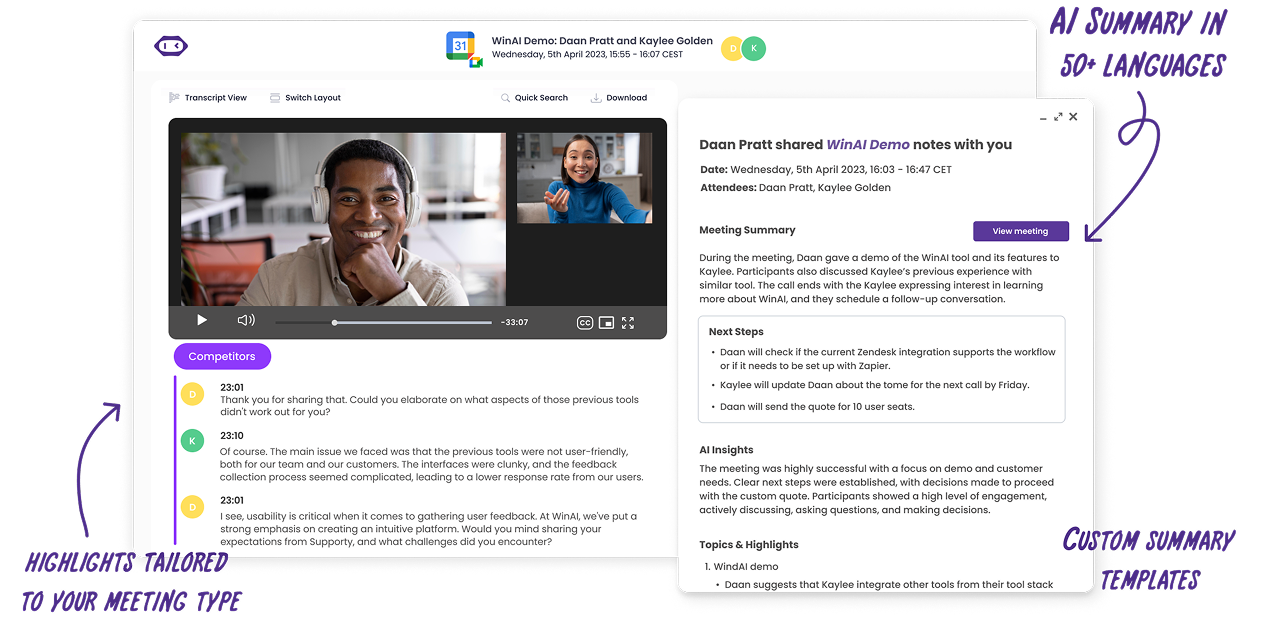
Once the extension is active, MeetGeek can:
- Automatically record meetings on Zoom, Google Meet, Microsoft Teams, or any browser-based platform thanks to the browser extension
- Deliver accurate AI-powered transcriptions
- Generate clean summaries with key points, decisions, and action items
- Highlight important moments you can revisit instantly
- Organize all your calls into a searchable meeting history
- Sync insights with tools like Slack, Notion, HubSpot, and your workspace apps
- Support ad hoc meetings through instant link joining
- Make every meeting easy to share with teammates who could not attend
Pairing MeetGeek with Perplexity creates a powerful environment for people who jump between research and conversations throughout the day. You can gather information with Perplexity, move into a meeting with MeetGeek, capturing every detail, and return afterward to transcripts and summaries that keep all your context intact.
What you can do with Perplexity AI
Perplexity AI is versatile enough to support many different tasks. Over time, people have adopted it for education, research questions, daily planning, creative work, and professional analysis. Its flexibility comes from its multi-model setup, real-time access to online sources, and easy-to-read responses.
Here are some of the most common ways people use the platform.
Quick answers for everyday questions
When you want a fast, straightforward answer, Perplexity provides a clear explanation supported by recent information. If you want to know about weather trends, sports scores, or current events, the platform retrieves up-to-date data quickly, making it ideal for information discovery.
Exploring market trends
Business professionals often use Perplexity AI to understand new developments in their field. The platform can summarize market trends, give you a big picture view of changes, and condense large volumes of data into accurate responses with an easy-to-read format.
Researching academic topics
Students and researchers use Perplexity to explore academic papers, scientific findings, and detailed concepts. The platform can summarize research papers and in-depth information, list key concepts, and provide explanations that help users build understanding efficiently.
Content creation and analysis
Writers and content creators rely on Perplexity for fact-checking, topic research, and information verification. The platform retrieves relevant information and helps users create more accurate content (like a blog post or article) by grounding ideas in trusted sources.
Handling complex questions
Perplexity excels at breaking down multi-layered questions and giving accurate answers. It supports a full research workflow that helps users understand deeper topics without switching between dozens of sources manually.
Navigating web content
With dedicated mobile apps, desktop apps, and integrations inside browsers, Perplexity helps users interact with web content more easily. You can summarize long pages, evaluate different viewpoints, or explore new topics quickly.
Pricing options for Perplexity AI
Perplexity offers several plans for different types of users, from casual searchers to advanced researchers and enterprise teams.
Individual pricing
Free (Standard) Plan — Free
The Free plan includes search history, unlimited free searches, very limited Pro Searches, and basic file uploads. Perplexity selects the model automatically, and advanced models or image generation are not included. This plan is ideal for light use.
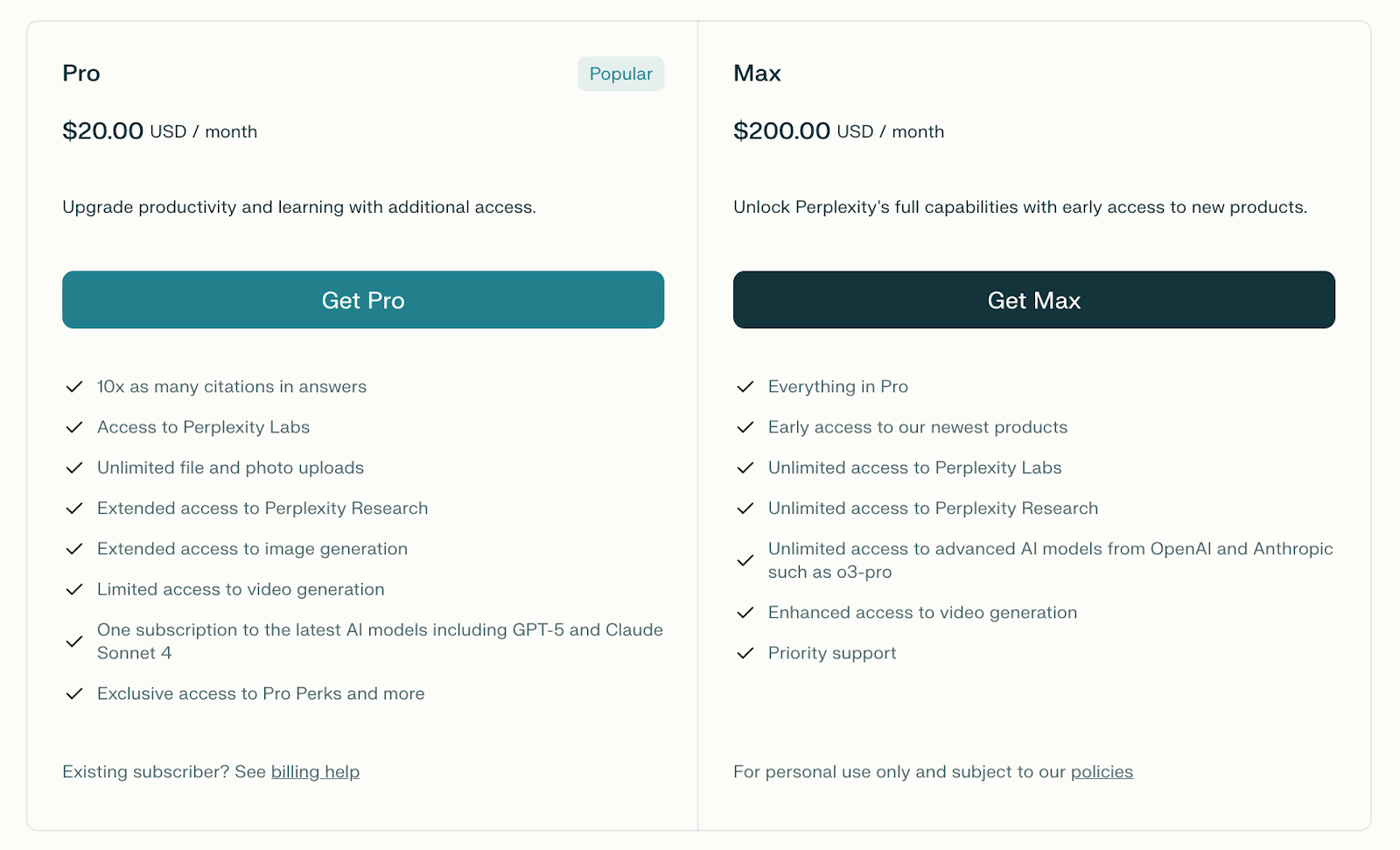
Perplexity Pro — $20 per month or $200 per year
Pro offers practically unlimited Pro Searches, access to advanced AI models, image and video generation, priority support, and generous file upload limits. It also includes monthly Labs queries and up to 500 file uploads per Space. This plan suits individuals who need strong daily research and productivity capabilities.
Education Pro — Free for 1 month, then $4.99 per month
Available to verified students and faculty, Education Pro includes everything in the Pro plan, plus extended access to Research and Academic modes, Study Mode for interactive learning, unlimited image uploads, and increased citations. It is designed for teaching and learning at a discounted price.
Perplexity Max — $200 per month or $2,000 per year
Max includes all Pro features and adds unrestricted access to the newest advanced AI models, unlimited Labs queries, unlimited Research queries, early access to new features, and the highest support priority. It is built for users who need the full power of Perplexity without usage limits.
Enterprise pricing
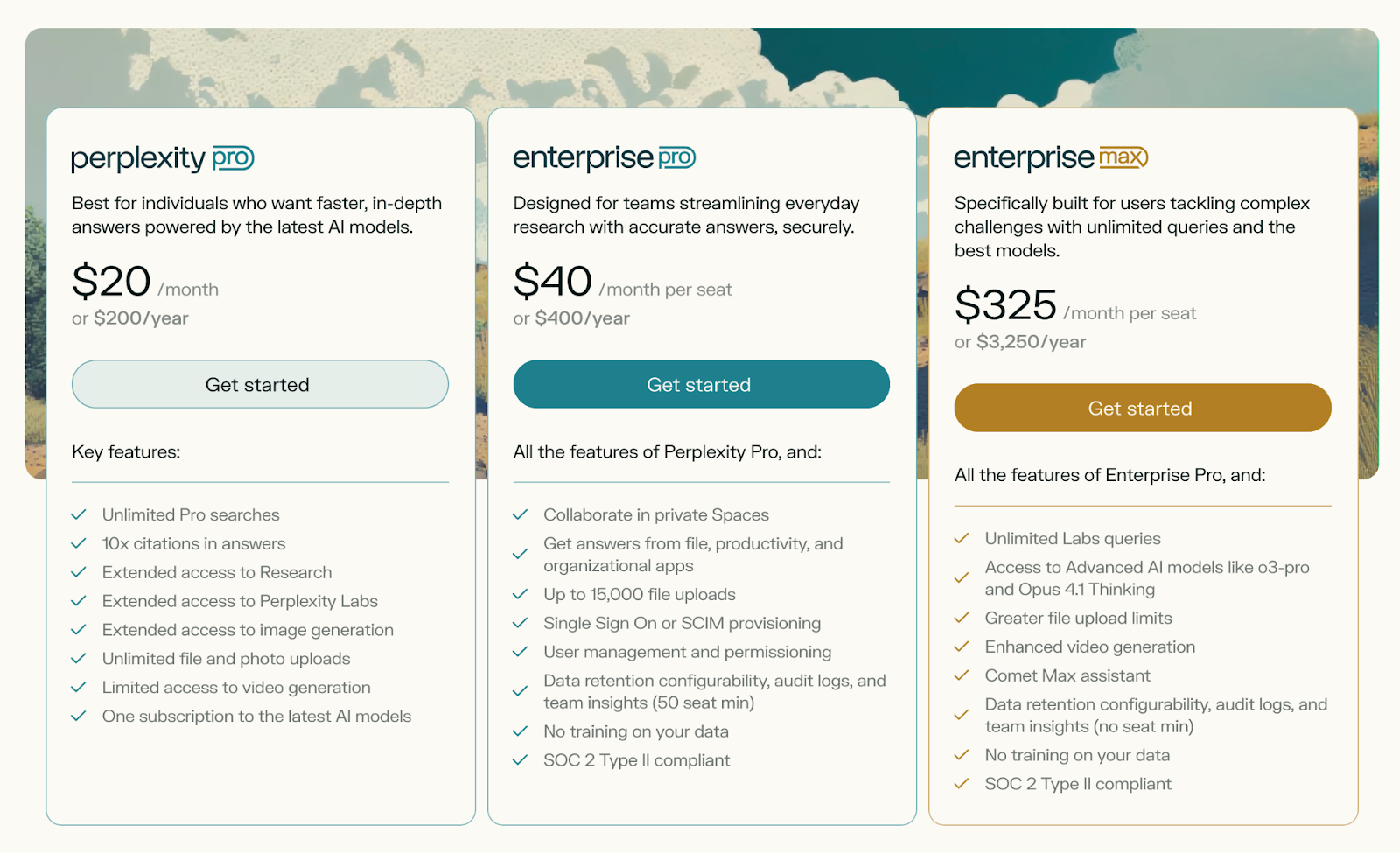
Enterprise Pro — $40 per seat per month or $400 per seat per year
Enterprise Pro includes all Pro features plus strict data privacy, advanced seat management, centralized organizational file repositories, internal knowledge search, increased file limits, and dedicated support with faster response times. It is suited for businesses that need secure, collaborative AI research.
Enterprise Max — $325 per seat per month or $3,250 per seat per year
Enterprise Max includes everything in Enterprise Pro with unlimited Labs and Research queries, enhanced video generation, access to top-tier models such as GPT-5 Thinking and Opus 4.1 Thinking, higher file limits, premium security features, and early access to new releases. This plan is intended for organizations requiring the highest level of capability and control.
Sonar API — Pay-as-you-go
Sonar is Perplexity’s API option for developers, offered through usage-based billing. It provides programmatic access to the platform without the advanced model features available in the web interface.
Strengths and limitations of Perplexity AI
Like any AI platform, Perplexity has clear strengths and some limitations to be aware of.
Strengths
- Perplexity AI accuracy is strong from diverse source integration
- Ability to retrieve information from multiple sources
- Clear citations that support fact-checking
- Intelligent handling of complex queries to provide an in-depth report
- Fast access to recent news and updates
- Natural conversational flow
- Alternative search types that match different needs
- Real-time web searches that enhance relevance
Limitations
- Limited creativity compared to generative AI models
- Difficulty with extremely niche topics
- Inconsistencies when sources provide conflicting information
- Occasional challenges with very long conversations
Looking at what Perplexity AI offers, the strengths outweigh the limitations for most users, especially those who need reliable, well-sourced answers instead of creative writing.
How Perplexity and MeetGeek work together
Perplexity's ability to help you understand information pairs great with MeetGeek, which helps you use information effectively inside your meetings. When you combine the two, you create a productive workflow that supports preparation, participation, and follow-up.
MeetGeek records your meetings, transcribes the conversation, highlights key moments, and produces summaries that are easy to revisit. This removes the pressure of taking notes manually. It also makes it simpler to review important details long after the meeting has ended.
Perplexity naturally complements this process. You can explore background information before a meeting, research topics on the spot, or ask clarifying questions after the call. Then MeetGeek turns the conversation into a clear record. With the MeetGeek browser extension available inside Comet, these two tools now work more smoothly together than ever before.
You can start an ad hoc call with a link, let MeetGeek handle the transcription, and use Perplexity to explore related topics or summaries without switching tools. This combination supports teams that need accurate information and organized communication throughout the workday.
MeetGeek helps you understand what happened in your meeting. Perplexity helps you understand the world around it. Together, they make complex work feel much simpler.
Start your MeetGeek free trial today and pair it with Perplexity for increased meeting productivity.
Frequently asked questions
What is Perplexity AI mainly used for?
Perplexity AI is mainly used as an AI-powered search engine that provides direct, well-sourced answers instead of long lists of links. People rely on it for quick explanations, complex research questions, fact-checking, market insights, and real-time information from the web. It helps users understand topics faster by summarizing content from multiple sources and supporting natural follow-up questions.
Is Perplexity AI better than ChatGPT?
Neither tool is universally better because they serve different purposes. Perplexity AI excels at retrieving up-to-date information, citing sources, and answering research-focused queries.
ChatGPT is stronger at creative writing, long-form content generation, and conversational reasoning.
Many users rely on both tools: Perplexity for factual, real-time information and ChatGPT for generative and creative tasks.
What is the difference between OpenAI and Perplexity AI?
OpenAI develops large language models like GPT, which power many AI applications. Perplexity AI is a search-focused platform that uses these models, along with its own systems, to retrieve information from the web and provide citation-backed answers. In simple terms, OpenAI creates the underlying AI models, while Perplexity builds a search engine experience on top of them.
Is Perplexity AI trustworthy?
Perplexity AI is considered trustworthy for research and fact-based questions because it cites its sources and retrieves information directly from the web. Its transparency makes it easier to verify accuracy.
However, like any AI platform, it can only be as reliable as the sources it references, so users should still review citations when working on critical or highly specific topics.



.avif)