

Notion AI Meeting Notes transcribes your meeting and saves the summary and action items on a Notion page. It works in the desktop app, in the browser and on mobile. It's included with Notion's Business and Enterprise plans.
Notion Calendar can automatically add a notes page to new events. You start transcription from the event when you're ready.
Starting December 1, 2026, Notion estimates that a one-hour meeting uses about 10 Standard credits. A monthly allowance of 1,500 Standard credits covers roughly 150 meeting hours if you use it all for meeting notes.
This guide shows both ways to start it, what it costs in credits and where it falls short. MeetGeek can join and record scheduled calls automatically. Its Notion integration sends the notes to the page or database you choose.
How to Automatically Add Meeting Notes to Notion Calendar Events
Notion Calendar is Notion's own calendar app and works with Google, Outlook and iCloud calendars. Once you connect your workspace, you can turn on automatic notes pages for new meetings. When you're ready to transcribe, open the meeting note and select Start transcribing.
To set it up:
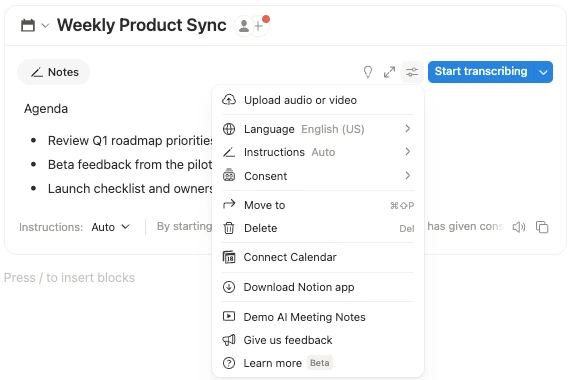
- If your workspace isn't connected to Notion Calendar yet, type /meet on any Notion page to add an AI Meeting Notes block, then select Settings and Connect Calendar.
- In Notion Calendar, open Settings → Notion workspaces and select your workspace. Choose the default database for meeting notes and turn on the option to automatically add AI Meeting Notes to new events.
- By default, from 15 minutes before a video meeting, the event shows Join and transcribe if you're the organizer, if you created the linked notes page or if an earlier meeting in the series was transcribed. Once everyone has agreed to transcription, select it to open the notes page and start from there.
For events without a video link, look for Transcribe meeting. All-day events don't support meeting notes. After the meeting, select View summary in the event to open the result.
How to Start AI Meeting Notes in Notion
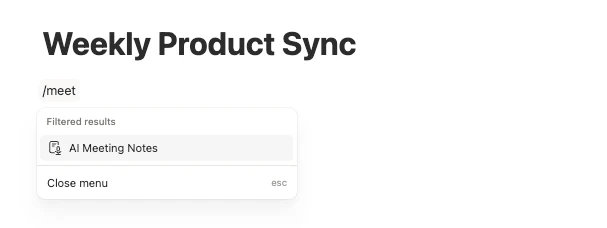
Whether you start from the calendar or from a page, the block gives you a transcript, a summary and action items from team meetings, one-on-ones or sales calls without typing. Type /meet on any page to add one.
1. Choose Where You Record
Where you start the notes decides what Notion hears:
- Desktop app: captures your microphone and the call's system audio, so it is the best choice for Zoom, Google Meet or Microsoft Teams calls;
- Browser: captures your microphone only. If you wear headphones on a video call, the other participants won't be picked up;
- Mobile app: transcribes what the phone's microphone picks up, which suits in-person meetings.
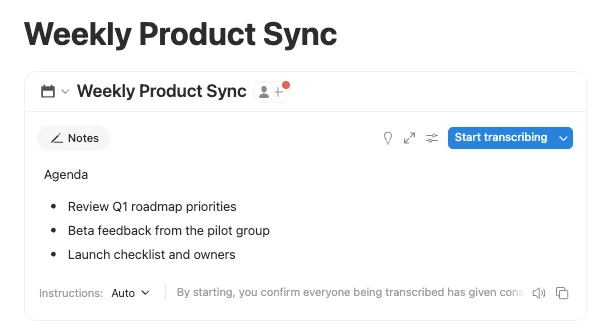
Before the meeting, add an agenda or context under Notes. Notion uses your agenda and notes as context for the summary.
2. Change the Summary Format
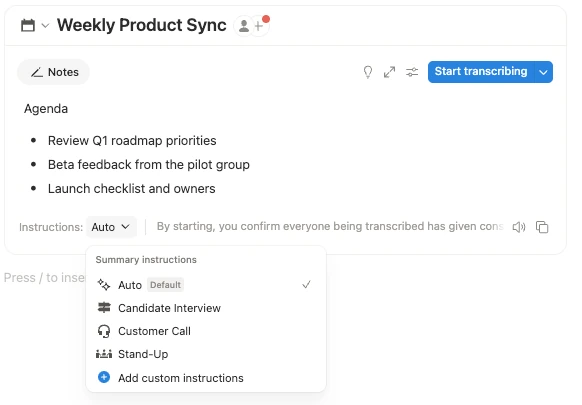
At the bottom of the meeting notes block, open Instructions and choose a format from the dropdown. Next to the default Auto, Notion offers Candidate Interview, Customer Call and Stand-Up, or you can add your own instructions. To apply new instructions to an existing summary, click Retry summary.
3. Ask for Consent
Before transcribing, get consent from everyone in the meeting. You can ask for consent in any of these ways:
- Text: copy a consent message into the meeting chat;
- Voice: click the speaker icon to play the message through your computer speakers. If you're wearing headphones, use the meeting chat instead;
- Out loud: ask, "Is everyone OK if I use Notion AI to transcribe this?"
Workspace owners can also make an automatic consent message the default for every member.
4. Start and Stop Transcription
When the meeting begins, click Start transcribing. When the meeting ends, click Stop. Notion then generates the summary. To pick up again, open the block's settings menu and select Resume transcription.
Notion needs at least 300 transcribed characters to generate a summary. That's roughly a minute of speech. Each person can transcribe up to 10 hours a day. If you already have an audio recording, you can upload it from the block's settings.
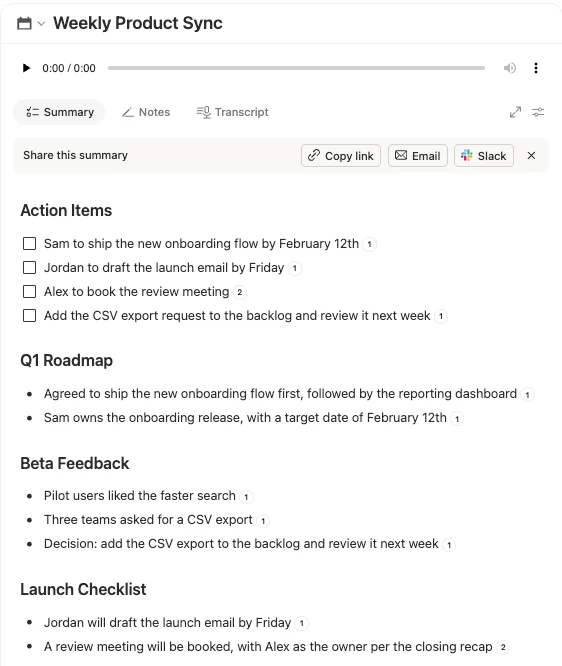
The summary lands inside the block, with the transcript and your notes in their own tabs. From the same block you can share it by link, email or Slack.
How Much Does Notion AI Meeting Notes Cost?
AI Meeting Notes is included with Notion Business and Enterprise. Business starts at $20 per member per month when billed annually. Free and Plus workspaces can try it. It is also available on eligible mobile subscriptions that include Notion AI.
As of December 1, 2026, meeting notes also draw on the monthly AI credits that come with each Business and Enterprise seat. Notion's guide to AI credits gives the figures:
- A one-hour meeting uses about 10 Standard credits;
- Notion lists 1,500 Standard credits per member per month, though the allowance can vary by plan and purchase agreement. Meeting notes share that allowance with other AI features;
- Credits reset every month and don't roll over.
In hours, 1,500 credits would cover about 150 hours of meetings a month if a member spent them only on meeting notes. Any credits you spend on other AI features reduce the balance available for meetings.
| One-hour meetings a month | Standard credits used | Share of a 1,500-credit allowance |
|---|---|---|
| 5 | About 50 | About 3% |
| 20 | About 200 | About 13% |
| 50 | About 500 | About 33% |
| 150 | About 1,500 | About 100% |
Table last updated: November 18, 2026.
If a member runs out of Standard credits, the features that use them pause until the next monthly reset. A workspace owner can let that member keep going on paid credits, which the workspace buys at $10 per 1,000.
Buying extra credits depends on how the workspace is billed and set up: it isn't possible on a subscription billed through the App Store or Google Play.
What Notion AI Meeting Notes Can and Can't Do
Where It Works Well
- The transcript, summary and your own notes live on the same page as the rest of the project;
- Transcripts and summaries can be edited right on the page;
- Action items can become tasks in your Notion databases;
- With Notion Calendar connected, you can open the notes from the event and enable automatic sharing with attendees in your workspace.
Where It Falls Short
- Speaker labels work best on desktop in one-on-one calls and are limited in in-person meetings, on shared microphones and in the browser or on mobile. For speaker names in group calls, Notion supports Google Meet through its Chrome add-on on desktop. On a Mac, it can also identify Zoom participants when speaker identification is enabled;
- Recording: by default, Notion doesn't give you a replayable recording of a live meeting. If your workspace enables local audio storage, the person who starts transcription can keep the 10 most recent recordings on their device. There is no video recording.
When You Need More Than Notion's Meeting Notes
Notion can create the notes page for you, but someone still has to start transcription in every meeting.
MeetGeek connects to your Google or Outlook calendar and, by default, joins your scheduled Zoom, Google Meet and Microsoft Teams calls on its own, then records and transcribes them.
After each call, it sends the summary, highlights or full transcript to the Notion page or database you pick, so Notion stays the home for your notes. Automatic workflows to Notion are available from Pro.
It also helps when you need a recording you can replay or when the notes have to reach tools other than Notion. Here's how the two compare (MeetGeek publishes this guide):
| Feature | Notion | MeetGeek |
|---|---|---|
| Calendar meetings | Manual start | Auto-join by default |
| Call capture | Desktop app, browser or mobile | Meeting bot, desktop app, Chrome extension or mobile |
| Saved recording | Optional local audio | Audio on all plans. HD video from Business |
| Speaker labels | Yes | Yes |
| Transcription languages | 16 | 100+, detected automatically |
| Where the notes go | Notion page | Notion, CRM, Slack or email via workflows (Pro+) |
| Free use | Trial on Free and Plus | Free plan, 3 hours a month |
| Notion AI credits from Dec 1, 2026 | About 10 Standard credits/hour | None |
| Paid plan (billed annually) | Business · $20/member/month | Pro · $9.99/user/month |
Table last updated: November 18, 2026.
Besides Zoom, Google Meet and Teams, MeetGeek can record a Webex meeting or a Discord call. Its mobile app covers in-person meetings.
How to Export AI Meeting Notes to Notion With MeetGeek
Connect Notion once in MeetGeek, then choose between a workflow that sends every new meeting and a one-off send for a past meeting. Because MeetGeek writes to Notion through its API, sending notes this way doesn't use your Notion AI credits.
To connect Notion:
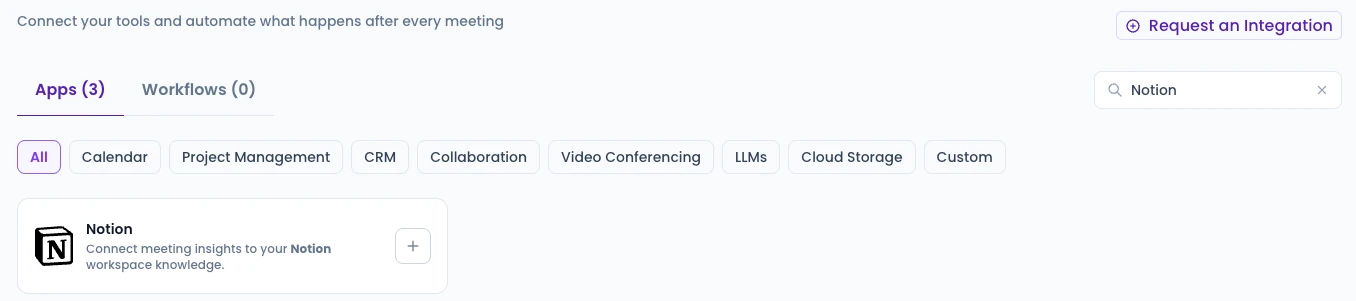
- In MeetGeek, open Integrations in the sidebar. On the Apps tab, search for Notion, click + and grant the permissions Notion asks for.
- In MeetGeek, open the Notion integration settings. Choose a default Notion page or database, then select what to send: the full transcript or a summary with highlights.
To send every new meeting automatically:
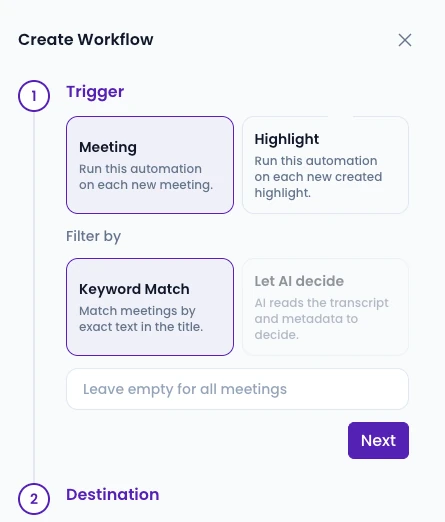
- Open the Workflows tab and click New workflow. Under Trigger, choose Meeting.
- Under Keyword Match, enter a word from the titles of the meetings you want to send. Leave the field empty to include every meeting. Click Next.
- Under Destination, choose Notion in Send to, pick the parent page or database and save the workflow. After each meeting, MeetGeek creates a Notion page with the meeting details, summary and highlights.
To send a past meeting: open it in MeetGeek, click Share meeting, select Notion, pick a page and click Send.
Here's a short video of the Notion integration:
For a wider look at tools that send notes to Notion, see our guide to meeting notes apps. And if you write the minutes yourself, these tips keep them clear and organized.
Key Takeaways
- Notion Calendar can add a notes page to new meetings automatically. You start transcription yourself.
- Use the desktop app for calls. It captures your microphone and the system audio, while the browser and mobile apps capture only your microphone.
- As of December 1, 2026, a transcribed meeting uses about 10 Standard credits per hour, from the same monthly balance as the other Notion AI features.
- To skip the manual start, MeetGeek joins your calendar meetings on its own and sends the notes to Notion without using Notion AI credits.
Frequently Asked Questions
Can Notion Automatically Take Notes From Calendar Events?
Notion Calendar can create the notes page automatically. Someone in the meeting still needs to start transcription. MeetGeek joins calendar meetings on its own and can send the notes to Notion.
Is Notion AI Free for Meeting Notes?
No, not for ongoing use. Free and Plus workspaces get a trial. Ongoing access comes with the Business and Enterprise plans.
How Many AI Credits Does a Notion Meeting Use?
Starting December 1, 2026, a one-hour meeting uses about 10 Standard credits, according to Notion's estimate. With a monthly allowance of 1,500 Standard credits, the estimate is about 150 meeting hours if you use the full balance for notes.
Does Notion AI Meeting Notes Notify Participants?
In Google Meet, Notion's add-on automatically posts and pins a notice in the chat when transcription starts. In other setups, you can ask participants directly or use Notion's text or audio message. Get everyone's consent before you start transcribing.
Is Notion AI Meeting Notes Worth It?
If your team already uses Notion Business or Enterprise and wants meeting notes alongside project work, AI Meeting Notes is included in your plan. MeetGeek can record scheduled calls automatically on any plan. On Pro and higher plans, you can also set up a workflow to send the summaries to Notion or your CRM.