


An ad hoc meeting is a meeting called for one specific purpose, at short notice, with only the people needed to settle it. It has no standing slot in the calendar and usually no formal agenda. The name comes from the Latin ad hoc, meaning "for this", so the meeting exists for a single question and ends once that question is answered.
Those calls are no longer the exception. Microsoft's 2025 Work Trend Index found that 57% of meetings are ad hoc calls with no calendar invite, and that 1 in 10 scheduled meetings gets booked at the last minute. Unplanned calls that never reach the calendar are a normal part of modern work, not an edge case.
Ad Hoc, Adhoc, or Ad-Hoc? What the Term Covers at Work
All three spellings mean the same thing, and Merriam-Webster gives ad hoc as the standard form. Merriam-Webster defines it as "concerned with a particular end or purpose" and "formed or used for specific or immediate problems or needs". If you are looking for the full form of ad hoc, there is none in the acronym sense: it is the Latin phrase itself, not an abbreviation.
At work, the same two words attach to several different things, and they are not interchangeable:
- Ad hoc meeting. A call or a room booked for one question, right now;
- Ad hoc call. The same thing, usually voice-only or started from a chat thread;
- Ad hoc session. Common in agencies and consulting for an unplanned working block, often longer than a meeting;
- Ad hoc request. A task that arrives outside the planned workload, not a meeting at all;
- Ad hoc committee. A group formed to handle one issue and dissolved when it is done, which is a structure, not an event.
The last one causes most of the confusion. An ad hoc committee can exist for months and meet several times for that one objective. Ad hoc meetings are typically one-off rather than recurring.
How Ad Hoc Meetings Differ From Recurring Meetings
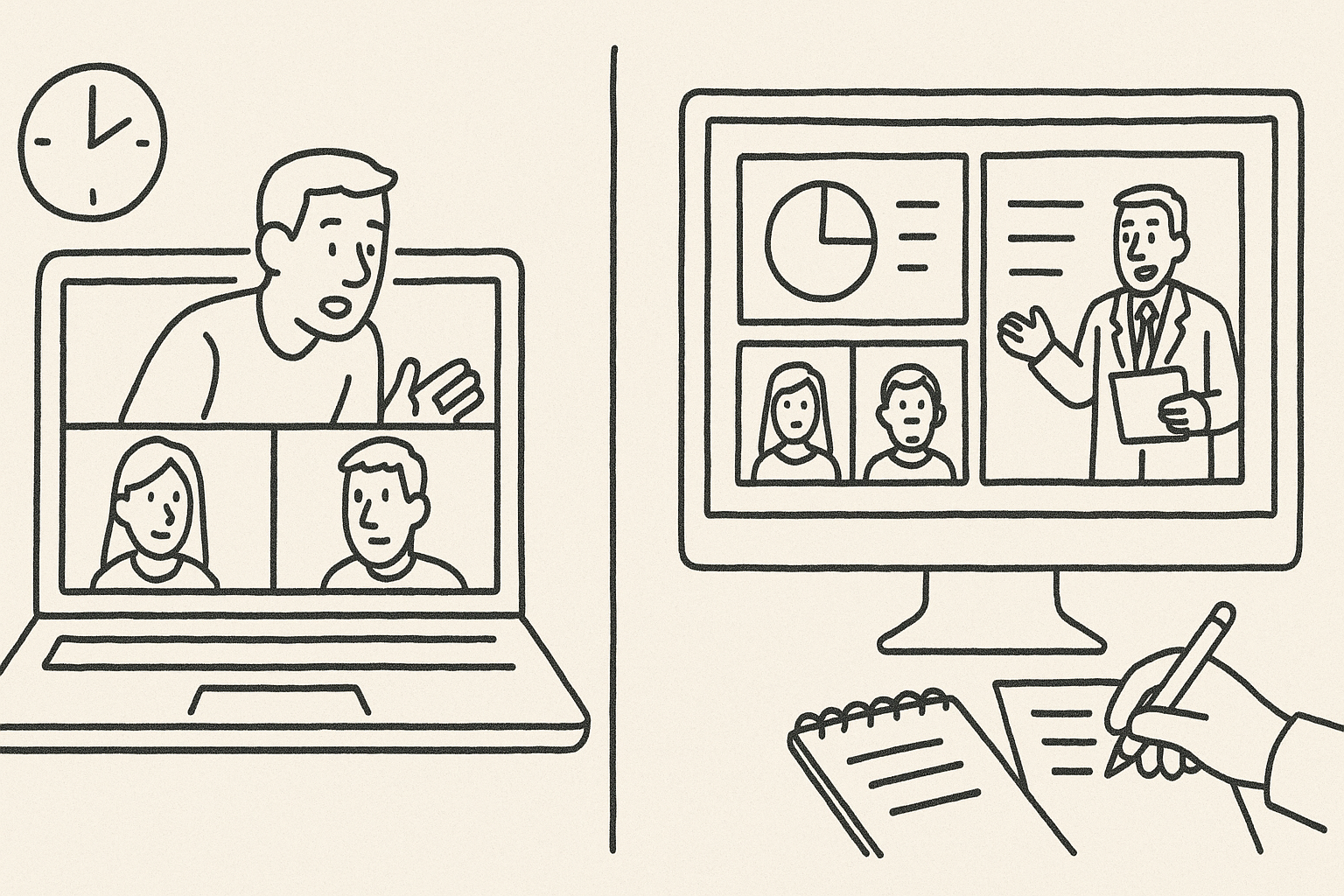
A recurring meeting exists because of the calendar; an ad hoc meeting exists because of a problem. That difference changes who joins, how long it runs, and what comes out of it.
| What Changes | Ad Hoc Meeting | Recurring Meeting |
|---|---|---|
| Trigger | A decision or blocker that cannot wait | A fixed slot agreed in advance |
| Notice | Minutes to a few hours | Days or weeks |
| Agenda | One question, often written in the chat message that called it | A standing agenda with several items |
| Who joins | Only the people who can decide or unblock | The whole team or a fixed invite list |
| Recommended length | 15 to 30 minutes | 30 to 60 minutes |
| Output | One decision with a named owner | Status, alignment, and follow-ups |
| Documentation | Easy to miss unless someone records it or writes it down | Minutes or notes by habit |
Table last updated: August 20, 2026.
Neither type is better. Teams get into trouble when they use one where the other belongs, which is usually a question of choosing a meeting cadence that leaves room for the unplanned.
What Does an Ad Hoc Meeting Look Like? A Worked Example
Imagine this hypothetical example, start to finish, at a B2B software company on an ordinary Tuesday.
At 09:12 the support lead sees three tickets about failed card payments. She posts in the on-call channel and gets no reply for six minutes. Instead of waiting, she starts a call and pulls in three people: the backend engineer on call, the account manager for the largest affected customer, and the VP of Engineering.
The call has exactly one question: roll back last night's release, or patch forward?
It runs 18 minutes. The decision is to roll back. The backend engineer owns it. The account manager agrees to send a status note to the 11 affected accounts by 10:30. Everyone leaves.
That is the whole shape of it: one question, four people who can answer it, a decision with a name attached, and a deadline. Notice what is missing. The call never appeared in anyone's calendar, so nothing scheduled it, nothing reminded anyone about it, and by Thursday the only trace of the rollback decision is whatever the four of them remember.
Why Ad Hoc Meetings Matter in Modern Teams
They are how distributed teams keep moving between scheduled checkpoints. When half the team is remote, there is no doorway to lean into and no desk to walk over to, so the equivalent is a call started from a message.
The cost is attention. The same Microsoft report found that employees using Microsoft 365 are interrupted roughly every 2 minutes during core working hours, by meetings, emails, or notifications. An ad hoc meeting is one of those interruptions, and it is worth it only when the thing it settles is bigger than the focus it breaks.
What Goes Wrong With Ad Hoc Meetings
Four things go wrong most often:
- They land in the middle of focused work. A 20-minute call can cost far more than 20 minutes, because getting back into a complex task takes time;
- With no agenda, they drift. Typically, the question that triggered the call gets answered in 5 minutes and the remaining 25 turn into general catch-up;
- They multiply. Once a team learns that anything can be solved with a quick call, the quick calls replace the planning that would have prevented them;
- Nothing gets written down. The decision lives in four people's memories, and the person who needed it most was not on the call.
The last one is the expensive one. It is also the easiest to fix, either with meeting minutes templates somebody actually fills in, or with a recording. If the real problem is volume rather than documentation, how SocialBee cut its meeting time is a useful comparison.
How to Keep a Record of Meetings That Never Reach the Calendar
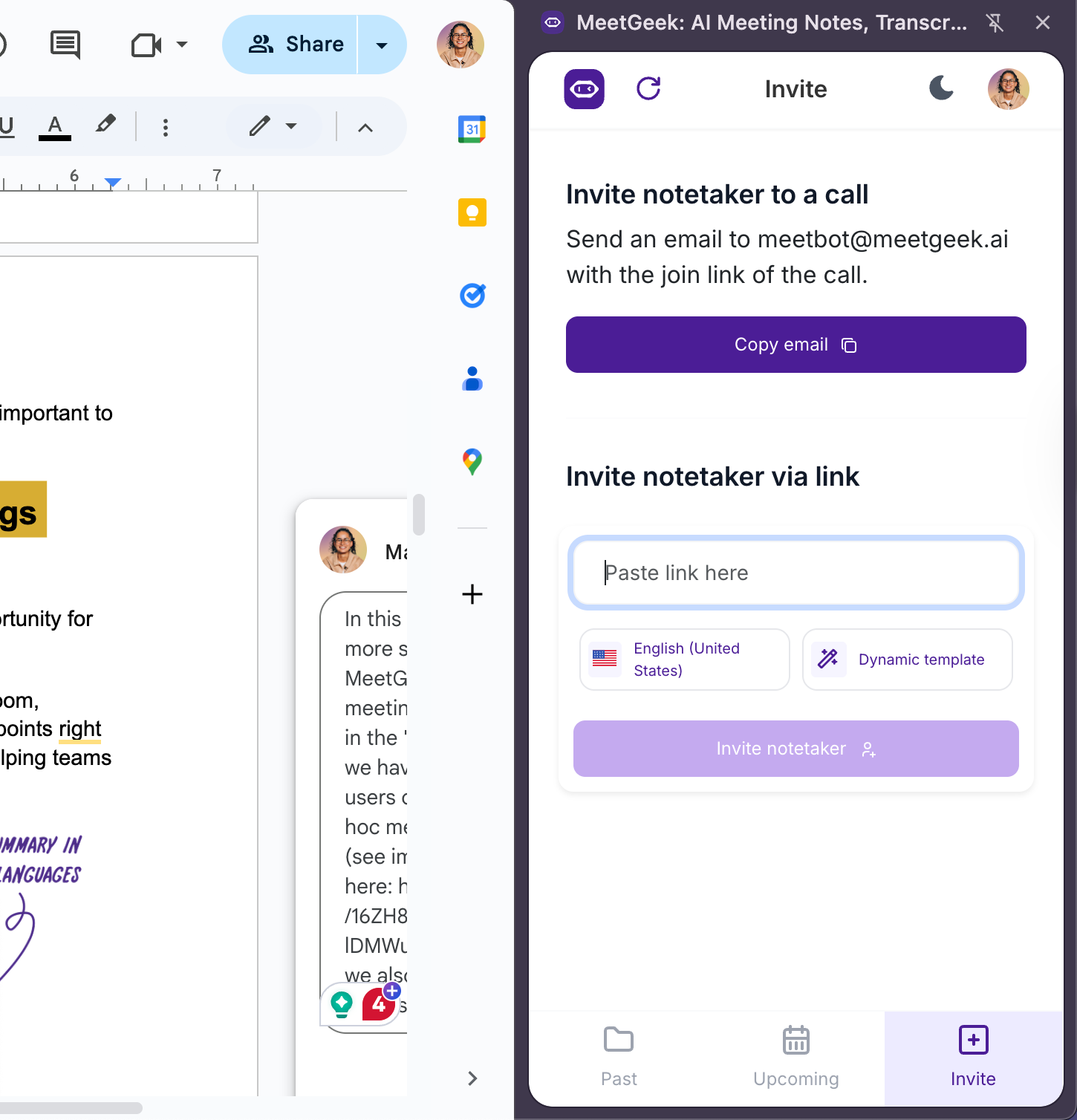
A calendar-based assistant joins what is on the calendar, which is exactly the wrong tool for a call that started as a chat message. An assistant that relies only on calendar invitations would not automatically capture those no-invite calls.
Two capture methods work without an invite and without putting a bot in the room. The MeetGeek Chrome extension records the browser tab on demand, so any call running in a browser can be captured the moment it starts. The desktop app does the same on macOS and Windows for calls running in a native client. Both produce a transcript, an AI summary, and searchable action items afterwards, and both are available on every plan, including the free one. For scheduled calls, MeetGeek's meeting platform integrations cover Zoom, Google Meet, and Microsoft Teams in the usual way.
Two limits are worth knowing before you rely on it. The free plan covers 3 hours of transcription a month, with a 2-hour cap on any single recording, so at 15 to 30 minutes per call that is roughly 6 to 12 ad hoc meetings a month before you need a paid plan. And recording without a bot is not the same as recording without telling anyone. Telling participants, and following the recording-consent and privacy rules that apply to your team, is still your responsibility.
If you want the decisions from those unplanned calls written down without anyone taking notes, MeetGeek captures them automatically.
When Should You Hold an Ad Hoc Meeting?
Call one when a conversation will settle in minutes what a thread would drag out for a day.
1. When a Decision Is Blocking Someone
A single approval is holding up work that is otherwise ready. Ten minutes with the person who can say yes beats a thread that collects four opinions and no decision.
2. During an Incident or a Crisis
Outages, security events, and customer escalations need role clarity fast. A short call assigns who investigates, who communicates, and who decides, before anyone starts duplicating the others' work.
3. When a Project Changes Shape Mid-Flight
A dependency slips or a requirement changes, and the plan the team agreed last week no longer describes reality. A 20-minute alignment call is cheaper than a week of people building toward different assumptions.
4. When an Idea Is Time-Sensitive
A competitor announcement or an unexpected opportunity has a short window. Getting three or four people talking beats scheduling a proper session for next Thursday, and the shape of it is closer to running a brainstorming session than to a status update.
How to Run an Effective Ad Hoc Meeting
The whole discipline fits in six habits.
1. Say the Question in the Invite Message
Write the one thing the call needs to settle, in the message that calls it. People join already thinking about the answer instead of asking what this is about.
2. Invite Only Who Can Decide or Unblock
Every extra person is an interruption you caused. If someone only needs the outcome, send them the outcome afterwards.
3. Cap It at 15 to 30 Minutes
MeetGeek's analysis of 1 million recorded meetings shows that 44.8% end before the 30-minute mark. For a meeting built around a single question, 15 to 30 minutes is a sensible ceiling. Say the cap out loud when the call starts. A stated limit changes how people talk: they get to the point because they know the clock is running.
4. Use a Micro-Agenda, Not a Real One
Three bullets in the chat is enough. If the conversation needs several agenda items or real preparation, a scheduled meeting is probably the better format, and one of these meeting agenda examples will suit it better.
5. Capture It Instead of Taking Notes
Somebody typing is somebody not participating, and in a four-person call that is a quarter of the room. Recording and transcribing the call keeps everyone in the conversation and still produces a record.
6. End With a Name and a Date
Before anyone drops off, say who owns the next step and when it lands. A decision without an owner is a conversation.
Alternatives to Ad Hoc Meetings
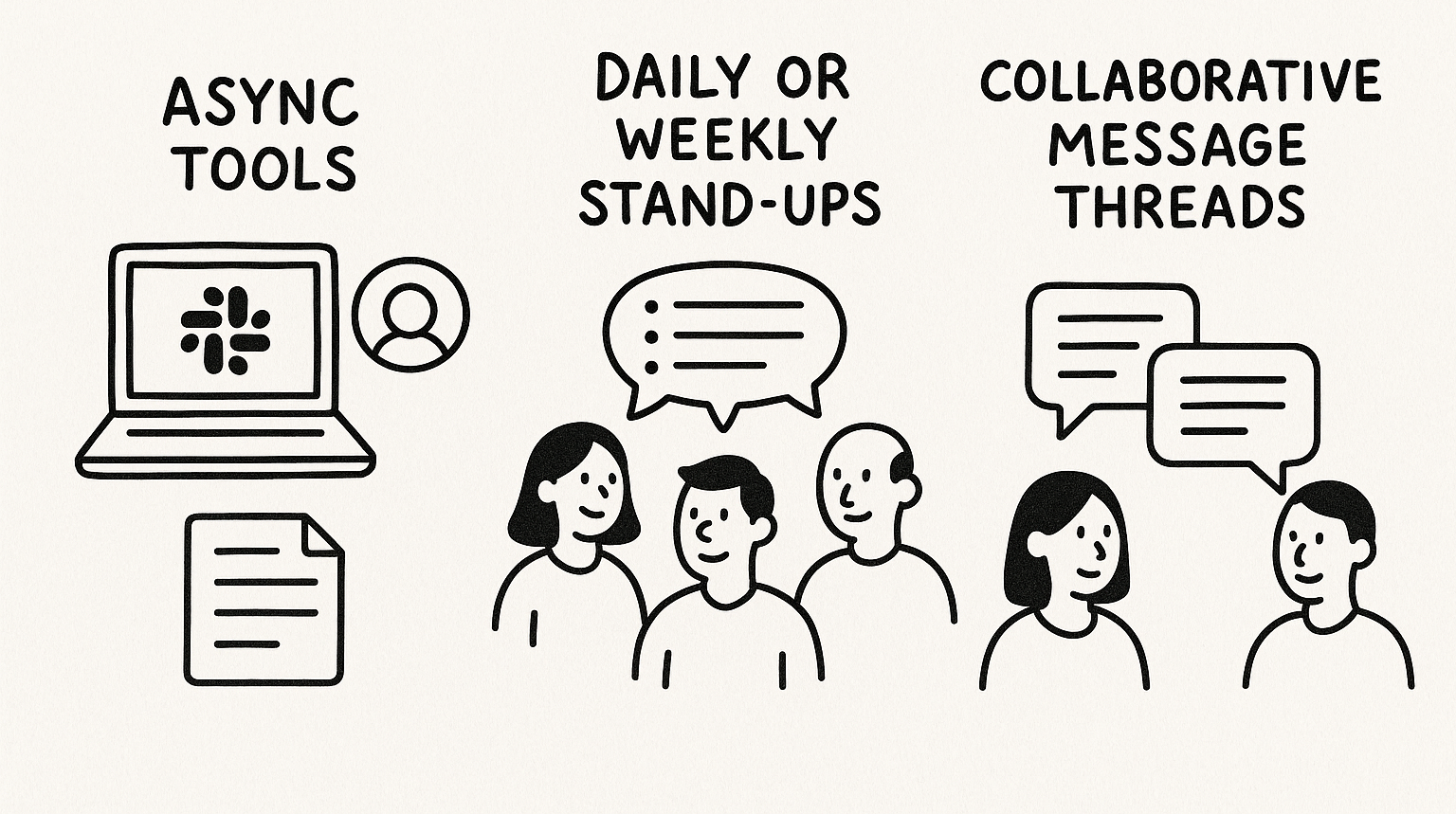
Not every urgent thing needs a call. Three alternatives cover most of what gets turned into one:
- Async updates. A message, a short Loom, or a shared doc handles anything that needs a response but not a discussion, which is the core of asynchronous communication;
- A standing daily or weekly slot. Teams that hold regular stand-up meetings tend to call fewer emergency ones, because blockers tend to surface within a day;
- A decision thread. State the question, tag the two people who decide, and set a deadline for their answer, which works for anything that is a judgment call rather than a conversation.
The test is simple. If the thing needs back-and-forth to resolve, it is a call. If it needs an answer, it is a message.
Key Takeaways
- An ad hoc meeting is called for one purpose at short notice, and it ends when that purpose is served;
- Microsoft found 57% of meetings now happen with no calendar invite, so the unplanned call is the normal case, not the exception;
- The format works when there is one question, only the people who can answer it, a 15 to 30 minute cap, and a named owner at the end;
- Its main failure is that nothing gets written down, which is why capture matters more here than in a meeting that already has minutes;
- If a team is calling several a week on repeating topics, the fix is a scheduled slot, not better ad hoc meetings.
Frequently Asked Questions
What Does Ad Hoc Mean in a Meeting Context?
Ad hoc in a meeting context means the meeting was created for one specific situation rather than as part of a routine. The Latin phrase translates as "for this", and in practice it describes a call arranged in minutes or hours to handle something that cannot wait for the next scheduled slot.
What Is the Purpose of an Ad Hoc Meeting?
To reach a decision or clear a blocker faster than written communication would allow. The purpose is narrow on purpose: one question, resolved live, with an owner named before people leave.
Does Ad Hoc Mean Last Minute?
Not exactly. Ad hoc describes the reason for the meeting, not the timing, so an ad hoc meeting can be arranged a day ahead and still be ad hoc. In practice the two overlap, because a meeting called for one immediate purpose usually gets called at short notice.
How Long Should an Ad Hoc Meeting Last?
Aim for 15 to 30 minutes. Past half an hour the call has usually stopped answering its original question, and whatever it has moved on to deserves its own scheduled meeting.
Can Ad Hoc Meetings Be Recorded or Transcribed?
Yes. Because many ad hoc calls have no calendar invite, the reliable methods are a browser extension that records the tab or a desktop app that records the call, both of which start on demand rather than from an invite. MeetGeek does both and produces a transcript and a summary afterwards.
What Is the Difference Between an Ad Hoc Meeting and an Ad Hoc Committee?
An ad hoc meeting is a single event, and an ad hoc committee is a group of people formed to handle one issue over time. The committee can exist for a period and meet several times for that objective, while the meeting is typically a one-off.
Based on 1 million meetings recorded by MeetGeek.



.avif)