

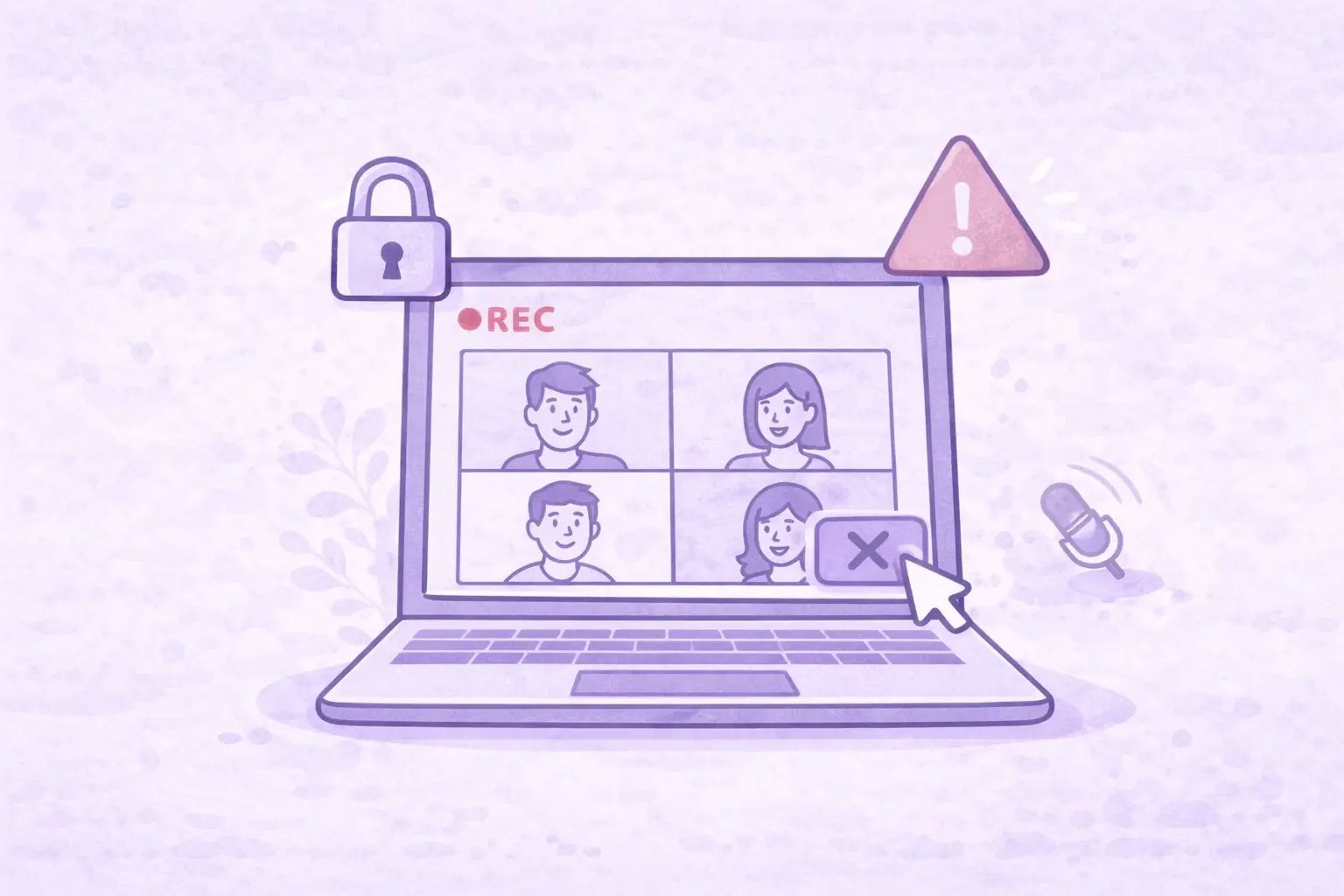

Is it illegal to record someone without their permission? In the United States, sometimes. Federal law generally allows recording when at least one party to the conversation consents, but individual states can impose stricter rules. Some require everyone's consent, while others apply different rules to phone calls, electronic communications, and in-person conversations.
Most states broadly follow one-party consent rules. A smaller group primarily requires all-party consent, commonly called two-party consent, and several states use mixed rules.
The European Union works differently. Rather than dividing countries into one-party and two-party jurisdictions, the GDPR treats identifiable recordings as personal data processing. Organizations need an appropriate lawful basis and must meet transparency, security, retention, and other data-protection requirements.
Important: This article provides general information about recording and privacy laws. It is not legal advice. Laws change, exceptions are fact-specific, and courts may interpret statutes differently. For specific legal questions, consult a qualified attorney in the relevant jurisdiction.
What does federal law say about recording conversations?
Under 18 U.S.C. § 2511(2)(d), you can generally record a conversation if you're part of it or if at least one participant has given prior consent, as long as the recording is not being made for a criminal or wrongful purpose.
In other words, under federal law, recording a conversation is generally allowed when at least one party agrees to it. If you're part of the conversation, your own consent is usually enough under the federal Wiretap Act and the Electronic Communications Privacy Act.
The same can apply if you're not personally part of the conversation but at least one person involved has given prior consent to the recording.
However, federal law is only the starting point. State law can set stricter rules, which is why it matters whether you're in a one-party consent state, an all-party consent state, or a state where the requirements depend on the type of conversation being recorded.
Getting this wrong can have serious consequences. Depending on the law that applies, an illegal recording can lead to criminal penalties, civil penalties, or a lawsuit seeking civil damages.
What are one-party consent states?
A one-party consent state generally lets you record a conversation as long as at least one participant agrees to it.
If you're part of the conversation, that participant can be you. In other words, your own consent is usually enough, so you do not necessarily need the other person's consent before recording a call or meeting.
For example, in a one-party state, you may be able to record a business call you're participating in even if the other people on the call have not given explicit permission.
That does not mean you can record any conversation you want. If you're not one of the parties involved, secretly recording a private conversation may still violate federal or state wiretapping laws.
The setting matters too. Some laws focus specifically on private or confidential conversations, so whether someone had a reasonable expectation of privacy can affect how the rule applies.
What are two-party consent states?
A two-party consent state generally requires everyone involved in a private conversation to agree before it is recorded.
You will also see these referred to as all-party consent states, which is technically more accurate. If five people are on a call, for example, the rule is not that only two of them need to agree. It applies to all relevant participants.
That makes secretly recording meetings or calls much riskier in these states. Recording without everyone's consent can lead to criminal charges, a civil lawsuit, or other legal consequences, depending on the law that applies.
There are also a few states that do not fit neatly into a one-party or two-party category. Connecticut, Michigan, Nevada, and Oregon, for example, can apply different rules depending on whether the conversation happens over the phone, electronically, or in person.
Which states are one-party and two-party consent states?
The following table provides a quick reference for all 50 states plus Washington, D.C.
When is it generally legal to record someone?
Whether it is generally legal to make audio recordings depends on where you are, who is participating, and whether the conversation is private.
1. Recording your own conversations in a one-party state
If you're part of the conversation in a one-party consent state, you can generally record a conversation without the other person's consent.
That can include recording phone calls, interviews, sales calls, business meetings, and some in-person conversations.
But one-party consent does not let you secretly record other people's private conversations when you're not involved. Only one party needs to consent, but someone still has to.
2. Recording conversations in public
Recording in a public space is often less restricted because people usually have a lower expectation of privacy.
Still, being in public does not automatically make every conversation fair game. A quiet conversation at a restaurant, for example, may still come with a reasonable expectation of privacy.
3. Recording police and public officials
Recording police and other public officials carrying out their duties in public can be protected under the First Amendment.
That protection has limits. Recording does not give you the right to interfere with police officers, enter restricted areas, or ignore lawful instructions.
When can recording someone be illegal?
Even in a one-party state, it may still be illegal to record someone in certain situations.
1. Secretly recording a conversation you're not part of
If you're not a person involved in the conversation and nobody has agreed to the recording, secretly recording audio may violate federal or state wiretapping laws.
Recording a meeting you're attending is very different from hiding a microphone to record private conversations between other people.
2. Recording in private spaces
Privacy protections are stronger in private spaces such as bathrooms, changing rooms, hotel rooms, bedrooms, medical offices, or law offices.
States may also have separate rules covering hidden cameras, surveillance, and capturing audio.
3. Recording without everyone's consent in an all-party consent state
In an all-party consent state, you generally need everyone's consent before recording a covered private conversation.
That can include phone calls, private meetings, and other confidential discussions. Some laws include exceptions for emergencies, threats, or certain crimes.
What happens when you record phone calls across state lines?
Recording phone calls across state lines can be tricky because more than one state's recording laws may apply. If a caller is in a one-party state but the other participant is in an all-party state, the stricter rule may become relevant.
For businesses, the simpler approach is usually to disclose the recording to everyone on the call.
Is audio recording different from video recording?
Yes, audio recordings are often covered by wiretapping and eavesdropping laws, while a video recording without sound may fall under privacy, surveillance, or hidden camera laws.
Once video also includes audio, conversation-recording rules may apply too.
How can businesses record meetings more transparently?
For companies with teams and customers in different locations, checking the minimum legal requirement before every meeting is not very practical.
A better approach is to make recording clear from the start and protect the data once the meeting is over.
MeetGeek can automatically record meetings on Zoom, Google Meet, and Microsoft Teams, then turn them into searchable transcripts, summaries, decisions, and action items. Using a consistent notification and consent process also makes it easier to handle meetings across one-party, two-party consent, and mixed-consent states.
%20(2).webp)
MeetGeek is also designed with privacy and security in mind, which is especially important when recordings may contain sensitive business discussions. The platform includes enterprise-grade protections such as:
- SOC 2, HIPAA, and GDPR compliance
- Encryption in transit and at rest
- Regional data hosting options (US and EU)
- Zero-training data policy, meaning your meeting data is never used to train AI models
That gives businesses a more consistent way to handle both sides of meeting recording: making participants aware that recording is happening and keeping the resulting meeting data protected.
How do recording laws work in the European Union?
EU rules work differently from U.S. one-party and two-party consent laws.
Under GDPR, recordings can contain personal data, so recording, storing, transcribing, or sharing them counts as data processing.
Consent is one possible legal basis, but it is not the only one. Depending on the situation, organizations may also rely on contractual necessity, legal obligations, legitimate interests, or another valid basis.
Individual EU countries can also have their own privacy laws and rules around secretly recording conversations. In countries such as Germany or France, recording a conversation without consent can be treated as a criminal offense under local privacy or communications laws.
For teams working in regulated industries, it is also worth looking at how to record meetings securely in regulated environments, especially when consent, access controls, retention, and data protection requirements all need to be handled consistently.
What does GDPR require when meetings are recorded?
Organizations need more than a lawful basis. They also need to think about:
- Why the meeting is being recorded
- Whether participants were properly informed
- How long the recording will be kept
- Who can access it
- How the data is protected
Participants may also have rights over their personal data, depending on the situation.
What should you do before recording a conversation?
A few simple habits can make recording much easier to manage:
- Check which recording laws apply.
- Consider whether there is a reasonable expectation of privacy.
- Tell participants when you're recording.
- Keep a record of consent when needed, including written consent where appropriate.
- Limit who can access recordings and how long they are stored.
- Use one clear company policy across teams and locations.
Make the meeting recording clear from the start
So, is it illegal to record someone without their permission? Sometimes.
In the U.S., federal law sets a one-party baseline, but state laws can impose stricter rules. In the EU, businesses also need to consider privacy, transparency, retention, and data protection requirements.
The simplest approach is to make recording visible and follow a consistent process across every meeting.
That is where MeetGeek can help. It gives teams a structured way to record meetings transparently, notify participants, keep recordings and transcripts in one secure workspace, and turn conversations into summaries, decisions, and action items.
For companies recording meetings across teams, customers, and locations, that makes it much easier to standardize how recordings are handled instead of leaving consent and data management to individual employees.
Try MeetGeek for free and make meeting recordings easier to manage.
Frequently asked questions
1. Can you legally record a phone call without telling the other person?
In a one-party state, you can often record a call you're participating in without the other person's consent. In an all-party state, everyone covered by the law generally needs to agree.
2. Can someone secretly record you in person?
Sometimes. In a one-party state, the person recording may be allowed to record a conversation they're participating in. In a two-party state, secretly recording a protected private conversation may be illegal.
3. Is voice recording someone without permission illegal?
Not always. Federal law and many states allow a voice recording when at least one party consents. Other states require all-party consent.
4. Is it legal to record a conversation in a public place?
It can be. Recording in public is often legal, but a private conversation may still carry a reasonable expectation of privacy.
5. Can an illegal recording lead to a lawsuit?
Yes. Depending on the law, an illegal recording can result in criminal penalties, a civil lawsuit, or civil damages.
6. What can I do if someone is recording me without my consent?
Start by asking the person to stop and, if appropriate, leave the conversation or meeting. Whether the recording is illegal depends on the law where you are, including whether it is a one-party, all-party, or mixed-consent jurisdiction and whether you had a reasonable expectation of privacy.
If you think the recording may violate the law, keep any evidence you have and speak with a qualified lawyer or the relevant authorities. In a workplace, you may also want to report it through your employer’s HR, legal, or compliance process.





.avif)