


Verdict: MeetGeek wins for teams that need meeting intelligence (analytics, agentic workflows, follow-up automation), and it's significantly cheaper at every paid tier ($9.99/user/mo Pro vs. $18/user/mo for tl;dv on annual billing; $17/user/mo Business vs. $59/user/mo). tl;dv is fine if your needs stop at basic notes and you only use Zoom, Google Meet, or Microsoft Teams. MeetGeek supports more platforms (Zoom, Meet, Teams, Webex, Discord, Slack huddles, in-person via mobile app), more languages (100+ vs. 30+), and includes Voice Agents and the MeetGeek MCP Server for Claude/ChatGPT. Those features tl;dv doesn't match.
Virtual meetings come with the same problems they always did: context lost between calls, action items dropped, recap emails nobody reads. AI meeting assistants fix the post-meeting work. The two most-compared tools in this category right now are MeetGeek and tl;dv.
This is a head-to-head comparison: features, accuracy, analytics, integrations, pricing, and clear verdicts on which tool fits which use case.
MeetGeek and tl;dv at a glance
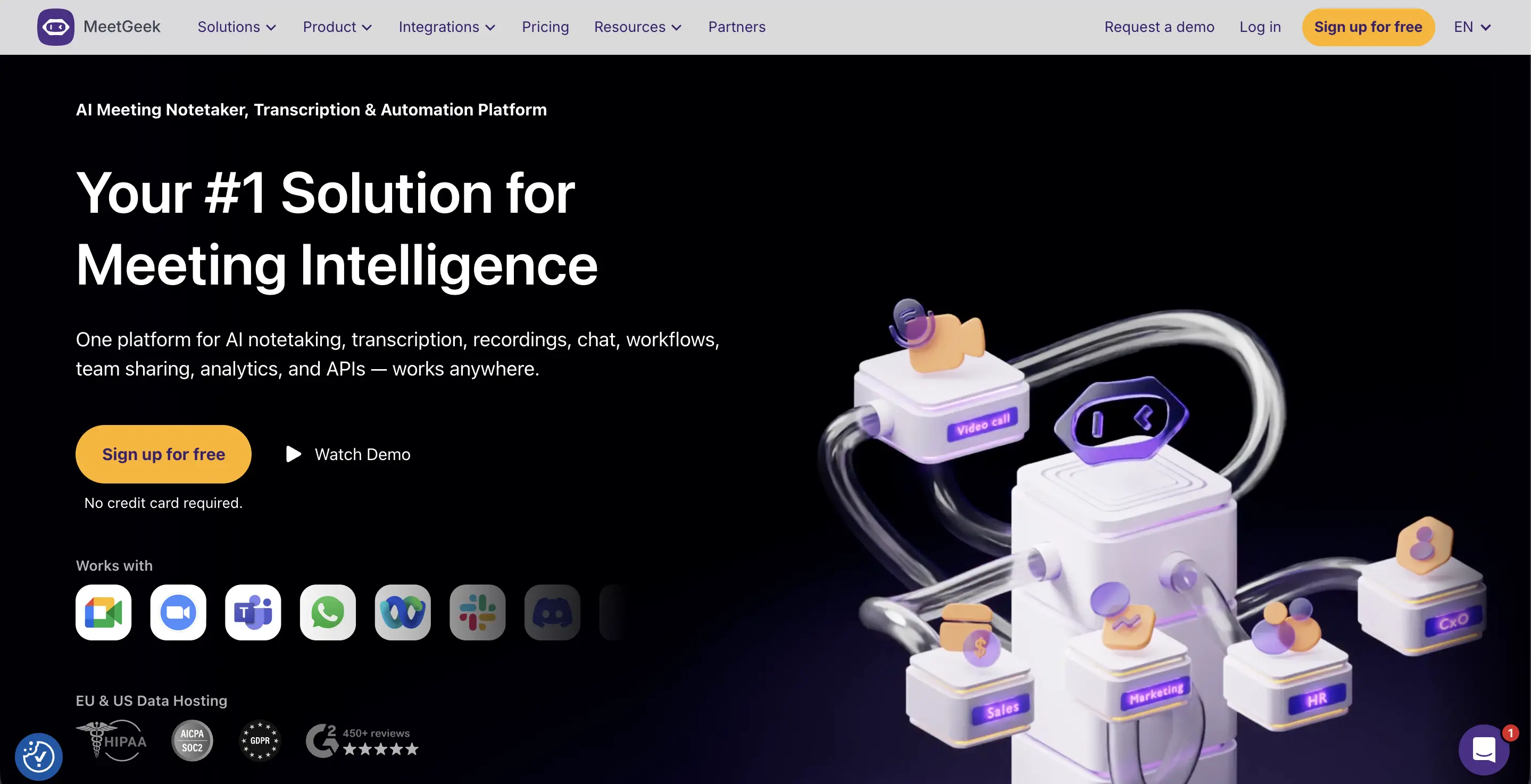
MeetGeek is an AI meeting intelligence platform. It records, transcribes, and summarizes meetings, then goes further with AI Chat, agentic workflows, Voice Agents, and meeting analytics. Used by 50,000+ teams across 100+ countries.
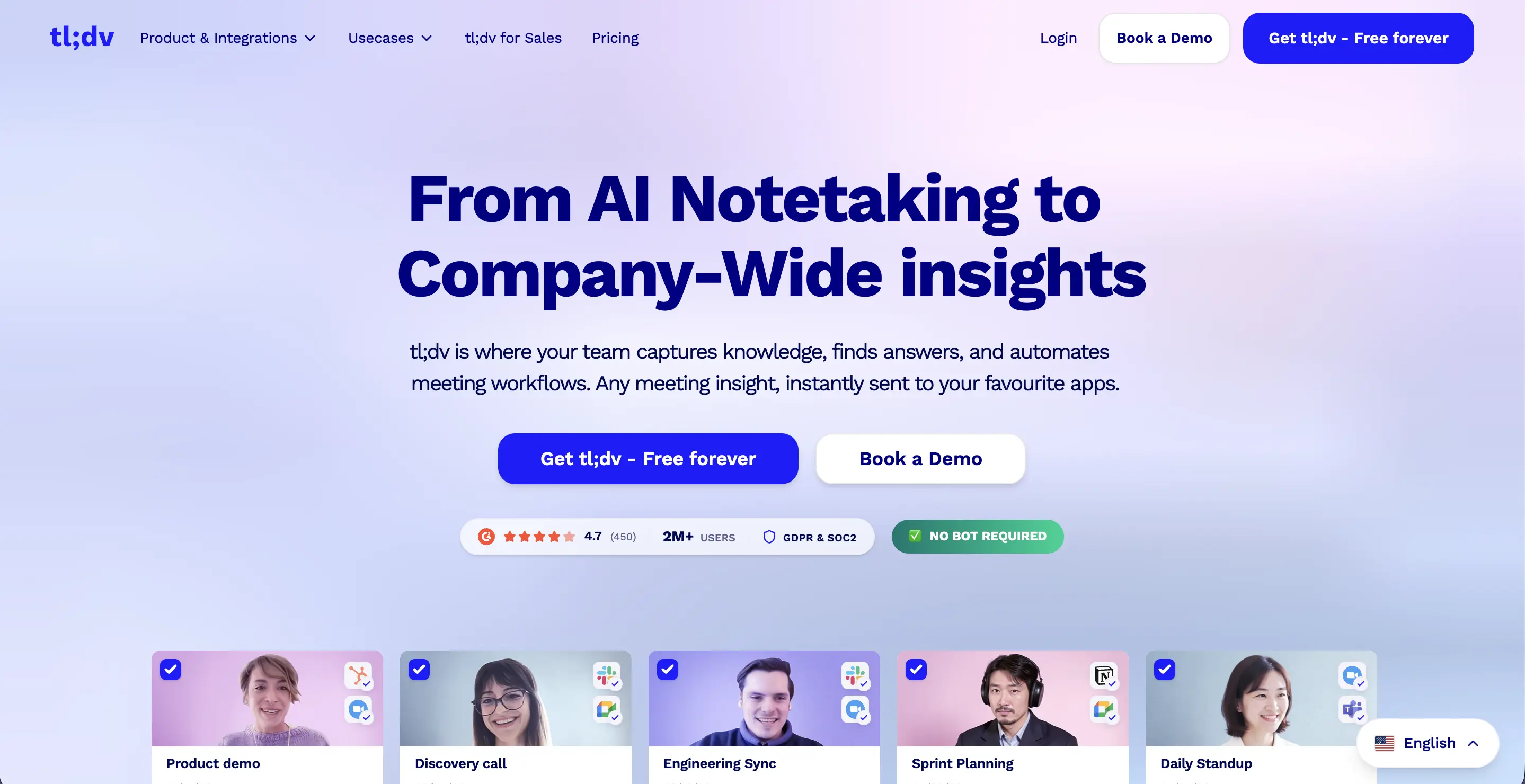
tl;dv is an AI meeting note-taker focused on transcription, summaries, and quick sharing. Popular with individual contributors and smaller sales teams. As of 2026, tl;dv's free plan is heavily limited (10 AI summaries and 10 AI queries for the lifetime of the account). That's a meaningful change from prior years.
Both tools auto-join calls, transcribe in real time, generate summaries, and integrate with major productivity tools. The differences show up in depth, scope, pricing, and platform support.
MeetGeek vs tl;dv: feature comparison
| Feature | MeetGeek | tl;dv |
|---|---|---|
| Supported platforms | Zoom, Google Meet, Microsoft Teams, Webex, Discord, Slack huddles + in-person (mobile app) | Zoom, Google Meet, Microsoft Teams |
| Transcription accuracy | 95%+, consistent in noisy environments and with multiple accents | ~96% in clean audio; drops with overlapping speakers/accents |
| Languages | 100+ with auto language detection | 30+ |
| AI summaries + action items | Yes. split into tasks, next steps, decisions, and concerns | Yes. basic summary + timestamp highlights |
| AI Chat across meetings | Yes. query every past meeting | Yes. "Ask tl;dv AI" (limits on free) |
| MCP Server (Claude / ChatGPT) | Yes. agentic workflows trigger from meeting context | Yes (Enterprise plan only, early access) |
| AI Voice Agents | Yes. autonomous AI conducts inbound/outbound calls | No |
| Meeting analytics | Talk-time, punctuality, sentiment, engagement, Meeting Productivity Score (built from 100+ KPIs) | Talk-vs-listen, objection patterns, recurring AI reports |
| Integrations | Google Calendar, Outlook, Drive, Slack, HubSpot, Salesforce, Notion + 10,000+ apps via Zapier, Make, n8n | CRMs, Slack, Notion, Google Drive + 6,000+ apps via Zapier (Pro+) |
| Mobile app for in-person meetings | Yes. iOS and Android | Yes. iOS and Android (record only) |
| Chrome Extension | Yes. bot-free recording | Yes |
| Compliance | SOC 2 Type II, HIPAA BAA, GDPR, CCPA. EU & US data residency | SOC 2 Type II, GDPR. EU-hosted AI on Pro+ |
| Free plan | 3 hours transcription/month; all core features; 2-hour max meeting length | 10 AI summaries lifetime; 10 AI queries lifetime |
| Starting paid price (annual) | $9.99/user/mo (Pro) | $18/user/mo (Pro) |
MeetGeek vs tl;dv: transcription and language support
Both tools deliver high transcription accuracy under good conditions. The differences emerge in real-world use.
MeetGeek uses a transcription engine designed for noisy environments and multilingual conversations. It supports 100+ languages with automatic language detection. When participants switch languages mid-meeting, MeetGeek follows. According to MeetGeek's published benchmarks, the engine hits Word Error Rate (WER) as low as 2.8% on Spanish.
tl;dv supports 30+ languages and produces accurate transcripts in clean audio. Multiple speakers with strong accents or overlapping speech can drop accuracy noticeably, a known limitation users flag in reviews.
Verdict: MeetGeek wins for international, multilingual, or in-person teams. tl;dv is fine for clean Zoom/Meet calls in a single language.
MeetGeek vs tl;dv: AI summaries and action items
Both tools generate AI summaries from every meeting. Both extract action items and decisions. The depth differs.
tl;dv's summaries are concise: a paragraph plus timestamped highlights. Good when you want to scan a meeting quickly.
MeetGeek's summaries are structured by meeting type. The AI splits content into tasks, next steps, decisions, and concerns based on the kind of meeting (sales call, 1:1, customer interview, project sync). MeetGeek also produces meeting minutes formatted for sharing via email and supports 30+ industry-validated meeting templates.
Verdict: tl;dv for quick summaries. MeetGeek for structured outputs you can route into a CRM or project tool without manual cleanup.
MeetGeek vs tl;dv: integrations and platform support
This is where the gap widens.
tl;dv integrates with the big three (Zoom, Google Meet, Teams) and connects to CRMs, Slack, Notion, and Google Drive. Zapier integration is available on Pro and above (6,000+ apps).
MeetGeek supports the big three plus Webex, Discord, and Slack huddles, and adds a mobile app for in-person meetings. Native integrations include Google Calendar, Outlook, Drive, Slack, HubSpot, Salesforce, and Notion. Through Zapier, Make, and n8n, MeetGeek connects to 10,000+ apps.
For teams using Webex, Discord, or recording in-person (sales meetings, interviews, conferences), MeetGeek covers ground tl;dv can't reach.
Verdict: MeetGeek wins on platform breadth. tl;dv covers the basics.
MeetGeek vs tl;dv: AI analytics
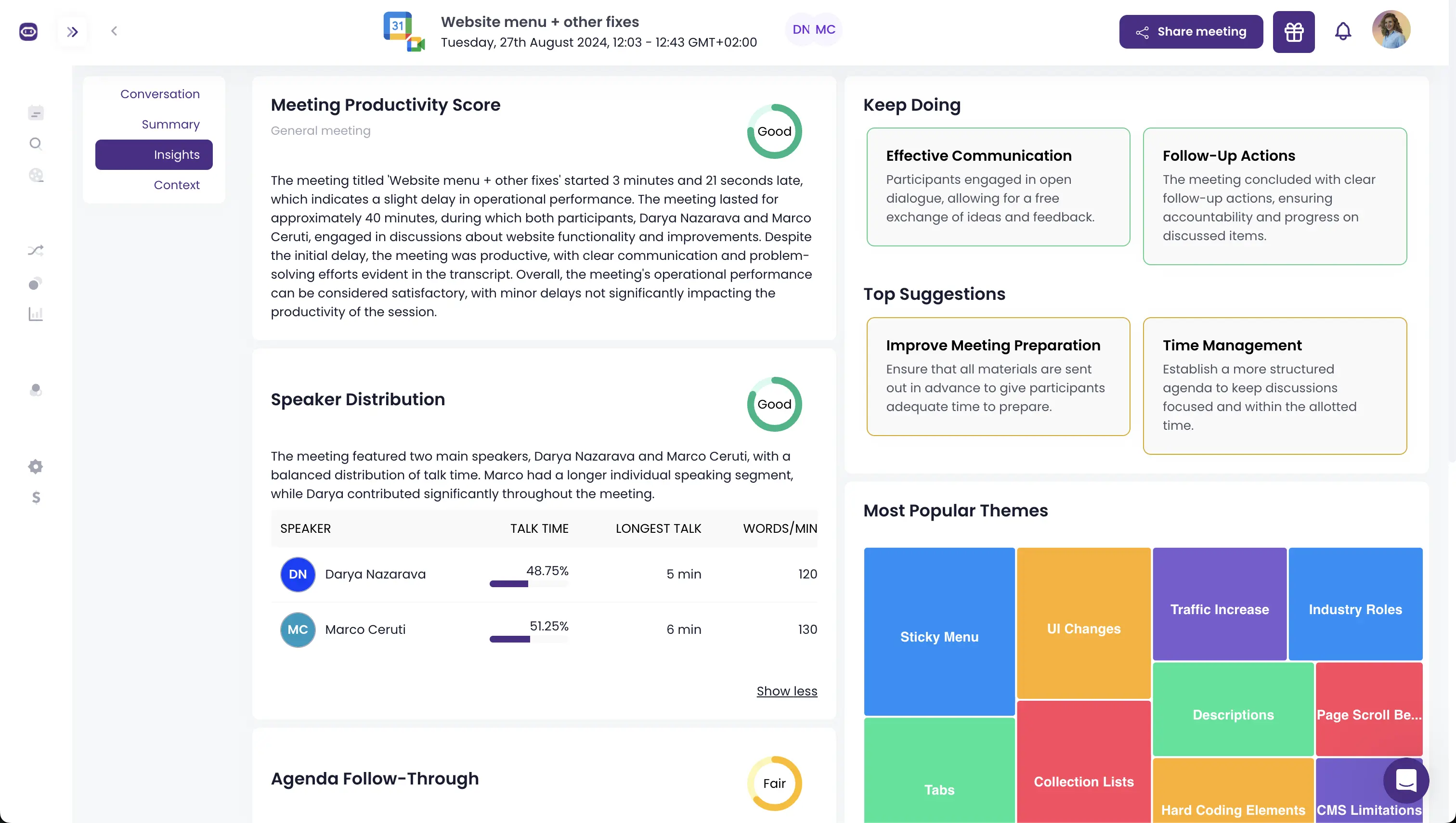
Both tools surface analytics from your meetings. Their lenses are different.
MeetGeek's analytics are built around meeting quality and team performance. The Meeting Productivity Score combines 100+ KPIs: punctuality, talk-to-listen ratio, sentiment, engagement, agenda adherence, action-item completion. Managers get drill-down by company, team, or individual, plus benchmarks against industry averages. The use case: improving how your team runs meetings over time.
tl;dv's analytics are oriented around sales conversation patterns: competitor mentions, objection patterns, feature requests, talk-vs-listen ratios, and Recurring AI Reports across calls. The use case: sales coaching and revenue intelligence on customer-facing calls.
Verdict: Different focus. MeetGeek for org-level meeting effectiveness. tl;dv for sales call analysis.
MeetGeek vs tl;dv: AI Chat and agentic workflows
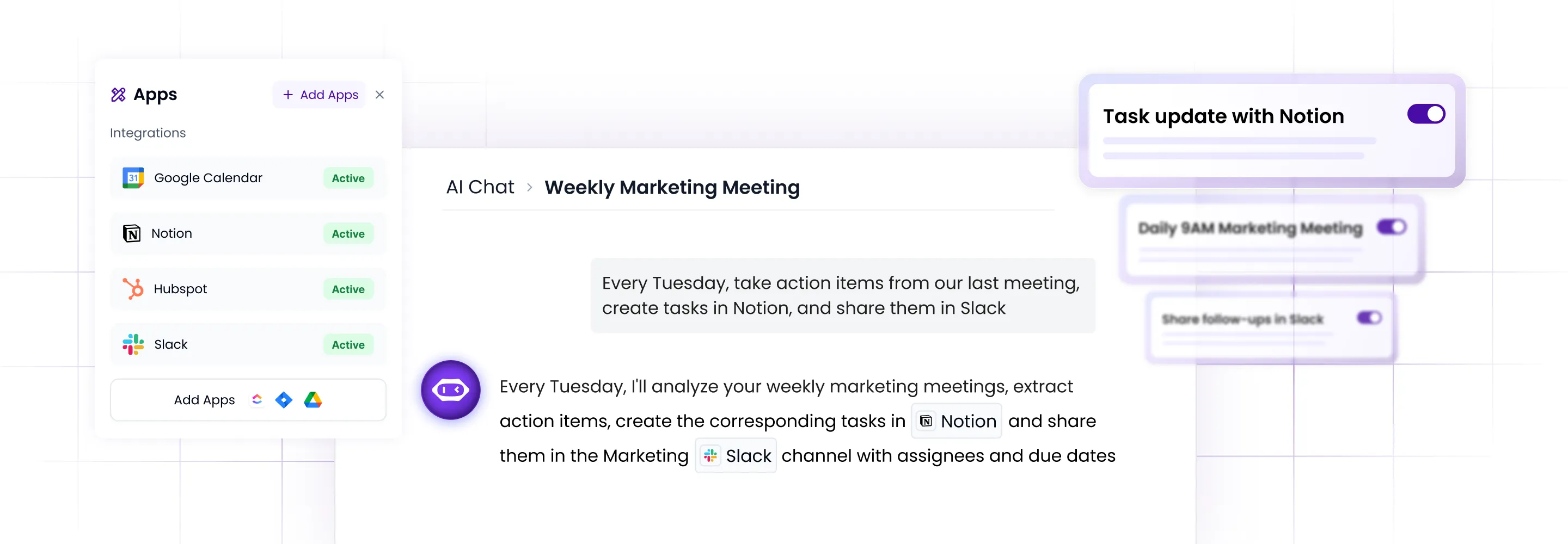
Both tools support AI Chat across past meetings. Ask a question, get an answer, no scrolling through transcripts. The difference is what happens next.
MeetGeek's AI Chat runs across every meeting in your library and supports both internal queries ("What did Alex say about onboarding?") and agentic workflows that act on meeting context. The MeetGeek MCP Server plugs MeetGeek's meeting data directly into Claude or ChatGPT. That means Claude can reason over your meeting history and trigger automations across your stack (CRM updates, ticket creation, email drafts, Slack notifications).
tl;dv's "Ask tl;dv AI" answers questions about meetings. The MCP Server is on the Enterprise plan in early access.
Verdict: MeetGeek wins for teams building agentic, meeting-driven automation. Both work for basic Q&A over meetings.
MeetGeek vs tl;dv: AI Voice Agents
This is a feature only MeetGeek offers.
MeetGeek's AI Voice Agents are autonomous AI colleagues that conduct inbound and outbound calls without a human on the line: qualifying leads, scheduling demos, answering common questions, even handling negotiations within defined parameters. Use cases include Recruiter Agent, Sales Agent, and Support Agent.
tl;dv doesn't offer Voice Agents.
Verdict: If you want AI to talk on calls, not just transcribe them, MeetGeek is the only option of the two.
MeetGeek vs tl;dv: pricing comparison
| Plan | MeetGeek (annual) | tl;dv (annual) |
|---|---|---|
| Free | 3 hrs transcription/mo · 3 mo transcript storage · all core features · 2-hr max meeting length | 10 AI summaries lifetime · 10 AI queries lifetime · 5 uploads · severely limited |
| Pro | $9.99/user/mo · 20 hrs/mo · 1 yr transcript storage · API & MCP access · no-bot recording | $18/user/mo · unlimited uploads · custom bots · email follow-up drafter |
| Business | $17/user/mo · unlimited transcription · 12 mo video storage · team analytics | $29/user/mo · sales playbook monitoring · AI coaching · multi-meeting insights |
| Enterprise | Custom · SSO/SCIM · custom retention · dedicated CSM | Custom · privately hosted AI · dedicated CSM |
| Monthly billing | Pro $15.99 · Business $27 | Higher than annual; varies |
Pricing accurate as of May 2026, annual billing. See MeetGeek pricing.
The pricing math:
- Free: MeetGeek's free plan is significantly more usable. tl;dv's "unlimited transcription" became "10 AI summaries lifetime." Once you hit the cap, the free plan is essentially read-only. MeetGeek's free plan resets monthly with full feature access.
- Pro: MeetGeek is $8/user/month cheaper ($9.99 vs. $18) and includes API & MCP access.
- Business: MeetGeek is $12/user/month cheaper ($17 vs. $29).
- Enterprise: Custom on both.
For a 50-person team on Business, MeetGeek saves $7,200/year vs. tl;dv ($850/mo vs. $1,450/mo). For a 10-person team, that's $1,440/year. The pricing gap at the Business tier is the single biggest reason teams switch.
MeetGeek vs tl;dv: which one should you pick?
Pick MeetGeek if you want…
- A complete meeting intelligence platform, not just notes
- Multi-platform support beyond Zoom/Meet/Teams (Webex, Discord, Slack huddles, in-person)
- More languages (100+ vs. 30+) and stronger multilingual support
- Org-level meeting analytics with Meeting Productivity Score
- Agentic workflows via the MeetGeek MCP Server connecting to Claude and ChatGPT
- AI Voice Agents for autonomous inbound/outbound calls
- Lower per-user cost at every paid tier
- HIPAA BAA for healthcare or regulated industries
Pick tl;dv if you…
- Are testing AI meeting tools casually with a small number of meetings (note: tl;dv's free plan caps at 10 AI summaries lifetime, so for ongoing free use, MeetGeek's resets-monthly free plan is more practical)
- Only use Zoom, Google Meet, or Microsoft Teams (no Webex/Discord/in-person)
- Mostly do sales calls and want sales-coaching analytics specifically
- Don't need agentic workflows or Voice Agents
For most teams in 2026, especially mid-market companies with mixed video stacks, multilingual teams, or anyone exploring AI-driven workflow automation, MeetGeek is the stronger fit.
Frequently Asked Questions about MeetGeek vs tl;dv
What is an AI meeting assistant?
An AI meeting assistant is software that automatically joins your video calls, records and transcribes them, and produces structured outputs: summaries, action items, decisions, and (in some tools) analytics or agentic workflows. It removes the manual work of taking notes, writing recap emails, and tracking follow-ups.
What are the best AI meeting assistants in 2026?
The top tools in 2026 are MeetGeek, tl;dv, Otter, Fireflies.AI, and Granola. Each has different strengths: MeetGeek for full meeting intelligence and multi-platform support, tl;dv for sales-team conversation analytics, Otter for individual note-taking, Fireflies for sales-call coaching, and Granola for note-taker-style live capture.
Is there a free AI note-taker?
Yes. MeetGeek offers a free plan with 3 hours of transcription per month (resets monthly), automatic recording, AI summaries, action items, and access to AI Chat. tl;dv's free plan is much more limited as of 2026, capped at 10 AI summaries and 10 AI queries for the lifetime of the account.
Which is more accurate, MeetGeek or tl;dv?
Both are highly accurate in clean audio (95-96%+). MeetGeek tends to perform better in noisy environments and with multiple speakers using different accents, and supports automatic language detection across 100+ languages. tl;dv accuracy can drop with overlapping speech or strong accents.
Does tl;dv have a Claude or MCP integration?
Yes. tl;dv added an MCP Server in 2025, currently available on the Enterprise plan in early access. MeetGeek's MCP Server is generally available and integrates with Claude and ChatGPT directly across all paid plans.
Can MeetGeek and tl;dv record in-person meetings?
Both have mobile apps. MeetGeek's mobile app records in-person conversations and processes them through the same pipeline as virtual meetings: same dashboard, same summary, same searchable library. tl;dv's mobile app supports recording but with fewer in-app processing features.
Which integrates better with HubSpot or Salesforce?
MeetGeek has native HubSpot and Salesforce integrations on Business and Enterprise plans, syncing meeting summaries, action items, and key moments directly to deal records. tl;dv supports CRM integration through Zapier on Pro and above.




.avif)