


Tactiq is a bot-free AI meeting note taker that transcribes conversations live across Google Meet, Zoom and Microsoft Teams. The lightweight setup is one of its biggest strengths: there is no meeting bot to admit, and you can read the transcript while the conversation is still happening.
Instead of recording and storing the meeting itself, Tactiq keeps the transcript as text. The Free plan includes 10 transcripts and 5 AI credits a month, while Pro removes the transcript limit but still caps AI usage at 10 credits. If pricing is your main question, our Tactiq pricing guide breaks down every plan and credit limit.
That setup works well when live transcription is what you need. Teams that want replayable recordings, more ways to capture a conversation, or a different way of paying for AI usage may find another platform fits better. Below are five worth comparing, and what each one is actually good at.
Best Tactiq Alternatives in 2026
One disclosure before the table: MeetGeek is our own product and appears first in it, so treat that row accordingly and check each vendor's own documentation before deciding. Every figure came from the vendors' pricing pages.
Table last updated: September 1, 2026.
1. MeetGeek
Best for: teams that want replayable recordings, broader capture options and meeting-driven workflows.
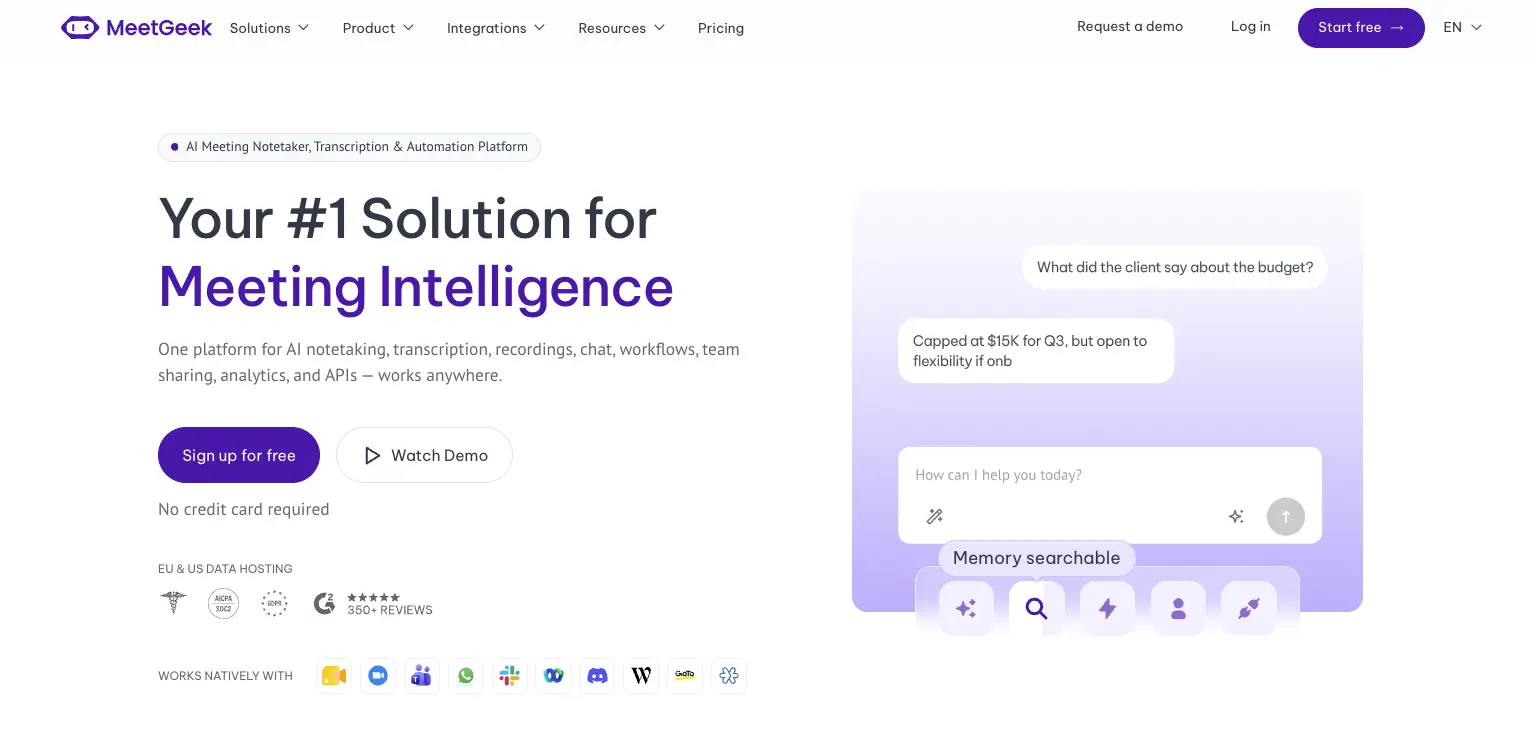
Tactiq saves the text. MeetGeek keeps the meeting. Audio and video are recorded and stored alongside the transcript, so a demo can be rewatched and a moment can be clipped and sent, rather than reconstructed from a wall of text.
Capture is also less dependent on where you happen to be. A bot can join scheduled calls on Zoom, Google Meet and Microsoft Teams whether or not you are at your desk, a Chrome extension records silently from the tab when an extra participant would be awkward, and mobile apps handle the conversations that happen in a room.
Because the recordings stay, the back catalogue becomes something you can work from. AI Chat answers questions across past meetings, and automated workflows push what came out of a call into whatever tool owns the next step, with 10,000+ apps reachable through the automation ecosystem.
The usage model is different too. Meeting summaries are not metered by AI-summary credits, so there is no monthly ceiling on how many meetings you apply AI to, and the AI Chat and workflows above are not bought in credits either. Free gives 3 transcription hours a month, Pro is $9.99 per user per month with 20 hours, and Business is $17 with unlimited transcription. Tactiq is still the lighter and cheaper option if the live transcript is the whole job.
If it is the recording you are missing, meeting recording and transcription is the side to compare first.
2. Otter
Best for: people whose main job is producing an accurate transcript on a small budget.
The closest like-for-like swap. Otter also produces a transcript you can search afterwards, but it keeps the audio, which is the one thing Tactiq never does.
Free covers 300 minutes a month with a 30-minute cap on any single conversation, so it suits standups better than workshops. Pro is $8.33 per user per month on annual billing with 1,200 minutes and a 90-minute cap, and Business is $19.99 with unlimited minutes.
The trade-off is that you move from a browser extension to a standalone app, and Otter does less with the meeting once it ends. For the detail, there is our MeetGeek vs Otter comparison and a full Otter AI pricing breakdown.
3. Fireflies
Best for: teams with a lot of meetings who want the notes to end up in a CRM.
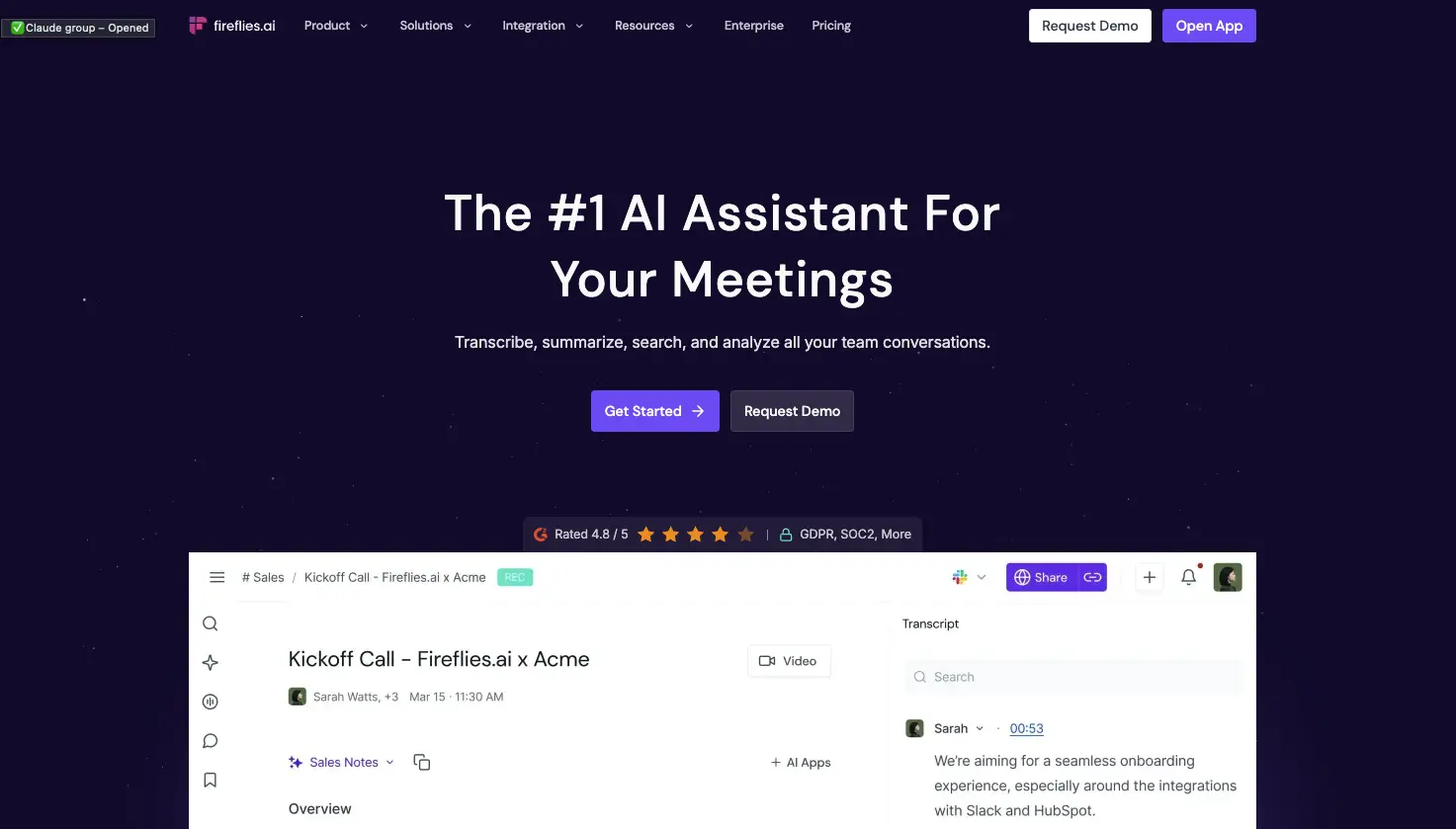
The opposite capture model to Tactiq's. A bot joins the call on your behalf, so nothing depends on whether you opened the right tab, though a visible participant is not always welcome in a customer meeting.
Volume is where it is strongest. Free includes unlimited transcription with 400 minutes of storage shared across the team, and Pro is $10 per seat per month on annual billing with 8,000 minutes per seat. Business is $19 with unlimited storage, and Enterprise is $39.
Storage, not transcription, is the number to watch on the free tier, and the notes are built to land in a CRM rather than sit in a browser.
4. Avoma
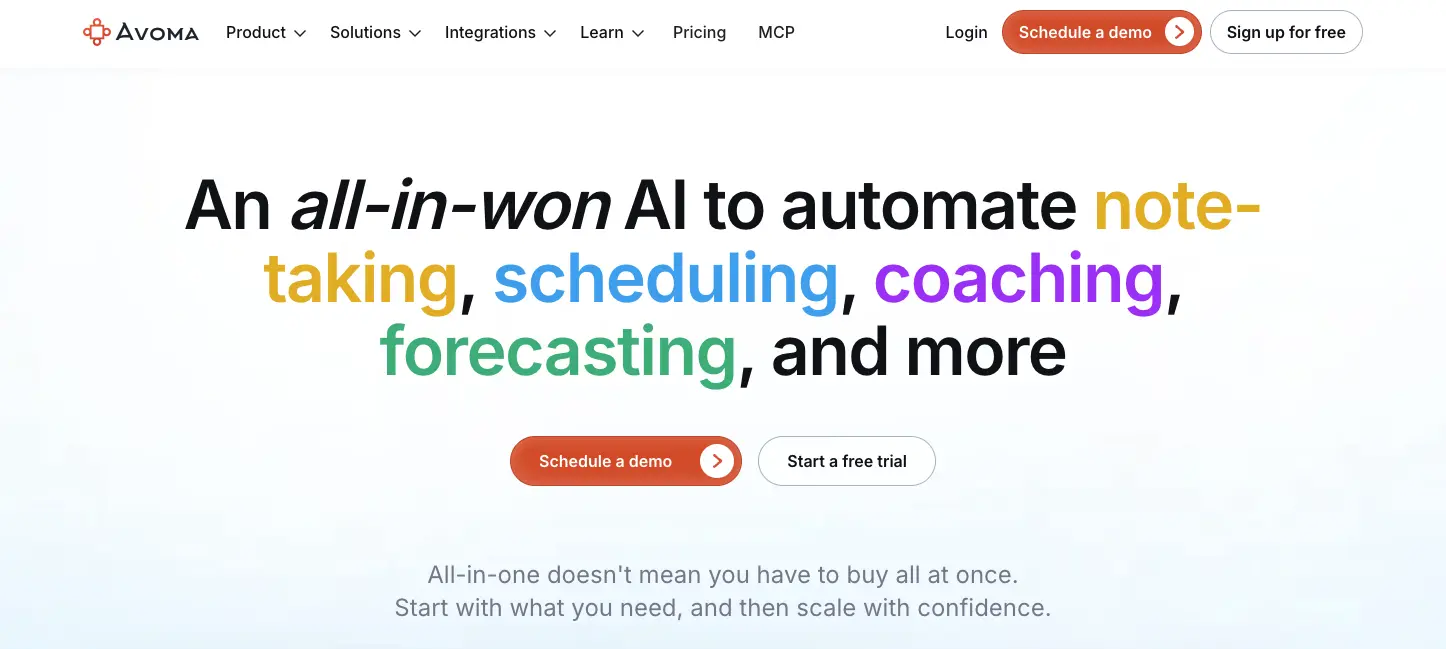
Best for: sales teams whose conversations happen on the phone as well as on video.
Relevant if what you have outgrown is not transcription but the sales process around it. Dialers including RingCentral, Zoom Phone and Aircall are covered, so phone calls get the same treatment as video, scheduling is built in, and the CRM connections are native.
Pricing works per recorder seat: Startup is $19 per seat per month on annual billing for up to 25 seats, Organization is $29 for up to 100, and Enterprise is $39 with a 10-seat minimum. People who only watch or read are free.
The step up from Tactiq is significant in both directions. There is no free plan, only a 14-day trial, and the deeper coaching sits in separate per-seat modules, with the advanced conversation intelligence module at $29 on top.
5. Fellow
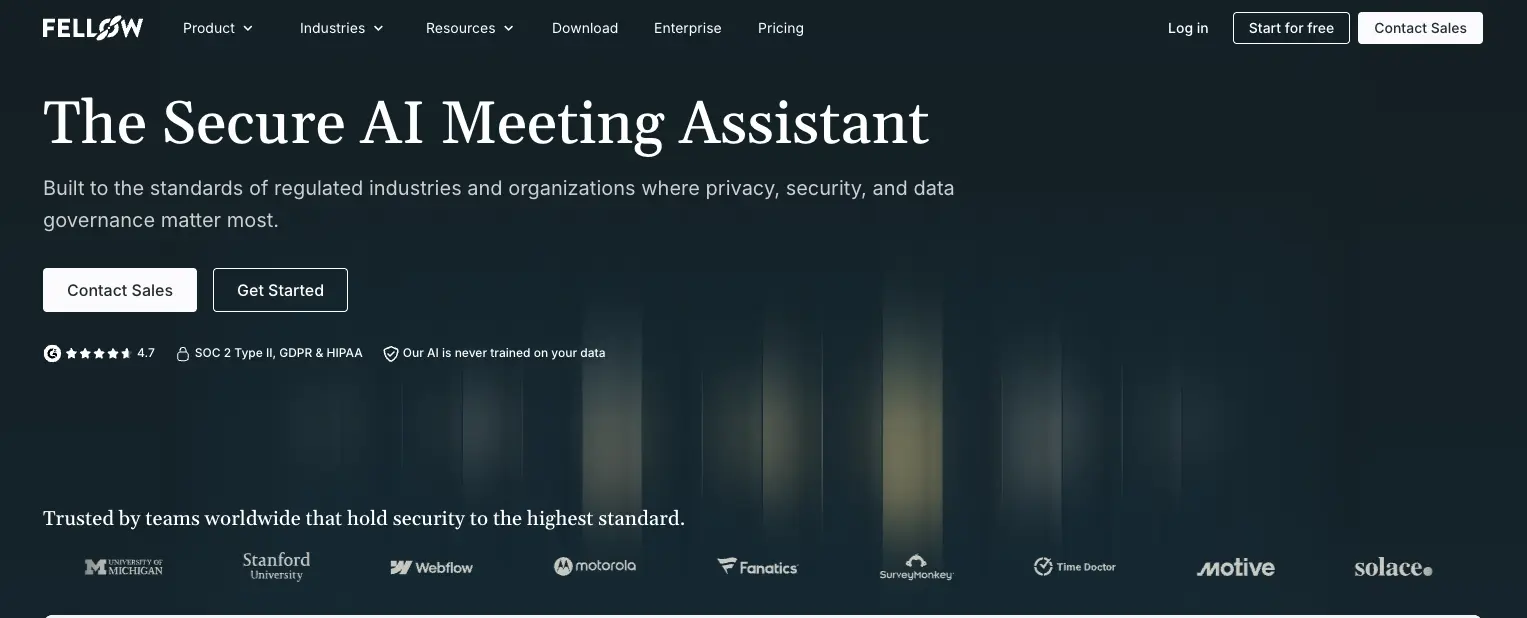
Best for: teams that already write an agenda before every meeting.
For teams whose real problem turned out to be the meeting rather than the transcript. Fellow attaches notes, decisions and action items to a collaborative agenda written beforehand, so preparation and record live in the same document. It covers Zoom, Google Meet, Microsoft Teams and Slack Huddles, with or without a visible bot.
Team is $7 per user per month on annual billing, the lowest entry price here, with 10 AI notes per user each month. Business is $15 with unlimited notes and recordings.
Two limits to check. Free gives 5 AI notes and 5 recordings for the lifetime of the account rather than monthly, and each plan caps the workspace at 5, 20 or 50 people before Enterprise.
Why Teams Look for a Tactiq Alternative
Tactiq does what it was built for well, and it has kept adding to it. Three things tend to drive the switch anyway.
- It does not keep the audio. Tactiq states plainly that it does not record or store the audio from your meetings, and that the transcript is generated in real time and saved as text. For plenty of workflows that is fine, and it keeps the product light. It matters when you need to rewatch a demo, check the tone of a difficult conversation, or send a colleague a clip, because a transcript on its own cannot do any of those.
- Capture options are more limited. The Chrome extension covers Google Meet, Zoom and Microsoft Teams, and a native Mac app now transcribes Zoom desktop calls without the browser, though it is in beta and Google Meet and Teams still run through the extension. What is missing is a bot that can attend a scheduled meeting on your behalf, and a native mobile recorder for live in-person conversations. Existing recordings can be uploaded and transcribed on any plan, including Free, but another device or tool has to capture the conversation first.
- AI usage is metered by credits. Free includes 10 transcripts and 5 AI credits a month. Pro, at $8 per user per month on annual billing, makes transcripts unlimited but still gives you 10 credits. A meeting uses at most one credit no matter how many AI actions you run on it, so the ceiling is the number of meetings you apply AI to rather than the number of prompts. Teams that do that after most calls may reach the allowance quickly, in which case Team at $16.67 is the first tier with unlimited AI credits, along with shared transcripts and centralised billing and admin.
Two things are worth ruling out as reasons to switch. Tactiq publishes ISO 27001, a SOC 2 Type II attestation, and GDPR and HIPAA compliance, so security is unlikely to be the deciding factor. And the AI is not thin: Ask Tactiq works during the meeting and across multiple meetings, AI Workflows are available from the Free plan up, and they push meeting context into tools like Slack, Notion, Linear and HubSpot. AI Meeting Agents are the one part reserved for higher tiers, starting on Business.
What Tactiq Users Say
The extension is widely used and highly rated: 4.8 out of 5 from around 4,100 ratings on the Chrome Web Store, with more than a million users.
A business development representative reviewing Tactiq on G2 in April 2026 gave it four stars and described what the live transcript changes day to day. It lets them "stay fully focused on the conversation instead of worrying about taking notes".
An IT reviewer writing on the same platform later that month rated it 3.5 out of 5. They liked getting transcripts and summaries without adding a bot to the call, but flagged the output: "Tactiq sometimes fails to correctly transcribe some words."
Both are worth weighing on your own calls. The bot-free capture is the draw, and transcription quality is the thing to check.
How to Choose
It helps to start from what Tactiq is not giving you, because that narrows the list fast.
If you need the recording, look at MeetGeek, Otter or Fireflies. If the problem is that meetings happen when you are not at your own screen, you want a tool with a bot that joins on its own, which is standard for Fireflies, Avoma and MeetGeek. If you were hitting credit limits, check how each tool meters AI, because they do it differently: MeetGeek does not use credits for summaries, Fireflies gives a fixed monthly allowance, and Avoma sells intelligence as per-seat modules.
Then compare the free tiers properly, because they are not measured in the same units. Fireflies caps storage rather than transcription, Otter counts minutes, MeetGeek counts hours that reset each month, and Fellow's five notes are a lifetime allowance rather than a monthly one. A free plan you can settle on and a free plan that runs out after five meetings are different products, and it is worth knowing which one you are testing.
Finally, count the people. Some tools cap seats per plan, some let you mix free and paid licences, and that difference often matters more to the invoice than the headline price.
That leaves a fairly clean map. Tactiq is enough when lightweight, bot-free live transcription is what you need. MeetGeek is worth comparing when the meeting itself matters, along with more ways to capture it and the work that follows. Otter fits transcript and search work, Fireflies high volume feeding a CRM, Avoma specialised revenue workflows, and Fellow agenda-centred meeting management.
If you want a wider view of the category, our round-up of the best AI note takers ranks the main options, and apps for taking meeting minutes covers the lighter end.
Key Takeaways
- Tactiq gives you live, bot-free transcription and does not record or store the meeting audio.
- Free includes 10 transcripts and 5 AI credits a month; Pro at $8 makes transcripts unlimited but keeps the 10-credit cap.
- A meeting uses at most one AI credit however many AI actions you run on it, and Team at $16.67 is the first tier with unlimited credits.
- AI Workflows and file uploads are available from the Free plan up, while AI Meeting Agents start on Business.
- Tactiq now runs through both a Chrome extension and a native Mac app for Zoom desktop calls, so it is no longer accurate to describe it as browser-only.
- MeetGeek is worth comparing when you need the recording itself, more ways to capture a conversation, and meeting-driven workflows without AI-summary credits.
- The others fit specific cases: Otter for transcripts and search, Fireflies for volume feeding a CRM, Avoma for revenue teams with dialer calls, Fellow for agenda-led meetings.
How We Reviewed Tactiq and Its Alternatives
For each of the six tools we read the current pricing page and worked out what the free tier and the entry plan actually allow, since none of them measure usage the same way. We then mapped how each one captures a meeting, extension, bot, desktop or mobile, and what it keeps afterwards. Tactiq's own Help Center settled the plan tiers and how AI credits are consumed, and recent verified reviews on G2 and the Chrome Web Store covered the user side. None of these products were tested by us, and nothing here is written as though they were.
Frequently Asked Questions
What Is the Best Tactiq Alternative?
It depends on which limit you hit. MeetGeek is worth comparing if what you are missing is the recording itself, broader capture options or workflows that run across your meeting history. Otter is worth considering if transcripts and search are the priority. Fireflies suits teams running a lot of meetings into a CRM. Avoma fits sales teams with dialer calls, and Fellow fits teams built around written agendas.
Does Tactiq Record Meetings?
No. Tactiq says it does not record or store the audio from your meetings, and that the transcript is generated in real time and saved as text. If you need to replay a conversation rather than read it, you need a tool that stores the recording.
Is There a Free Tactiq Alternative?
Yes, several. MeetGeek's free Basic plan includes 3 hours of transcription a month with unlimited AI summaries and does not expire. Fireflies offers unlimited transcription on its free tier with 400 minutes of storage shared across the team. Otter gives 300 minutes a month with a 30-minute cap per conversation.
Why Do Tactiq Users Run Out of AI Credits?
AI credits are used when you run AI features such as summaries, questions or workflow steps. A meeting uses at most one credit, so running several AI actions on the same call does not cost more. Free includes 5 credits a month and Pro includes 10, which teams applying AI after most meetings can pass fairly quickly. Unlimited credits start on the Team plan at $16.67 per user per month on annual billing.
Can I Use a Tactiq Alternative for In-Person Meetings?
Tactiq does not offer a native mobile recorder for live in-person conversations. You can upload an audio or video recording afterwards, including on the Free plan, but another device or tool has to capture the conversation first. MeetGeek's mobile apps record in-person meetings directly and sync them to the same workspace as your online calls.
How Many Languages Does Tactiq Support?
Tactiq's current website says it supports transcription in over 60 languages. It is worth checking your specific language before committing, particularly if most of your meetings happen on one platform.
If you are weighing up a switch, MeetGeek's free plan gives you 3 hours a month with unlimited summaries, which is enough to run the comparison on your own meetings.



.avif)