

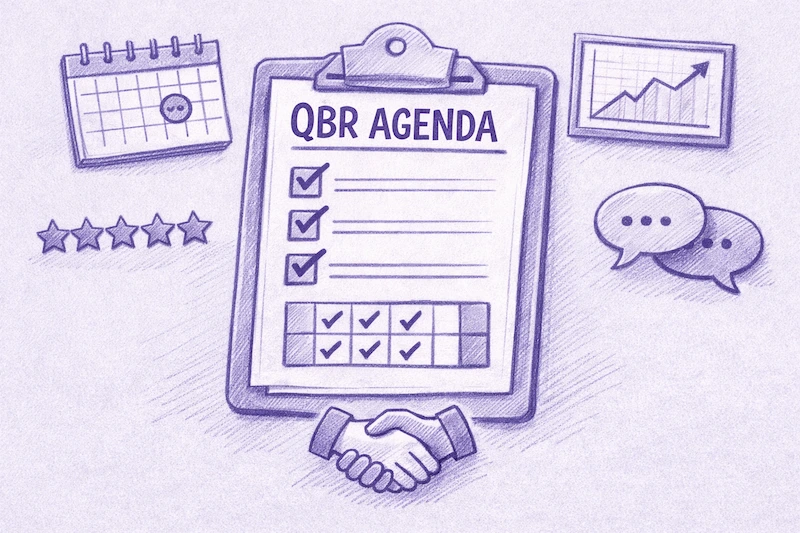

A quarterly business review (QBR) is a recurring strategic meeting between a vendor and a customer, usually every 90 days, where both sides review outcomes against goals, surface risks, and align on priorities for the next quarter.
Done well, a QBR is the single most valuable hour in the post-sale relationship and the primary lever for Net Revenue Retention (NRR). Done badly, it's a slide deck nobody asked for. Gartner and Forrester both rank NRR as the single most predictive metric for SaaS enterprise value, and the QBR is the meeting where it's either earned or lost.
This guide gives you a QBR template that flips the first 10 minutes to customer priorities, a slot-by-slot agenda, 12 discovery questions that surface expansion signals, the metrics that make a QBR defensible, and the renewal narrative that should come out of every review.
What most QBRs get wrong
Most QBRs are one-sided status reports. The CSM walks the customer through what their team did, shows a usage chart, and closes with “any questions?” The customer nods and returns to their actual job. Harvard Business Review frames the Customer Success Manager role around helping B2B customers maximize the value of their purchase, not delivering status updates, and the default QBR format breaks that framing.
The pattern is predictable. The vendor talks 80% of the time. The metrics shown are activity metrics (logins, seats provisioned), not outcome metrics (NPS, CSAT, time-to-value, NRR impact). Next quarter's priorities are the vendor's priorities, not the customer's. And because the meeting never seriously tests whether the customer is getting value, the renewal conversation arrives cold.
A QBR that customers actually want does three things the default one doesn't:
- Opens with the customer's priorities, not the vendor's slides
- Reviews outcomes against the goals set last quarter, in the customer's language
- Ends with decisions and owners, not “we'll circle back”
The frame shift is straightforward. The QBR is not an update on what your team has done. It's a joint working session on whether the customer is getting what they bought and what to change if they're not.
How to prep a QBR the customer will actually attend
QBR attendance erodes over time. The economic buyer skips the second review, a director sends a deputy to the third, and by the fourth you're presenting to the users, not the decision-makers. The prep prevents that.
Send the agenda 48 hours ahead. Include one section the customer fills in: “What we'd like to cover.” This single change reshapes the meeting as the customer arrives having thought about what they want, not reacting to what you brought.
Share the outcomes scorecard in advance. Actuals versus targets on the metrics you agreed last quarter. No surprises. If you missed, the explanation is in the doc, not a live defense.
Confirm the right attendees. The economic buyer, the user lead, and anyone who influences renewal on the customer side. The CSM, a product or engineering lead if the roadmap is relevant, and the exec sponsor for strategic accounts on yours. Total attendance under eight. Post-sale teams running on Gainsight, Totango, ChurnZero, Planhat, or Vitally should pull the account health score into the pre-read so all attendees arrive with the same baseline.
Pre-align with your exec sponsor. A 15-minute internal call before strategic-account QBRs lets your team walk in with one message, not three.
The QBR template (what to fill in)
A strong QBR template has these sections. Keep it in a shared doc (not a one-way deck) so both sides can edit during the meeting.
- Customer context: business priorities for this quarter (filled in by the customer 48 hours before)
- Outcomes scorecard: the 3–5 metrics you agreed to last QBR, with actuals
- Usage and adoption: only the data points tied to those outcomes
- Wins since last QBR: one or two specific stories, not a list
- Open risks and blockers: what's in the way of the customer getting value
- Roadmap alignment: what's coming and what's relevant to their goals
- Priorities for next quarter: 2–3 specific commitments, owner-attached
- Open decisions and actions: each with a name and a date
Skip the company update slide. Nobody came for the company update.
The 60-minute QBR agenda (slot by slot)
This agenda is built for a customer-led review. Allocate 60 minutes. If the relationship is new or strategic, take 75.
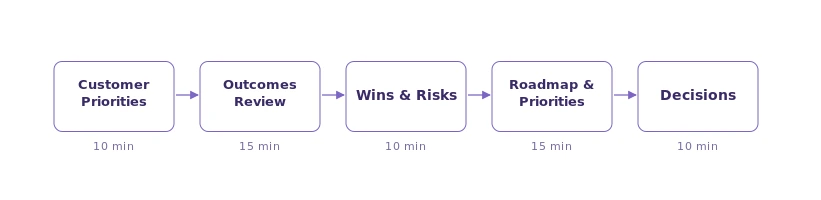
0–10 min — Customer priorities (customer speaks)
Open with the customer. “Before we get into anything, what are the two or three things your team is trying to get done this quarter that we should be aware of?” This reframes the whole meeting. Every section that follows is filtered through what you just heard.
If you only keep one change from this template, keep this one.
10–25 min — Outcomes review (both)
Walk through the 3–5 outcome metrics you agreed on last quarter. Show actual vs. target. Where you hit, name what worked. Where you missed, name why and what's different now. Avoid showing 20 metrics to hide the one that matters.
Outcome metrics are things like “time-to-first-value (TTV) reduced from 21 to 9 days,” “Customer Effort Score (CES) up 12 points,” or “support tickets per user down 18%.” Activity metrics such as logins, feature clicks, or seats provisioned belong in an appendix, not the main story. Lincoln Murphy's long-running rule of thumb applies here: tie every QBR metric back to the customer's desired outcome, not your product telemetry.
25–35 min — Wins, risks, and blockers (customer-led)
Ask, don't present. “What's working that we should do more of? What's getting in the way?” The answers in this 10-minute block are more valuable than the rest of the meeting combined. Write down the blockers verbatim.
Listen for the words the customer uses to describe value. Those words become the headline of the renewal narrative at the end of the year. You can't manufacture them; you can only capture them when they're said.
35–50 min — Roadmap alignment and next-quarter priorities (both)
Skip the generic roadmap tour. Show only what's relevant to the goals the customer named at the top. Then move into the 2–3 commitments for next quarter: what you'll do, what they'll do, and what “done” looks like for each.
Joint commitments only. “We'll ship X, you'll roll it out to team Y by Z” lands differently than “we'll ship X.” The second is a feature announcement; the first is a shared plan.
50–60 min — Decisions and next steps (both)
Every open item gets an owner and a decide-by date. Close with a confirmation round: each side states their one next action. No exceptions.
12 discovery questions that surface expansion signals
Drop these into the customer-priorities and wins/risks slots. They're designed to surface use cases, stakeholders, and friction that don't show up in a usage dashboard.
- What's the biggest bet your team is making this quarter?
- If we weren't here, what would you have to do instead to get the same outcome?
- Who else on your side has tried to use us and hit friction?
- What's a process your team still runs manually that you wish didn't exist?
- Where has adoption stalled, and what's the reason?
- What did we commit to last quarter — and how did we do against it, in your words?
- If your CFO walked in tomorrow and asked “is this tool earning its place?”, what would you say?
- What's one thing a competitor of ours does that you wish we did?
- What's changing in your business this year that we should plan for?
- Who on your team hasn't been onboarded yet but should be?
- What's the next team or department that could get value from this?
- If we could fix one thing before the next QBR, what would it be?
Questions 7, 9, and 11 surface expansion and renewal signals. Questions 4 and 11 surface use cases. Questions 5 and 12 surface churn risk early enough to fix it.
Because the QBR feeds renewal prep, churn detection, and reference matching, it is also where AI for customer success does most of its work across the account's meeting history.
Don't ask all 12 in one sitting. Pick four per QBR, rotating through the set over a year, so the customer doesn't feel interrogated.
Outcome metrics that make the QBR defensible
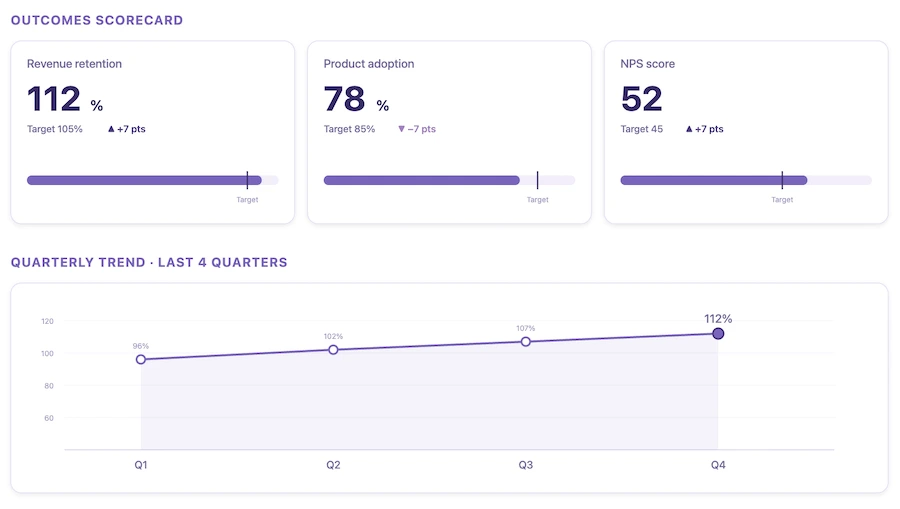
Three rules for choosing QBR metrics.
Tie every metric to a business outcome the customer named. If the customer cares about reducing sales cycle length, show sales cycle length, not meeting volume. Common outcome families include revenue metrics (NRR, GRR, ACV, CAC payback), experience metrics (NPS, CSAT, CES), and operational metrics (TTV, adoption rate, ticket deflection).
Agree on targets one quarter in advance. A metric without a target is a story without a point. If you arrive at a QBR and start negotiating what “good” looks like for this quarter, you're already a quarter behind. Forrester's Customer Experience Index methodology is a reasonable reference for how to set experience benchmarks that survive leadership turnover.
Show trend, not just current state. A single quarter's number is noise. Four quarters of trend is signal, and it's also the backbone of the renewal conversation.
A defensible QBR outcomes scorecard has between three and five metrics. Fewer and it looks thin. More and you're hiding. If you can't narrow the list, ask: “If we could only track one thing for this customer, what would it be?” The answer belongs in the scorecard. Everything else is support.
The renewal narrative, built by design
A QBR that's run well builds the renewal narrative quarter by quarter, so the renewal conversation is not a surprise. By the fourth QBR in an annual cycle, the customer should be able to answer three questions without your help:
- What outcome did we get that we wouldn't have otherwise?
- What's on the plan for the next 90 days?
- Where is this relationship going next year?
If those three answers aren't obvious, the QBR format is carrying the weight of a conversation it was never designed to have and renewal will feel like a negotiation instead of a continuation.
Three failure modes to avoid
1. Showing up with a deck the customer didn't ask for. If your QBR prep was 100% internal, you already lost. Send the customer the agenda and the outcomes scorecard 48 hours ahead. Ask them to add one section: “what we'd like to cover.” That single change reshapes the meeting.
2. Treating the QBR as a status update. Status belongs in your weekly or monthly sync. The QBR is for outcomes, strategy, and decisions. If someone in the room says “can you walk us through what you did last month?”, redirect: that's a different meeting.
3. Ending without commitments. “Great discussion, let's talk soon” is how QBRs quietly die. Every QBR should end with a written recap sent within 24 hours: priorities, decisions, owners, dates. Put it in the same shared doc as the agenda.
The 24-hour QBR follow-up
Within a day of the meeting, the CSM sends:
- The updated shared doc (scorecard, decisions, next-quarter commitments, action items)
- Calendar holds for any check-ins agreed during the QBR
- A one-paragraph written recap in email or Slack for the attendees who skim
- A note to internal stakeholders (account team, product, exec sponsor) surfacing anything relevant — a competitive mention, a feature request, a risk signal
The recap is where the QBR becomes an asset. A year from now, the four recaps tell the story of the relationship better than any dashboard.
How MeetGeek handles recurring QBRs
QBRs are the single most repeatable meeting in the customer lifecycle. Same attendees, same structure, every 90 days. That makes them a natural fit for meeting intelligence built on top of your actual meeting history.
MeetGeek's Meeting Agent joins every QBR from the calendar, produces a structured recap with action items and owners, and logs the outcome against the goals you set in the previous QBR. Three months later, when someone asks “what did we commit to last quarter?”, the answer is one search away. A year in, the renewal narrative is written for you quarter by quarter, in the customer's own words.
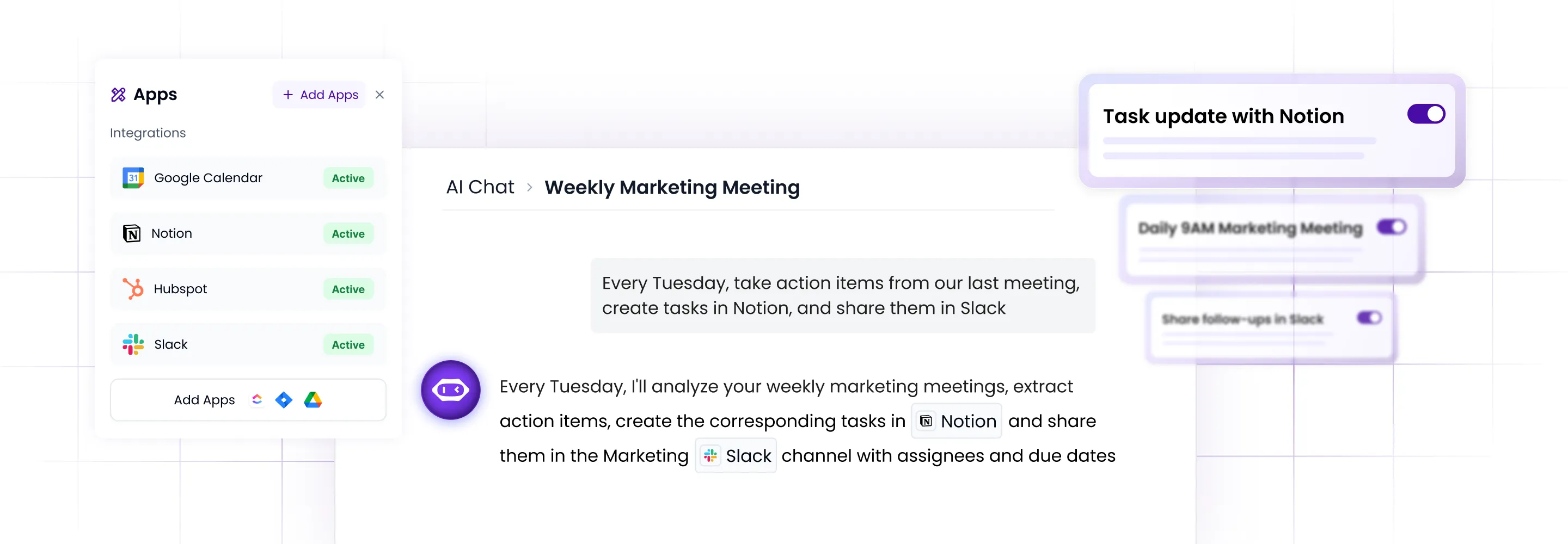
Ask AI Chat inside MeetGeek for in-the-moment questions across recent meetings, or pair MeetGeek with Claude through the MeetGeek connector to bring Claude's full reasoning over your entire customer-meeting history. The connector is the stronger option for synthesis across many QBRs, comparing Q1 vs. Q4 talking points, tracking whether a commitment was kept, or building a renewal brief from the last four reviews.
Frequently Asked Questions
How long should a QBR be?
60 minutes for most accounts; 75 for strategic ones. Under 45 minutes and you're running a status update, not a review. Over 90 minutes and you're collapsing a working session into the QBR.
Who should attend a QBR?
On the customer side: the economic buyer, the day-to-day user lead, and anyone who influences renewal. On the vendor side: the CSM, a product or engineering lead if the roadmap is relevant, and the executive sponsor for strategic accounts. Keep total attendance under eight.
How often should you run a QBR?
Quarterly is the default. Monthly is overkill unless the contract is new or at risk. Semi-annually is fine for smaller accounts where a full quarterly review would be performative.
Should the customer drive the QBR agenda?
Partly. The vendor owns the outcomes review and the roadmap alignment. The customer owns the first 10 minutes (priorities) and the middle 10 (wins, risks, blockers). Joint ownership of the next-quarter commitments.
What's the difference between a QBR and an executive business review (EBR)?
A QBR happens every 90 days with the operational team. An EBR happens annually, runs 30–60 minutes longer, and includes the customer's executive sponsor (often the CFO, COO, or CRO). The EBR is strategy; the QBR is execution plus strategy. Accounts running in Salesforce or HubSpot typically link the EBR to the renewal opportunity record so the narrative from four QBRs becomes the renewal brief automatically.
How do I run a QBR when the relationship is new?
For the first QBR, replace the outcomes review with a goal-setting section: what will we measure, what's the target, by when. The first QBR sets the frame; the second is the first real review.
What if the customer pushes back on having a QBR at all?
Understand why. Usually it's because prior QBRs were one-sided updates that wasted their time. The fix is the format, not the cadence. Offer to run a 30-minute “customer-led review” instead of a full QBR, with the customer controlling the agenda. If the value shows, the 60-minute cadence comes back on its own.




.avif)