


The Google Meet AI note taker is Take Notes for Me, a Gemini feature built into Google Workspace that writes a summary with decisions and action items into a Google Doc and files it in the meeting organizer's Drive. You switch it on from inside the call, in the Take notes with Gemini control at the top right, and nothing joins the meeting as a participant.
Access is decided by your Workspace edition, before you open Meet at all. Business Starter and Enterprise Starter do not include it, and that is the most common reason the control simply is not there.
This guide covers the 6 editions that qualify, the 8 languages Gemini handles, the exact steps to turn it on, where the doc lands after the July 2026 Drive change, what changes on September 21, 2026, and what to check when no notes appear. If you would rather compare tools than switch this one on, our ranking of the best AI note takers for Google Meet does that job instead.
Which Google Workspace Editions Include Take Notes for Me?
Take Notes for Me is included with 5 Google Workspace editions and 1 education add-on. Everything else is out, including both Starter tiers.
| Plan | Take Notes for Me |
|---|---|
| Business Standard | Included |
| Business Plus | Included |
| Enterprise Standard | Included |
| Enterprise Plus | Included |
| Frontline Plus | Included |
| Google AI Pro for Education add-on | Included |
| Business Starter | Not included |
| Enterprise Starter | Not included |
| Personal Google account | Only with an eligible Google AI plan |
Table last updated: July 31, 2026.
An eligible edition is necessary and not sufficient. Admins hold the same switch in the Admin console and can turn it off for a whole domain or for a single organizational unit, which is why two colleagues on the same plan can see different things.
The organizer's edition is the one that counts, not yours. Google states that the meeting organizer must have the Workspace edition that includes Take Notes for Me, so joining an eligible colleague's call gets you notes even when your own account would not.
One point worth squaring with our own numbers. Our breakdown of Google Meet pricing by plan says Gemini is included in every Workspace plan at no extra cost, and that is accurate for Gemini the assistant. Take Notes for Me is a separate Meet capability sitting on top of it, and it carries the edition floor in the table above.
Which Languages Does Google Meet Gemini Support?
Google Meet Gemini notes support 8 languages: English, French, German, Italian, Japanese, Korean, Portuguese and Spanish. Google's help page for Take Notes for Me is where that list is maintained.
The setting is per meeting, not per speaker. Gemini works the whole call against one language, so the language you pick is the lens everything is heard through.
Google states plainly that multiple languages in the same meeting are not supported. That bites hardest on the calls most worth summarizing: a customer call that opens in English and closes in Spanish, or a design review where two people drop into Portuguese for a minute.
There is a documented fallback, and it is manual. If a different language is spoken for at least 30 seconds, Google shows a notification offering to change the notes language, and you choose Change language or Ignore. Everything spoken before you accept it was still heard in the original language.
Accepting has 2 side effects worth knowing. The switch also changes the language for Ask Gemini and for every active meeting record, and it does not carry over to recurring or future meetings, so a bilingual weekly call needs the same decision every week.
For comparison, MeetGeek's Google Meet integration transcribes in 100+ languages and picks the language per meeting as well, so the ceiling moves but the one-language-per-call constraint is common to both.
How to Turn On Take Notes for Me in Google Meet
There are 3 places to switch it on: the Calendar event, the Meet Greenroom just before you join, and the call itself. Nothing needs installing in any of them.
The Calendar route is the one to use for a meeting you own, because you set it once and nobody has to remember on the day.
- Open the event in Google Calendar and click Edit event, with Google Meet video conferencing already added.
- Select Video call options, then Meeting records in the left column.
- Check the box next to Take notes with Gemini.
Inside the call the flow is faster, and it is the route for meetings you did not organize.
- Join the call at meet.google.com, signed in to an account that carries an eligible edition.
- Click Take notes for me at the top right of your screen.
- Adjust the settings if you want to, before starting. You can set who receives the notes, the notes language, and which sections the doc contains.
- Click Start taking notes, and clear the consent prompt if your admin requires one.
- Click Stop whenever you need to, for example before a confidential stretch.
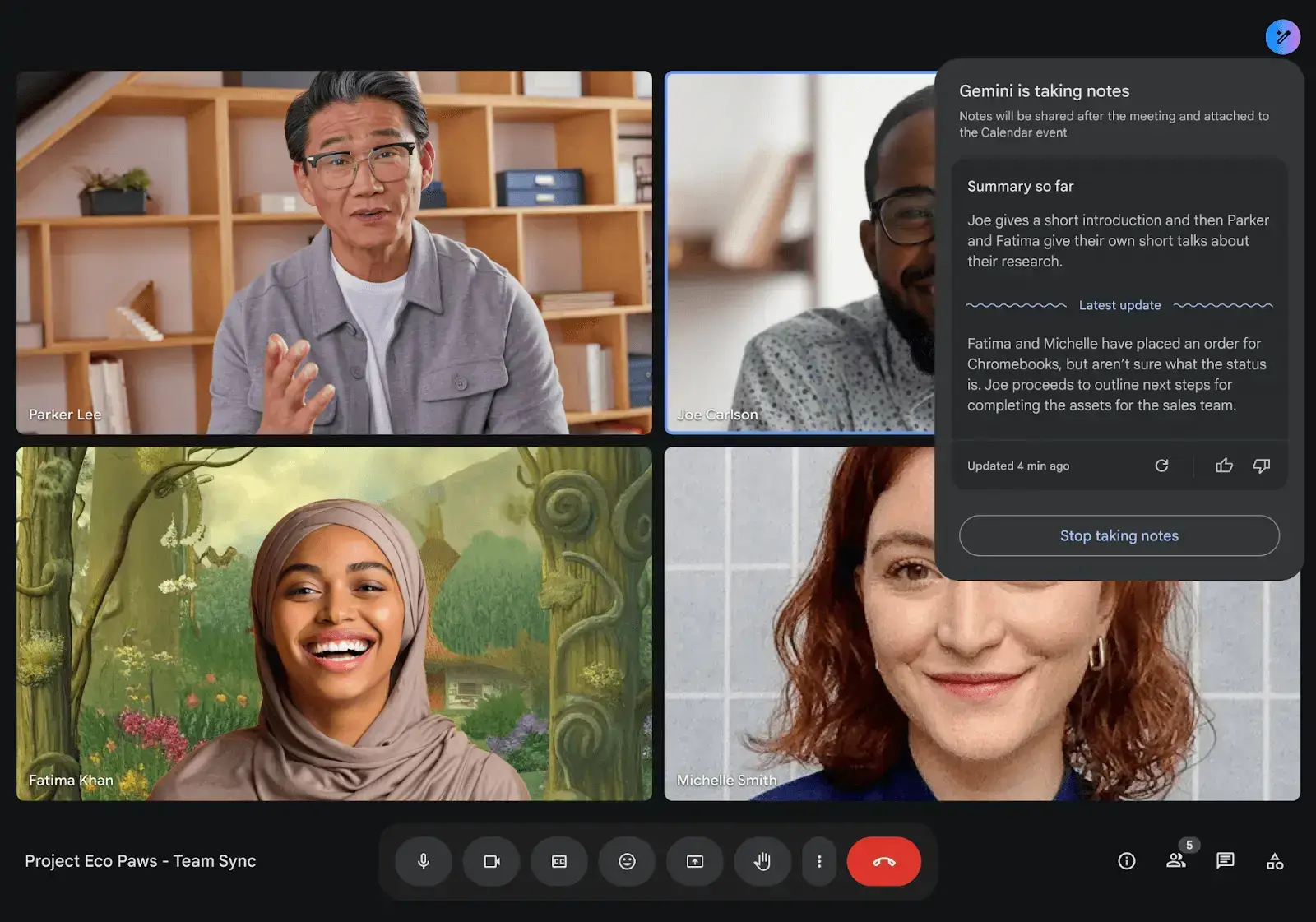
A pencil icon appears for every participant while notes are running. That icon is the only reliable confirmation, so if it is not there, nothing is being captured.
Stopping notes freezes Summary so far instead of deleting it. The text already generated stays on screen and stops updating until someone resumes, which is exactly what a still-working feature looks like.
Host management decides who holds the switch. With it enabled, only the host and co-hosts can start or stop notes. With it off, any participant internal to the host's organization can. There is also a Quick Stop setting your admin can enable, which lets any internal user end the capture for everyone at once.
Taking Notes on Android, iPhone and iPad
On mobile, open the Meet app, tap a meeting, tap the screen, then Menu, then Take notes with Gemini, then Start. Google's only stated prerequisite is that the app is up to date.
Summary so far is desktop only. Google's help pages state that live summary so far is not supported on Android and not supported on iOS, so a late joiner on a phone gets no in-call catch-up at all.
The mobile app is also where Google points for in-person meetings and on-the-go capture, since the feature is not tied to a video call. If that is your main use case, our ranking of AI note takers for in-person meetings covers what else handles it.
Where Your Google Meet AI Notes Are Saved
The doc saves to the meeting organizer's Drive, not to yours. The email that goes out carries a link to the doc, a summary of the meeting and suggested next steps, and the doc is attached to the Calendar event.
Sharing is narrower than the invite makes it look. Notes reach only individuals added to the calendar invite, and a group email does not inherit access, so everyone on a distribution list still needs the doc shared with them individually. That single detail explains most of the cases where half a team has the recap and the other half does not.
The filing changed in July 2026. Notes now land in a Google Meet folder in the host's My Drive with a sub-folder per meeting, and Google renamed the old Meet Recordings folder to Legacy Meet Recordings. Participants with access now see shortcuts to those files in their own Google Meet folder, which was not the case before.
That rename is worth knowing before you go hunting. A doc that looks missing is often sitting in the new structure while you search the old one, and our guide to where Google Meet recordings are saved is the place to start when a file has gone astray. If you are trying to reconstruct which call the notes belong to, how to see your Google Meet history covers that side.
Retention belongs to your organization rather than to Google's default. The doc follows whatever Meet retention rule your admins set in Google Vault, so it can expire on a schedule nobody in the meeting chose.
Admins also set who the doc is shared with, and they can require participant consent before any capture begins. If you want the audio and video alongside the notes, how to record a Google Meet call walks through the native route.
What Changes on September 21, 2026
From September 21, 2026, automatic note-taking is on by default for Business Standard and Business Plus. Enterprise Standard, Enterprise Plus, Frontline Plus and the Google AI Pro for Education add-on stay off by default and behave as they do today.
Meeting size is the trigger. Google applies automatic notes to meetings with 3 or more people.
Nobody has to wait for the date. The setting is already rolling out in the Admin console, with completion expected by August 3, 2026, so admins on Business Standard and Business Plus can decide before their users are switched on for them. Individual users get their own override in Meet settings from September 21 onward.
How Long Should a Meeting Be for Take Notes for Me?
Google's line is that Take Notes for Me is recommended for meetings of 15 minutes to a maximum of 8 hours.
Treat that as 2 separate facts rather than a range. A window running from a quarter of an hour to a full working day covers essentially every meeting anyone books, so as a recommendation it rules almost nothing out.
The floor is the half that earns attention. Google names it again in its troubleshooting list, where a meeting shorter than 15 minutes is 1 of only 3 documented reasons a summary comes back incomplete, inaccurate or missing entirely. A 10-minute standup 4 times a week yields very little, and no setting raises it.
The 8-hour ceiling is worth less than it looks. It appears only on the Computer tab of Google's help page, the Android and iPhone tabs carry no upper bound at all, and a call that reaches 8 hours has larger problems than its notes.
Limits on the call itself are a separate question, set by your plan rather than by Gemini. The Google Meet time limit by plan covers where each tier cuts a call off.
Which of Your Meetings Clear the 15-Minute Floor?
Most of them, and that is the useful finding. MeetGeek analyzed anonymized, aggregated meeting data from the teams that use MeetGeek to record and transcribe their calls, measured as of April 2, 2025 across 8 departments. The average meeting runs 28 to 42 minutes depending on the function, so the typical call everywhere sits above Google's floor.
Two notes on reading the table. Meetings per week and hours per week are measured directly from that dataset. Average Length is derived from them, weekly hours divided by weekly meetings, and it is the column that decides whether a meeting clears the floor.
| Department | Meetings per Week | Hours per Week | Average Length |
|---|---|---|---|
| C-level | 16.1 | 11.3 | 42 min |
| Sales | 14.6 | 8.4 | 35 min |
| Customer Success | 12.5 | 5.8 | 28 min |
| HR | 8.3 | 4.7 | 34 min |
| Marketing | 6.2 | 3.8 | 37 min |
| Product | 6.0 | 4.2 | 42 min |
| Finance | 5.9 | 3.9 | 40 min |
| Engineering | 5.6 | 3.4 | 36 min |
Table last updated: April 2, 2025.
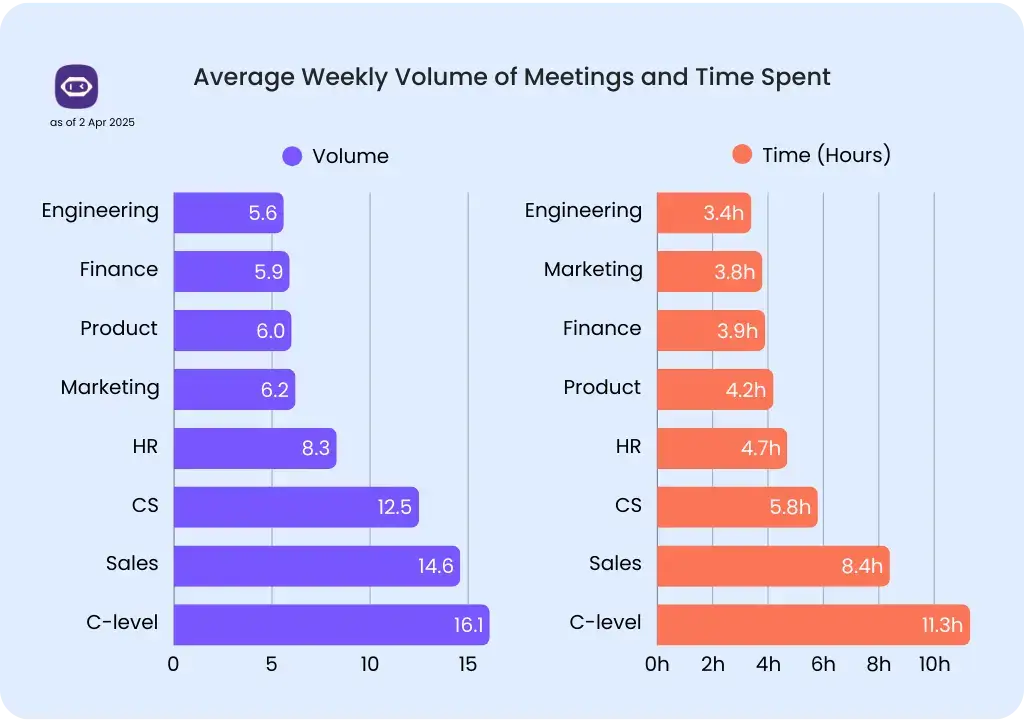
The average is what hides the problem. Customer Success runs the shortest calls at 28 minutes and the second-highest volume at 12.5 a week, which means a large number of short check-ins clustered near the floor even though the mean clears it. The same is true of any team with a daily standup.
So the 15-minute rule is not a departmental verdict. It is a meeting-type verdict, and the meetings it rules out are precisely the recurring short ones that repeat most often in a week.
Why Is Google Meet Not Taking Notes?
Nearly every case of missing Gemini notes comes down to 1 of 3 things. The notetaker was never available on your account, it never actually ran during the call, or the doc exists somewhere you have not looked.
Before the Call
Google documents exactly 3 reasons the control cannot be selected, and the third is the one nobody looks at.
- Ineligible edition. Business Starter and Enterprise Starter accounts never see the option, whatever else is configured. Google words this as the organizer's edition, not yours.
- Switched off by an admin. The control sits in the Admin console and can be disabled for a single organizational unit rather than the whole domain.
- Smart feature control is disabled. This is the third reason on Google's own list and it is easy to miss, because it lives in your Google account's smart-features settings rather than anywhere in Meet.
Three more block it in practice.
- Personal account. Outside Workspace, the feature needs an eligible Google AI plan.
- Host management enabled. Only the host and co-hosts can start notes, so a guest clicking will not help.
- Consent not given. Where an admin requires explicit consent, capture does not begin until participants clear the prompt.
During the Call
- No pencil icon. Nobody started notes. The icon shows to all participants whenever the feature is running.
- Language outside the supported 8. If the call switched languages mid-way and nobody accepted the 30-second prompt, that stretch was heard in the wrong language.
- Stopped and never resumed. Summary so far keeps showing its last text, which reads exactly like a feature still working.
- Phone or tablet. Summary so far is unsupported on iOS and Android, so its absence there is not a fault.
- Dropped connection. Gaps in the call audio become gaps in the notes.
After the Call
- Under 15 minutes. A very short summary, or none, is the expected result rather than a bug to report.
- Wrong folder. Since July 2026 the doc lands in the Google Meet folder, not the one now called Legacy Meet Recordings.
- Vault retention. The policy may have removed the doc already, so ask whoever owns retention rather than the organizer.
- Never shared with you. Sharing follows the calendar invite, and a group email does not pass access to its members.
- Flagged content. Google does not produce a summary for a call that breaches its Acceptable Use Policy.
Where Gemini's Notes Stop
The doc is the last stop. Gemini writes it, files it, emails it, and the sequence ends there.
That is enough when the follow-up is a person reading a recap. It is a gap when the meeting was meant to move something: a renewal date into the customer record, a candidate scorecard into your ATS, an onboarding checklist opened for a new hire.
Coverage is the second edge. Gemini's notes exist only inside Google Meet, so a Zoom or Microsoft Teams call in the same week leaves nothing in the same archive.
MeetGeek closes both gaps for the teams that need them, and it works with any Google Meet account, free or paid, so the edition gate at the top of this guide does not apply to it. A Business Starter domain gets the same capture as an Enterprise Plus one.
There are 2 ways in. The Notetaker joins from your calendar as a participant, including meetings you did not organize, where the host still admits it like any other guest. The Chrome Recorder captures straight from the browser tab instead, without joining, for the calls where you would rather nothing appeared in the participant list at all.
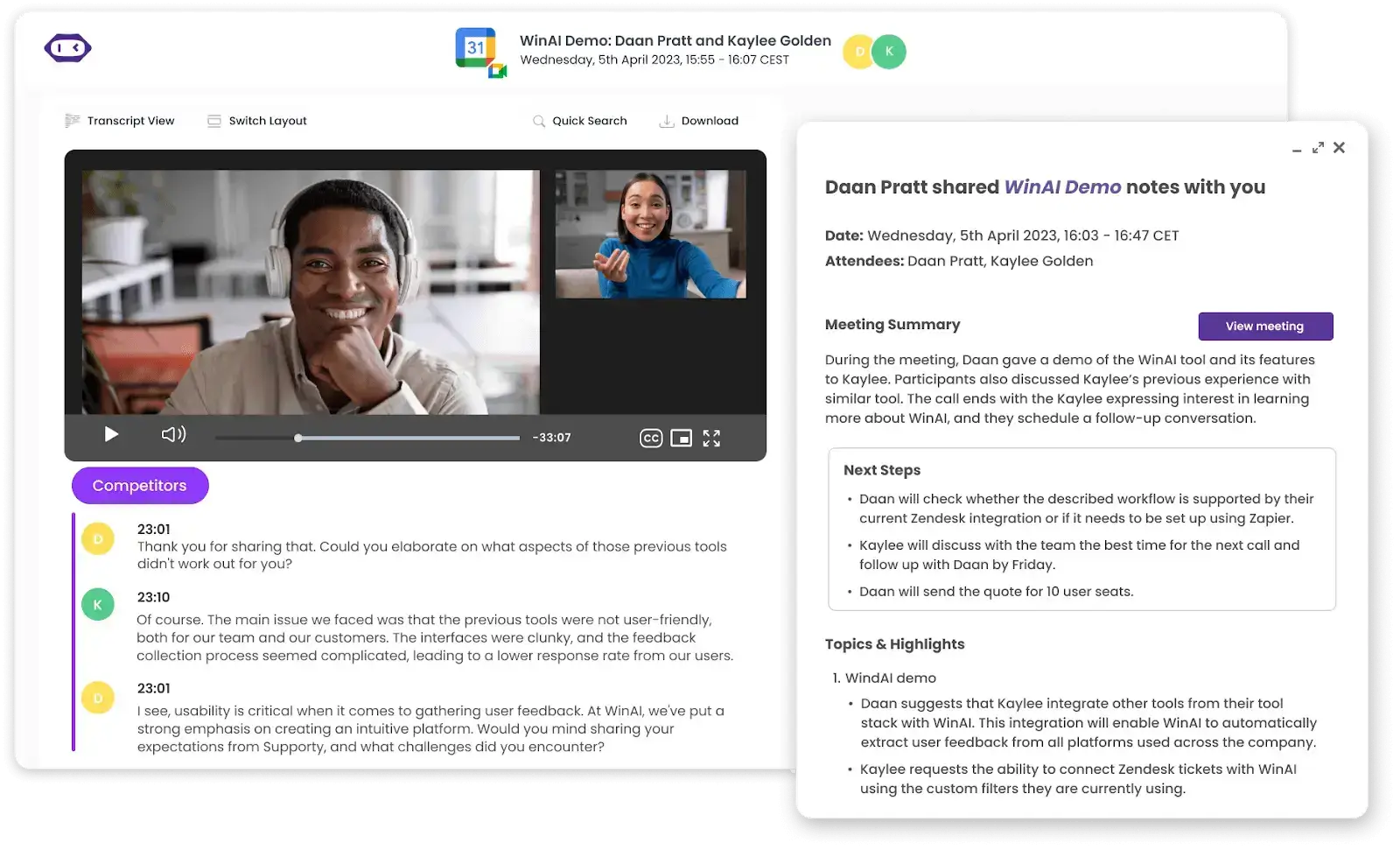
Structured AI meeting minutes then route themselves into your CRM, your issue tracker or the right Slack channel, and calls on other platforms land in the same searchable place. That is the practical difference between a notetaker that files a doc and one that closes the loop.
If your edition rules you out, or the notes need to end up somewhere other than Docs, you can try MeetGeek free on your next Google Meet call.
Key Takeaways
- Take Notes for Me is included with Business Standard, Business Plus, Enterprise Standard, Enterprise Plus, Frontline Plus and the Google AI Pro for Education add-on. Business Starter and Enterprise Starter are excluded, and a personal account needs an eligible Google AI plan.
- The organizer's edition decides whether notes are possible, not the edition of whoever clicks.
- It covers 8 languages, 1 per meeting. Google states that multiple languages in the same meeting are not supported, and offers a manual switch only after a second language has been spoken for 30 seconds.
- There are 3 ways to turn it on: from the Calendar event, from the Meet Greenroom, or inside the call.
- Note-taking runs on desktop, Android, iPhone and iPad. Summary so far is desktop only, on both iOS and Android.
- Google recommends meetings of 15 minutes to 8 hours, which is wide enough to rule almost nothing out. The 15-minute floor is the half that matters, and the 8-hour ceiling appears only on the Computer tab. MeetGeek's own data, from the teams that use it to record their calls as of April 2, 2025, puts average meeting length across 8 departments at 28 to 42 minutes, so the calls the floor rules out are the recurring short ones rather than a whole function.
- From September 21, 2026, automatic note-taking is on by default for Business Standard and Business Plus, for meetings with 3 or more people. Enterprise Standard, Enterprise Plus and Frontline Plus stay off by default.
- Notes save to the organizer's Drive in the Google Meet folder introduced in July 2026, reach whoever enabled the feature by email, attach to the Calendar event, and follow your Vault retention policy.
- The doc is where Gemini stops. Nothing is created in a CRM, an ATS or a tracker, and nothing outside Google Meet is captured at all.
Frequently Asked Questions
Does Google Meet Have an AI Note Taker?
Yes. Google Meet has a built-in AI notetaker called Take Notes for Me, powered by Gemini, which writes a summary with decisions and action items into a Google Doc and saves it to the organizer's Drive. It is included with 5 Workspace editions and 1 education add-on, and nothing joins the call as a participant to provide it.
Does Google Meet Have an AI Summary?
Yes. The doc that Take Notes for Me produces is a summary of the call, with decisions and suggested next steps rather than a full transcript. During the meeting, Summary so far gives a running version for anyone who joined late, on desktop only.
Is Take Notes for Me Included in Google Workspace Business Starter?
No. Business Starter and Enterprise Starter are both excluded. The feature is included with Business Standard, Business Plus, Enterprise Standard, Enterprise Plus, Frontline Plus and the Google AI Pro for Education add-on, and on a personal Google account it requires an eligible Google AI plan.
Does Take Notes for Me Cost Extra?
No, not as a separate line item. It is bundled into the editions listed above rather than sold as an add-on, so the cost sits in the plan price. Our breakdown of Google Meet pricing by plan shows what each tier costs and what else moves with it.
Is There a Free Way to Get AI Notes in Google Meet?
Yes, through a third-party note taker with a free tier, since Google's own feature has no free version outside the paid editions. Several tools cover Google Meet at no cost with monthly limits on transcription hours, and our ranking of the best AI note takers for Google Meet compares what each free plan actually allows.
How Do I Turn On Gemini Notes in Google Meet?
There are 3 routes. In the call, click Take notes for me at the top right and select Start taking notes. Before the meeting, tick Take notes with Gemini under Video call options, then Meeting records, in the Calendar event. You can also start it from the Meet Greenroom. A pencil icon then appears for every participant.
Why Is Take Notes for Me Greyed Out or Missing?
Google lists 3 reasons: the meeting organizer is on a Workspace edition that does not include it, your admin has turned it off, or smart feature control is disabled in your Google account settings. Host management adds a fourth in practice, because it limits starting notes to the host and co-hosts.
Which Languages Do Google Meet AI Notes Support?
8: English, French, German, Italian, Japanese, Korean, Portuguese and Spanish. Gemini uses 1 language per meeting, and Google states that multiple languages in the same meeting are not supported. If a second language runs for at least 30 seconds, you get a prompt to switch, and the switch is manual.
Does Take Notes for Me Work on Mobile?
Note-taking works on desktop, Android, iPhone and iPad. Summary so far does not, because Google's help pages state that live summary so far is unsupported on both iOS and Android, so in-call catch-up stays a desktop feature.
Where Do Google Meet Gemini Notes Get Saved?
In the meeting organizer's Drive, inside a Google Meet folder with a sub-folder for each meeting. The doc is attached to the Calendar event and retained under your organization's Meet policy in Google Vault. Access follows the calendar invite, and a group email does not pass access to its members, who each need the doc shared individually.
What Happens to Google Meet Notes on September 21, 2026?
Automatic note-taking turns on by default for Business Standard and Business Plus, for meetings with 3 or more people. Enterprise Standard, Enterprise Plus and Frontline Plus stay off by default. Admins can change the setting in the Admin console before that date, and users can override it in their own Meet settings from the date itself.
How Short Can a Meeting Be and Still Get Notes?
Google puts the lower bound at 15 minutes. Shorter calls may produce an incomplete summary or none at all, so a 10-minute standup is not a reliable candidate for the feature.
Take Notes for Me is a sound default for the Workspace teams it covers. The moment your edition, your languages, or your downstream tools sit outside it, the boundary is the one this guide has mapped.





.avif)