

- Zoom AI is the new name for Zoom AI Companion since June 2026. It includes meeting summaries, in-meeting questions and My Notes.
- Since October 19, 2026, My Notes can send meeting summaries to apps such as HubSpot, Salesforce and Notion.
- Coming next: Enriched Notes in November 2026, Follow the Meeting and a standalone My Notes app in December 2026 and a Live Meeting AI Agent in Q1 2027. Dates can change.
- The free plan includes summaries for 3 meetings you host, 3 My Notes uses and 20 AI queries a month. Paid plans start at US$14.16 per user per month, billed annually.
- ZoomMate is a separate AI workspace. Its advanced actions cost US$16.67 per user per month, billed annually. You don't need it for meeting summaries.
- Only the host or a co-host can start or stop a meeting summary.
Zoom AI is the name for Zoom's built-in AI features, including meeting summaries, in-meeting questions and help drafting messages. Until June 2026, Zoom called them AI Companion. Free accounts get a small monthly allowance and paid Zoom Workplace plans include the main features at no extra cost.
Some of what Zoom announced at Zoomtopia 2026 is already out. Since October 19, My Notes can send meeting summaries to apps such as HubSpot, Salesforce and Notion and run follow-up workflows you describe in plain language. Next on Zoom's list are Enriched Notes in November, Follow the Meeting and a standalone My Notes mobile app in December and a live meeting agent in Q1 2027.
This guide covers what's new, what each part costs and how to turn it on, use it and turn it off.
What Is Zoom AI (Formerly AI Companion)?
Zoom AI is Zoom's built-in AI, which Zoom called AI Companion until June 2026. The table below shows how the four names you'll see fit together. Zoom's announcement says the AI Companion features are now built into Zoom Workplace and "called by what they do now". Many university and third-party help pages still use the old name.
| Name | What it is | Access |
|---|---|---|
| AI Companion | Old name for Zoom's built-in AI, retired in June 2026 | No longer used |
| Zoom AI | Built-in AI: meeting summaries, questions and writing help | Included with paid plans; limited on free |
| My Notes | AI note taker for Zoom, Teams, Google Meet and in person | Included with paid plans; also sold alone |
| ZoomMate | AI workspace for searching apps, running workflows and creating documents | Partly included; advanced actions paid |
Table last updated: October 27, 2026.
Some ZoomMate features come with Zoom Workplace plans, including the free Basic plan. Advanced actions need a paid ZoomMate license and AI credits.
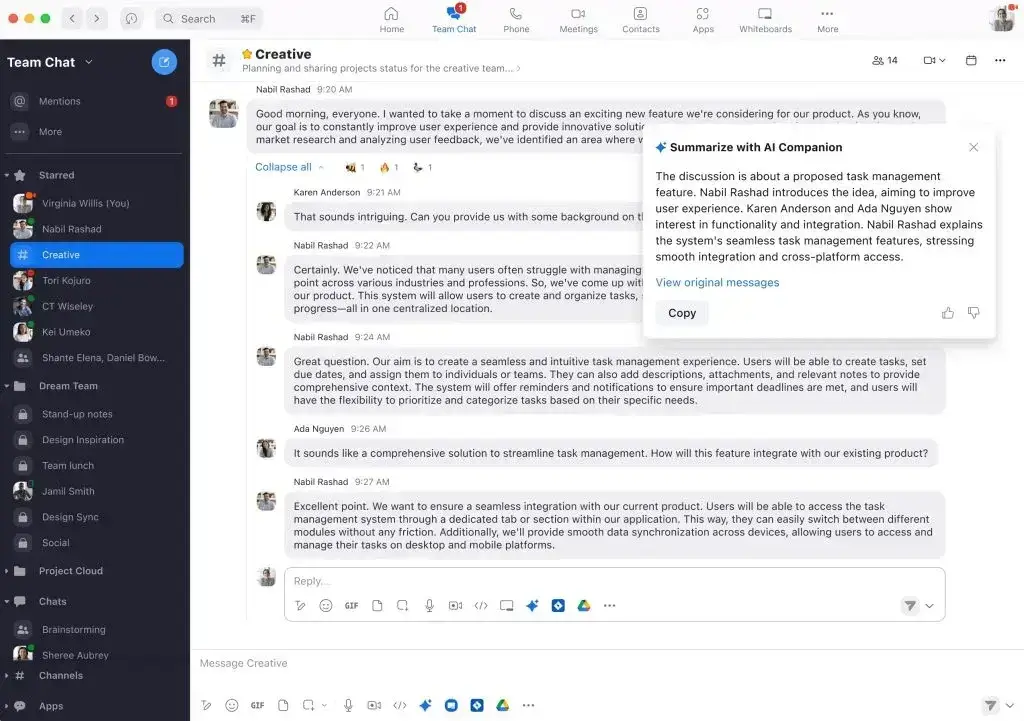
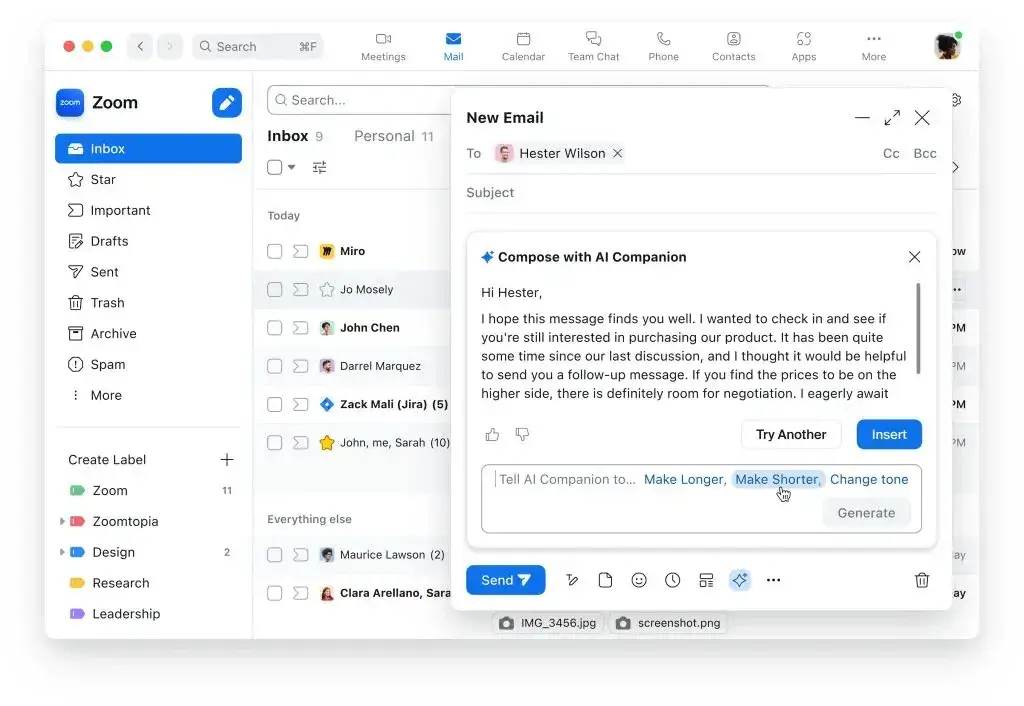
Outside meetings, it also helps draft and summarize messages in Zoom Team Chat, write emails in Zoom Mail, structure your Zoom Notes and summarize Zoom Phone calls and voicemails. For a side-by-side of ZoomMate with a standalone note taker, see ZoomMate vs Granola.
What's New in Zoom AI: Zoomtopia 2026 Announcements
At Zoomtopia on October 20, 2026, Zoom announced a new set of AI features. Some of them came out in Zoom's October 19 release, the day before Zoomtopia. For the rest, Zoom has announced expected launch dates, which can still move.
Already Available
- Workflows you describe in plain language: since the October 19, 2026 release, you can describe a follow-up task in My Notes and Zoom builds the workflow, according to Zoom's ZoomMate release notes.
- Summaries sent to other apps: the same release lets you send My Notes summaries to HubSpot, Salesforce, Notion, Google Drive, OneDrive, Confluence and Dynamics 365, among others. The release notes don't say which plans include this, so check your license.
- Agent teams in ZoomMate: with the paid ZoomMate plan, several specialized AI agents can split a task and hand the result to you for review.
- Voice translator: translates what you say for other participants during a meeting, with the Live Translation add-on or ZoomMate.
Coming Next
| Feature | What it does | Expected |
|---|---|---|
| Enriched Notes | Links slides, shared screens and chat to the transcript | Nov 2026 |
| Translate Me | Translates your speech in a synthesized version of your own voice | Oct 2026 |
| Zoom in AI assistants | Use supported Zoom features from Claude, Codex, Copilot and Muse | Oct 2026 |
| DTEN Action Card | Records in-person conversations with a portable device | Nov 2026 |
| Zoom workflows from Claude and Codex | Launch Zoom workflows from either assistant | Nov 2026 |
| Follow the Meeting | Transcript and summary for people who missed the meeting | Dec 2026 |
| Standalone My Notes app | Records and transcribes in-person talks without Zoom Workplace | Dec 2026 |
| Central AI management | One place for admins to control AI | Dec 2026 |
| Live Meeting AI Agent | Answers questions and keeps the meeting on track, live | Q1 2027 |
| My Notes on Bota | In-person notes with Bota hardware | Q1 2027 |
| AI guardrails | Rules on what AI can create or use | Q1 2027 |
Table last updated: October 27, 2026.
Zoom AI Pricing: What Is Free?
Prices are in USD, verified on October 27, 2026:
- Workplace Basic (free): meeting summaries and in-meeting questions for 3 meetings you host, 3 uses of My Notes and 20 AI queries a month. Basic meetings stop at 40 minutes;
- Paid Workplace plans (Pro, Business, Enterprise): from US$14.16 per user per month billed annually. Zoom's pricing page lists unlimited meeting summaries, unlimited AI note-taking and unlimited AI queries (questions you ask the AI) on Pro and Business;
- My Notes on its own: from US$8.33 per user per month billed annually;
- Paid ZoomMate plan: US$16.67 per user per month billed annually, or US$20 billed monthly, with 2,200 AI credits per user per month, which each advanced action uses up. Larger tasks, such as building a document, use more credits.
AI search across apps, workflows and credit-based actions have their own limits on each plan. On a company account, check your assigned license as well as the organization's plan. For the full plan-by-plan breakdown, see our guide to Zoom pricing plans.
How to Turn On Zoom AI
- Check your plan and license
- Update the Zoom Workplace app
- Open your AI settings
- Switch on the features you want
Step 1: Check Your Plan and License
Use the pricing section above to see what your plan includes. On a work or school account, your admin decides which AI features you can use, for the whole account or for specific groups.
Step 2: Update the Zoom Workplace App
Make sure you're on a recent version of the Zoom Workplace app. For full My Notes functionality, use version 6.7.5 or later on desktop or 7.0.3 or later on mobile. The ZoomMate tab needs version 7.0.5 or later on desktop.
Step 3: Open Your AI Settings
Sign in to the Zoom web portal, click Settings in the left-hand menu, then open the Zoom AI tab. This tab replaced the old AI Companion tab. If a setting is greyed out, an admin has locked it, so ask your IT or support team.
Step 4: Switch On the Features You Want
Each feature has its own toggle, so you can turn on meeting summaries and meeting questions and leave the rest off. You'll then find its button in:
- the Zoom Meetings toolbar;
- the Zoom Team Chat window;
- other Zoom tools, such as Zoom Whiteboard and Zoom Phone.
You may also see a ZoomMate tab, depending on your account permissions and settings. Access to the tab does not mean every ZoomMate feature is included in your plan.
Start a Meeting Summary
Turning a feature on in settings doesn't start it. To get a summary of a meeting you host on desktop:
- Start the meeting in the Zoom Workplace app.
- Hover over the Zoom AI icon in the top-right corner of the meeting window.
- Check Meeting summary.
- Click Start Zoom AI.
Hosts can also set the summary to start automatically. If you stop and restart it, the summary covers the parts of the meeting when it was on. After the meeting, you can find the summary under Summaries in the web portal. Delivery to participants depends on the host's sharing settings. Participants need to be signed in to Zoom to receive it automatically.
How to Turn Off Zoom AI (Formerly AI Companion)
How you turn it off depends on whether you're switching it off for yourself, for your organization or for a meeting in progress.
For yourself:
- Sign in to the Zoom web portal and click Settings.
- Open the Zoom AI tab.
- Switch off the features you don't want, such as meeting summaries or meeting questions.
Greyed-out toggles are set by your admin.
For your whole account (admins):
- Sign in to the Zoom web portal as an admin.
- Click your profile picture, then Admin Center.
- Click Settings, then Zoom AI.
- If your account has the Allow Zoom AI on this account toggle, switch it off and click Save. Otherwise, switch off the features individually, such as Meeting Summary with AI.
To change the settings for one group only, go to Admin Center, then Users, then Groups. Click the group, then Edit product settings and open Zoom AI.
During a meeting: to stop the meeting summary during a call, hover over the same icon, uncheck Meeting summary and confirm. Hosts and co-hosts control this feature. Turning features off in your own account doesn't turn them off in someone else's meeting, so if you're a participant, ask the host. Hosts can also stop My Notes transcription in their Zoom meetings from Host tools, then Advanced, then My Notes.
How to Turn Off ZoomMate
ZoomMate has its own switch on the same Zoom AI tab. In the ZoomMate section, turn off Show ZoomMate. This hides ZoomMate only and leaves the other AI features as they are. Admins can change it for the whole account or a group. Users can change it in their own Settings if the admin hasn't locked it. Zoom's help page on conversational AI lists the steps for each level.
Zoom AI Features for Meetings
It helps you before, during and after the call.
A. Before the Meeting
Preparing usually means setting an agenda and reviewing notes from previous sessions. It helps with the second part:
- Catching up: open the summaries of earlier meetings under Summaries in the web portal, or ask the AI a question about them, to review past decisions and action items before you join.
B. During the Meeting
Once the meeting starts, it works in the background so you can follow the conversation:
- Meeting questions: if meeting questions are turned on, you can privately ask what's happened so far or whether your name was mentioned.
- Note-taking with My Notes: My Notes takes notes and tracks key points and action items as they come up. It also works in Teams, Google Meet and in-person conversations. Taking notes in Teams or Google Meet calls is not supported from the Zoom mobile app. On desktop, My Notes needs access to your microphone and system audio.
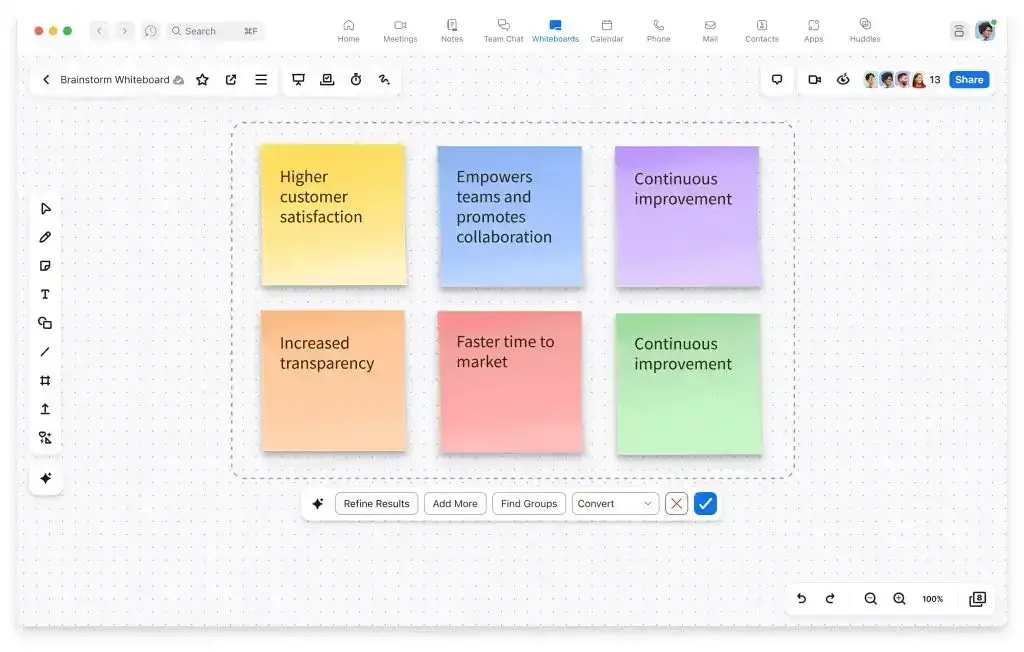
- Whiteboard content: if you're using Zoom Whiteboard for brainstorming sessions or planning, Zoom Whiteboard AI can generate and organize content from your prompts or existing whiteboard content.
C. After the Meeting
After the meeting, it can help with:
- Meeting summaries: the summary includes action items and is saved for the Zoom host, who can share it with participants and with anyone who couldn't attend.
- Smart recordings: for meetings recorded to the cloud, Zoom marks the highlights, splits the recording into chapters with short titles and suggests next steps below the video.
- Sharing outside Zoom: My Notes summaries can go to other apps (see What's New above). Zoom also lists automatic Slack delivery with the paid My Notes plan. More advanced workflows across third-party apps are part of the paid ZoomMate offering.
Zoom AI, My Notes and MeetGeek Compared
If all your meetings run in Zoom and you mostly need a summary after the call, a paid Zoom plan covers that well. My Notes also supports Teams, Google Meet and in-person conversations, although capture options depend on the device and app. Here's how the options compare on AI questions, follow-up work and price.
| Zoom paid plan | My Notes alone | MeetGeek | |
|---|---|---|---|
| Ask AI about meetings | Unlimited AI queries | Unlimited AI queries (ZoomMate web) | AI Chat, free plan |
| Send notes to other apps | Depends on feature and license | Slack, automatic | Paid plans |
| Price to start | US$14.16 | US$8.33 | Free, 3 hours a month |
Table last updated: October 27, 2026.
Zoom's October 19 release added destinations for My Notes summaries, but the release notes don't say which licenses include them. Zoom prices are the starting price per user per month, billed annually. MeetGeek's free plan includes 3 hours of transcription a month. On paid plans, MeetGeek for Zoom can send meeting information to your CRM and other apps and automate follow-up tasks once you connect them and set up a workflow. Native integrations include HubSpot, Salesforce, Notion and Slack. MeetGeek also connects to Zapier, Make and n8n. Paid plans also include 30+ summary templates and automatic meeting-type detection.
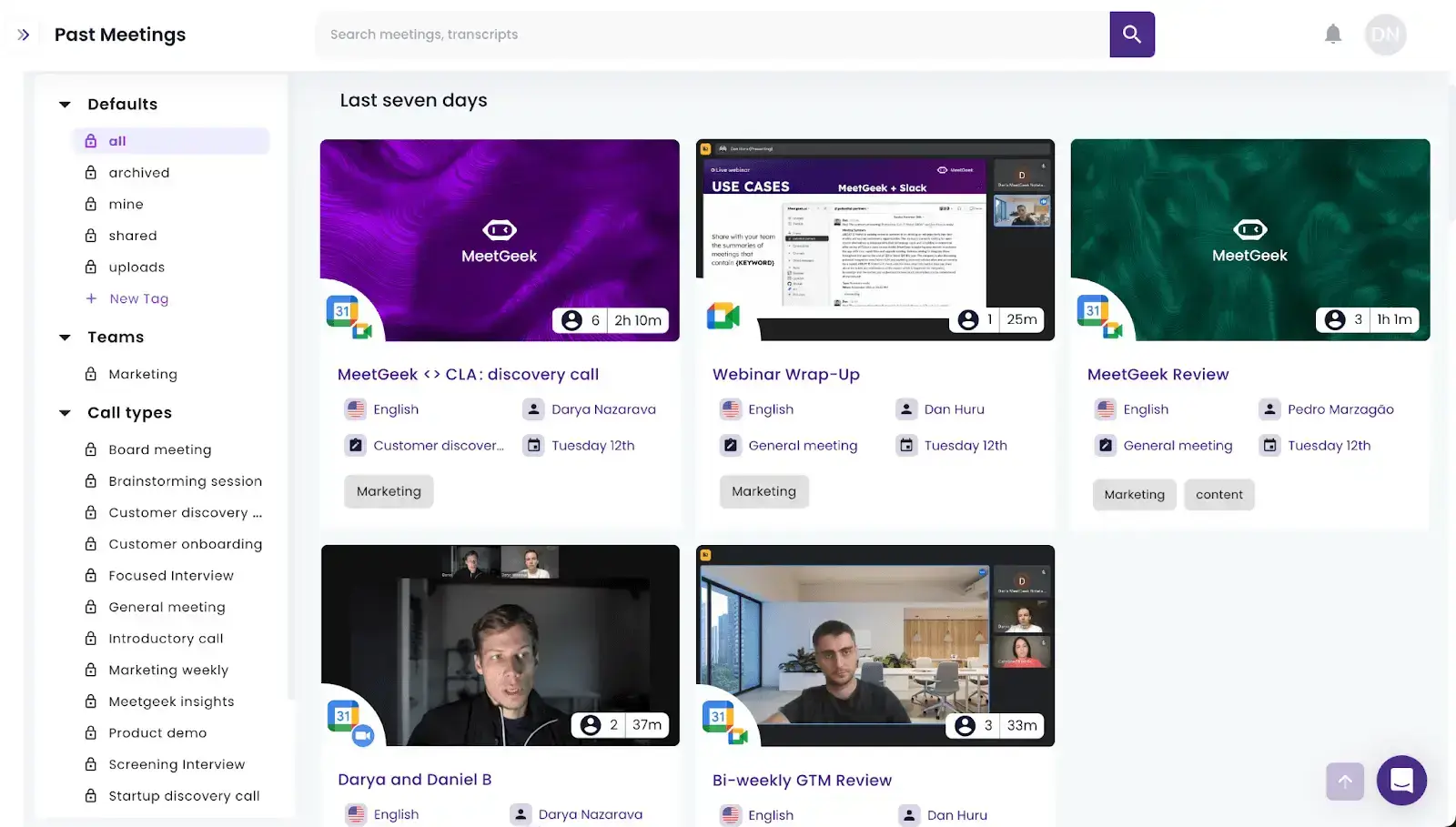
You can try it on a free account: connect your calendar, let MeetGeek record and transcribe your next Zoom call, then ask AI Chat what was decided. If you're comparing more note takers for Zoom, our guide to the best AI note takers for Zoom covers the main options.
Frequently Asked Questions
How Much Does Zoom AI Cost?
The built-in features are free with limits on Workplace Basic and included with paid Workplace plans, which start at US$14.16 per user per month billed annually. The paid ZoomMate plan, for advanced actions, costs US$16.67 per user per month billed annually. The pricing section above lists the limits for each plan.
When Will the New Zoom AI Features From Zoomtopia 2026 Be Available?
Some already are. Zoom's October 19, 2026 release added plain-language workflows in My Notes and sending summaries to apps such as HubSpot, Salesforce and Notion. Zoom's targets for the rest are Enriched Notes and the DTEN Action Card in November 2026, Follow the Meeting and the standalone My Notes mobile app in December 2026 and the Live Meeting AI Agent in Q1 2027. Targets can move, so check Zoom's release notes before relying on a feature.
What Are the Limitations of Zoom AI?
The free plan includes meeting summaries and in-meeting questions for 3 meetings you host a month, plus 3 My Notes uses and 20 AI queries. Only the host or a co-host can start or stop a meeting summary. Meeting summary isn't available in breakout rooms. My Notes can't take notes in Teams or Google Meet calls from the mobile app. Like any AI notes, summaries and action items can contain mistakes, so review decisions before you share them.
What Is the Difference Between Zoom My Notes and Zoom AI?
Zoom AI, formerly AI Companion, is the name for all of Zoom's built-in AI. My Notes is one feature within it: a personal AI note taker that works in Zoom, Teams, Google Meet and in-person conversations without a bot. In Zoom meetings, the host can stop My Notes transcription from Host tools. Meeting summary is a separate feature that works in the Zoom meetings you host.
Is ZoomMate the Same as Zoom AI Companion?
No. ZoomMate is a separate AI workspace, launched in June 2026, for searching across Zoom and connected apps, running workflows and creating documents. Some ZoomMate features come with Workplace plans, but advanced actions need a paid ZoomMate license and AI credits. The built-in features that used to be called AI Companion are still included with paid Zoom plans.
Does Zoom Use My Meetings to Train Its AI?
No. Zoom's data handling page says it doesn't use your audio, video, chat, screen sharing or other communications to train Zoom's or third-party AI models. Zoom still processes the content each feature needs and may share it with the AI providers it works with.