



An AI note taker for in-person meetings records the conversation in the room through your phone, laptop, or a dedicated device, then turns that audio into a transcript, a summary, and assigned action items, with no bot and no video call involved.
Most reviews of AI note takers focus on Zoom and Teams, yet 52% of remote-capable U.S. employees work hybrid (Gallup Hybrid Work Indicator, February 2026 data). The conference-room conversations that shape real decisions are the ones most likely to leave no record.
Capturing them raises its own questions: phone, laptop, or a device on the table? A live transcript during the meeting, or clean notes right after? And how does consent work when there is no recording banner on a screen?
We tested 6 tools across 3 categories to answer that. One disclosure up front: MeetGeek is our product. It ranks first because that is where our testing put it for hybrid teams, but every tool below is judged on what it does best in the room.
The Best AI Note Takers for In-Person Meetings in 2026
| Tool | Format | Platforms | How It Captures the Room | Best For |
|---|---|---|---|---|
| MeetGeek | Mobile app + full meeting platform | iOS, Android (+ web) | One-tap recording or file upload, processed into notes | Hybrid teams that want in-person and online meetings in one repository |
| Otter | Mobile + desktop app | iOS, Android, Mac, Windows | Live transcription as the meeting happens | Real-time captions during the conversation |
| Fireflies | Mobile app + meeting platform | iOS, Android | Records and transcribes from the phone | Teams already running Fireflies for online calls |
| Granola | AI notepad | macOS, Windows, iOS, Android | Transcribes in the background while you type your own notes | People who still want to write notes themselves |
| Plaud | Hardware recorder + app | Devices + iOS, Android, desktop | Dedicated device (card or wearable pin) records, app processes | Phone-free, hands-free capture all day |
| Krisp | Mobile app + meeting assistant | iOS, Android | Record on the phone, upload, transcribe | Teams that already use Krisp noise cancellation |
Table last updated: July 15, 2026. Every claim was checked against the vendor's own website or documentation on that date.
1. MeetGeek: Best for Hybrid Teams That Meet Everywhere

MeetGeek treats an in-person conversation the same way it treats a Zoom call: one more meeting that should end up transcribed, summarized, and searchable in the same place. Of the tools we tested, it was the strongest all-round pick for hybrid teams, with one honest trade-off: no live transcript during the meeting.
Its mobile app for Android and iOS records face-to-face conversations with one tap, works offline, and also accepts uploads of audio or video you recorded elsewhere.
What makes MeetGeek strong for in-person meetings:
- One-tap capture for office meetings, client visits, conference talks, and interviews, with offline recording that syncs when you are back online.
- Transcription in 100+ languages with automatic language detection (per MeetGeek's pricing page, July 2026).
- AI meeting notes tailored to the conversation type: action items, key topics, and decisions rather than a raw transcript dump.
- The recording lands in the same workspace as your online meetings, so search, sharing, meeting templates, and automations apply to everything you capture.
- Downloads: MeetGeek for iOS and MeetGeek for Android.
Weakness: you record, tap Analyze, and the transcript and notes arrive a few minutes later. If you need real-time captions in the room, Otter handles that better.
Best for: hybrid teams that want one system of record for every conversation, online or offline, with strong summaries and automation downstream.
If your meetings happen in conference rooms as often as on video calls, you can test the full workflow on a free account.
2. Otter: Best for Live Transcription in the Room
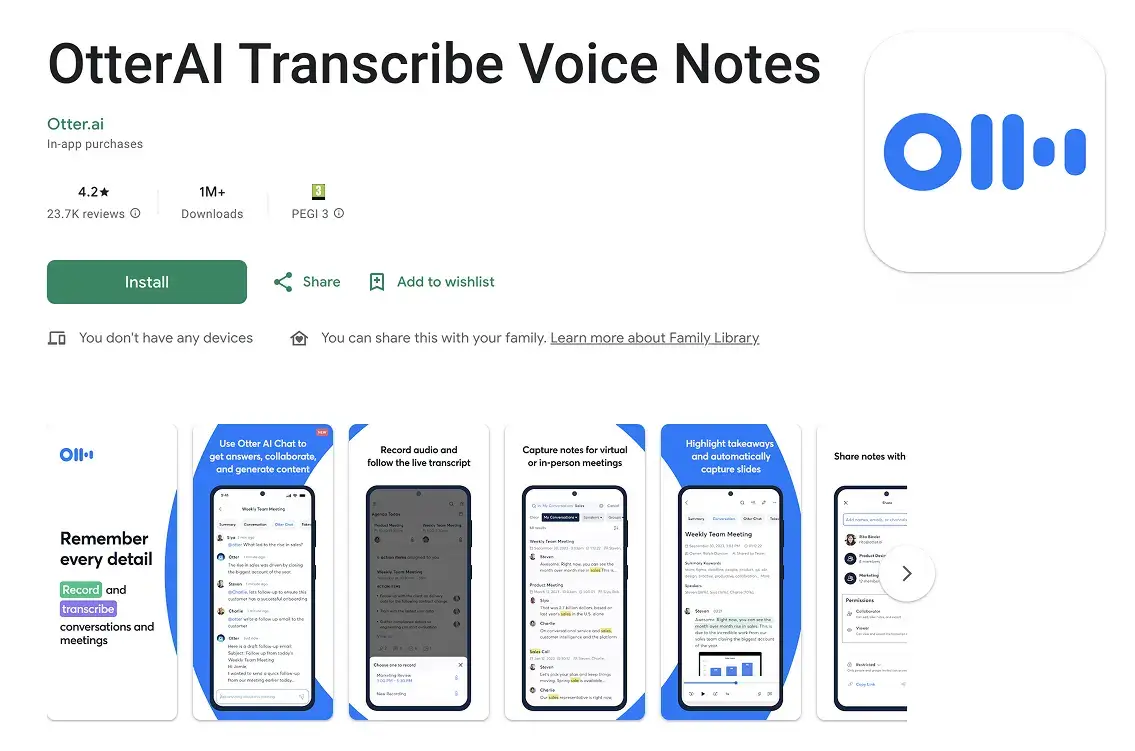
Otter's mobile app shows the transcript as people speak, which no other tool on this list does on a phone. That makes it the pick when you need to reference what was said 5 minutes ago while the meeting is still running, for example in interviews or lectures.
Otter's own site lists live transcription in 6 languages: English, French, Spanish, Japanese, German, and Mandarin (otter.ai, July 2026). Speaker identification runs during the recording, and you can highlight moments in real time. For a feature-by-feature look, see the MeetGeek vs Otter comparison.
Weakness: the language list is short compared to MeetGeek's 100+ or Plaud's 112, and community reviews consistently mention battery drain during long mobile recordings.
Best for: meetings where you need to see the words as they are spoken.
3. Fireflies: Best for Teams Already on Fireflies
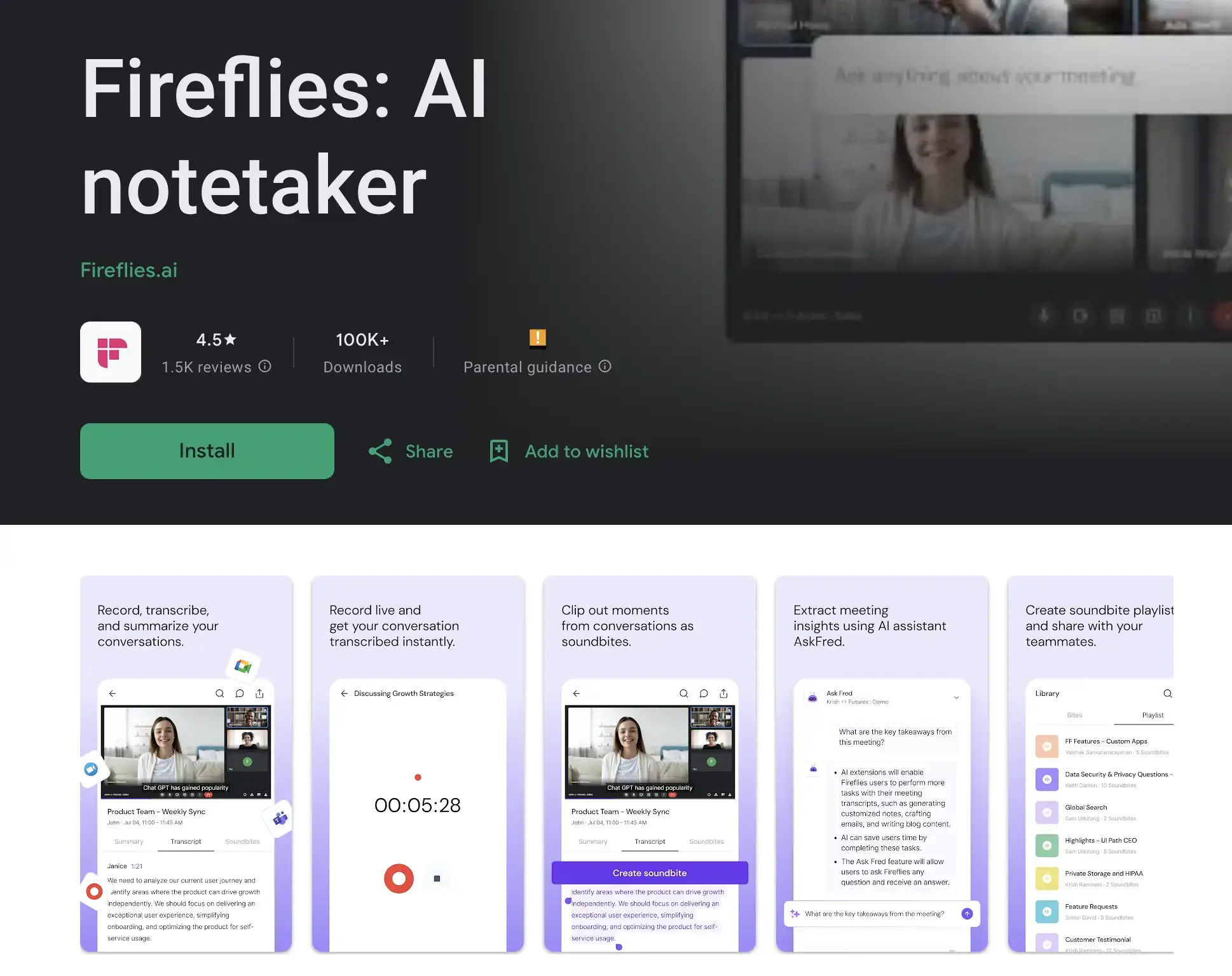
Fireflies positions its mobile app directly for this use case: record, transcribe, and summarize in-person conversations from your phone, with AI summaries and auto-assigned action items after each recording (fireflies.ai/mobile, July 2026).
Its AskFred assistant answers questions about past recordings, and notes flow into 100+ app integrations.
Weakness: Fireflies is a large platform, and users who only need in-person capture often find the interface heavier than a single-purpose recorder. If you are choosing between the 2 full platforms, the MeetGeek vs Fireflies comparison breaks down where each one wins.
Best for: teams that already run Fireflies for online meetings and want the same pipeline for offline ones.
4. Granola: Best if You Still Type Your Own Notes
Granola calls itself an AI notepad rather than a note taker, and the distinction matters in the room. You type short, rough notes during the conversation, and Granola transcribes the audio in the background, then merges both into a clean, structured note.
It runs on macOS, Windows, iOS, and Android, never sends a bot, and its site describes walking meetings, conferences, and coffee catchups as core use cases (granola.ai, July 2026).
Weakness: Granola is personal-notes-first. It is private by default, which many people like, but teams that want a shared, searchable meeting repository with analytics will outgrow it.
Best for: professionals who think by writing and want AI to fill the gaps rather than replace their notes.
5. Plaud: Best Dedicated Hardware for All-Day Capture
Plaud is the only entry here that is hardware-first. The Plaud Note ($159) is a card-sized recorder, the Note Pro ($189) adds better mics for larger rooms, and the NotePin ($159) and NotePin S ($179) are wearables for hands-free capture.
Recordings process through the Plaud app with transcription in 112 languages. AI plans run $99.99/year for 1,200 minutes per month or $239.99/year for unlimited transcription (plaud.ai, July 2026).
Weakness: it is a separate device to buy, charge, and carry, plus a subscription on top. A phone app does the same job for most people at no hardware cost.
Best for: heavy in-person schedules, such as sales reps, clinicians, and consultants who want to press one button and forget about their phone.
6. Krisp: Best for Krisp Users Extending to In-Person
Krisp built its name on noise cancellation and now offers an AI note taker with a dedicated in-person meetings workflow: record the conversation in the mobile app, upload it, and receive a transcript with speakers identified, a summary, and action items.
Its in-person page cites 96% transcription accuracy and support for 17 languages (krisp.ai, July 2026).
Weakness: in-person capture is upload-based rather than instant, and 17 languages is the narrowest published range on this list after Otter's live set.
Best for: teams already paying for Krisp who want in-person notes without adding another vendor.
How Do You Record an In-Person Meeting With AI?
Recording an in-person meeting with AI takes 4 steps, and the second one matters more than the tool you pick:
- Choose your capture method. A phone app (MeetGeek, Otter, Fireflies, Krisp), a laptop notepad (Granola), or a dedicated device (Plaud).
- Get consent and place the microphone. Tell participants you are recording, put the phone or device in the middle of the table, and keep it away from laptop fans and coffee machines. Audio quality drives transcript quality more than any AI model does.
- Record, then process. Some tools transcribe live (Otter, Granola); others process after you stop (MeetGeek, Krisp, Plaud). Either way you end with a transcript, a summary, and action items.
- Share and sync. Send the notes to participants and push action items into your task manager or CRM so the meeting produces follow-through, not just a file.
If you often start from existing recordings instead of live meetings, the same apps also work as a speech-to-text app for uploaded audio.
How to Choose an AI Note Taker for In-Person Meetings
4 criteria separate these tools more than their marketing does:
- Live vs. post-processed transcription. Live captions (Otter) help during the meeting; post-processing (MeetGeek, Plaud, Krisp) tends to suit people who want to stay present and read the notes after.
- Where the notes end up. A standalone meeting recording app leaves you with files. A platform like MeetGeek or Fireflies puts in-person notes in the same searchable repository as your Zoom, Google Meet, and Microsoft Teams meetings.
- Language coverage. Published ranges differ widely: 100+ for MeetGeek, 112 for Plaud, 17 for Krisp's in-person workflow, and 6 live languages for Otter. Check the vendor's own list against the languages your meetings actually happen in.
- Security and compliance. Look for SOC 2 Type II and GDPR compliance as a baseline, and a HIPAA BAA if you handle health information. Our vetting guide to HIPAA-compliant meeting transcription covers what actually qualifies.
Is It Legal to Record an In-Person Meeting?
Usually yes, with consent, but the rules depend on where you are. Some U.S. states require all parties to consent to a recording, others only one, and the EU adds GDPR obligations on top.
The safe habit is simple: announce the recording at the start of every meeting and get a verbal yes. For the full state-by-state and EU breakdown, see our guide on whether it is illegal to record someone without permission.
Key Takeaways
- Of the 6 tools we tested, MeetGeek was the strongest all-round pick for in-person meetings in hybrid teams, mainly because offline recordings land in the same repository as your online calls. If you need live captions in the room, Otter beats it on that axis.
- Pick by capture style: live captions (Otter), type-your-own notes (Granola), dedicated hardware (Plaud), platform extension (Fireflies, Krisp).
- Microphone placement and consent matter more than the AI model. A centered phone in a quiet room beats a better algorithm with bad audio.
- Verify language support and compliance (SOC 2, GDPR, HIPAA) on the vendor's own site; published ranges run from 6 to 112 languages.
FAQ
What Is the Best AI Note Taker for In-Person Meetings?
In our testing, MeetGeek is the best AI note taker for in-person meetings for most teams, because its mobile app records offline with one tap and delivers the notes into the same workspace as online meetings. Otter is the better pick if you need a live transcript on screen, and Plaud if you prefer dedicated hardware.
Can AI Take Notes During an In-Person Meeting?
Yes. An AI note taker records the room through a phone, laptop, or dedicated device and produces a transcript, summary, and action items. Some tools do it live (Otter, Granola), while others process the recording right after it ends (MeetGeek, Krisp, Plaud).
Do AI Note Takers Work Without Internet?
Some do. MeetGeek's mobile app records offline and syncs the transcription when you are back online, and Plaud devices store recordings on the hardware itself. Tools that transcribe live generally need a connection during the meeting, so check the vendor's documentation if you meet in dead zones.
Is There a Free AI Note Taker for In-Person Meetings?
Most tools on this list offer a free plan, including MeetGeek, Otter, Fireflies, Granola, and Krisp. Free limits change often and differ per tool, so compare them in our up-to-date roundup of the best free AI meeting note takers before committing.
Conclusion
In-person meetings are where relationships and decisions happen, and in 2026 they no longer need a designated scribe. Match the tool to how you meet: MeetGeek for a unified hybrid workflow, Otter for live captions, Granola for writers, Plaud for hardware, Fireflies or Krisp if you are already in their ecosystems.
Your next client lunch can end with notes, action items, and a follow-up draft already waiting.




.avif)