


tl;dv is an AI meeting recorder that joins your Zoom, Google Meet and Microsoft Teams calls, records the video, transcribes it in 30+ languages and writes up the notes afterwards. It has four plans, from a free tier to a custom Enterprise deal, and it prices in euros rather than dollars. The free plan is unusually generous about how much you can record, and unusually strict about how long it keeps it.
That mix is a big part of why so many teams ended up on it. It is also why 2026 has been a difficult year for the company: in August, a security researcher published a report showing that details about meetings across the whole platform could be pulled up by anyone with a tl;dv account. tl;dv has answered that report at length, and says nobody could reach the actual recordings or transcripts.
Should You Still Be Using tl;dv?
For plenty of teams, yes. tl;dv is a genuinely good recorder. You get unlimited video on every plan, including the free one, and a bot that shows up reliably on Zoom, Google Meet and Teams. The clip-and-timestamp workflow is quick to use, and hosting sits inside the EU by default. If that is what you hired it for, it still does the job.
What has changed is everything sitting around the recording. A researcher found that anyone with a tl;dv account could look up 181,874 meeting records belonging to other customers, including links to calls that were happening at that moment. We set out that report and tl;dv's answer to it in full further down.
If that changes what you expect from a recorder, this is where these tools differ. Two questions separate them: which plan lets you choose where your data is stored, and which plan puts a retention policy in writing. MeetGeek answers both on every plan, the free one included. You pick EU or US storage before anything is recorded, and SOC 2 Type II, GDPR and HIPAA cover you whether you pay nothing or run 200 seats.
None of that is locked behind a paid plan or a call with sales, and how meeting data is secured is published in full. Connect a calendar on the free plan, choose your region before the first recording, and see how it handles your own meetings. No card needed.
What Is tl;dv and How Does It Work?
tl;dv is a bot-based meeting assistant, which means it works by sending a participant into your call. You connect a Google or Outlook calendar, and from then on a tl;dv bot joins the meetings you have flagged.
It records them, writes a transcript, and turns that transcript into notes and action items once everyone has hung up. There is also a mobile app for iOS and Android, so you can record a conversation that happens in a room rather than on a call.
The name is a play on the internet shorthand "too long; didn't view", and it tells you what the product was originally for. Instead of sitting through an hour of recording to find the 90 seconds you actually need, you jump straight there using timestamps, highlights and clips.
Because it records on all three of the big platforms, it lands in the same bracket as every other AI notetaker on the market. Tools in that bracket rarely differ much on the recording itself. Where they pull apart is what happens to the recording afterwards, how long it stays around, and which country it stays in.
tl;dv Features
tl;dv is strongest at capture, and the higher you go up the plans, the more it turns into a tool for sales teams rather than a general notetaker.
Recording and Transcription
Recording is where tl;dv is hard to beat. Every plan gets unlimited video, including the free one, which almost nobody else offers. Transcription runs in 30+ languages by tl;dv's own count, and any single recording is capped at 3 hours no matter which plan you are on.
There is one limit that catches people out, which is how many meetings you can record from the web each week. That runs at 40 a week on Free, 80 on Pro, 120 on Business and 500 on Enterprise. Recording from the mobile app is unlimited on all of them.
If you need the better transcription engine, automatic detection of which language is being spoken, or meetings where people switch between languages, those all start on Business.
AI Notes and Ask AI
Free accounts get AI notes on 10 meetings and 10 Ask AI questions. Once you have used those up, the recording keeps working but the AI stops, which is a reasonable way to run a free tier as long as you know it is coming. Pro lifts both limits for anything you ask about a single meeting.
Asking a question across several meetings at once is a different feature, and that one stays capped at 5 questions until you reach Business. It is worth flagging because it is the feature that turns a pile of recordings into something you can actually search, and it is two plans up.
Business also brings scheduled AI reports, playbook monitoring and objection handling. That is the point where tl;dv stops being a notetaker and starts being a sales coaching product, which is great if you run a sales team and irrelevant if you do not.
Integrations and API
Pro is where tl;dv opens up: 5000+ integrations through Zapier, plus an MCP server, an API and webhooks. On the free plan you only get email and calendar connections, so if you want anything to land in your CRM or your task tracker, you will be exporting it by hand.
Storage and Retention
This is the line most free users miss, and it is worth slowing down on.
tl;dv gives free accounts unlimited recordings and unlimited storage, which sounds like your meetings are safe indefinitely. Separately, it sets the data retention period on the free plan at up to 3 months.
Those are two different promises. On a free account, the second one decides what you still have next quarter. Paid plans move retention to custom, so the constraint goes away once you are paying.
tl;dv Pricing in 2026
tl;dv charges per seat, per month, in euros, and it publishes both billing terms rather than hiding the monthly one. The annual prices carry the discount they advertise; the monthly prices are what you pay if you would rather not commit for a year.
| Plan | Billed annually | Billed monthly | What you get |
|---|---|---|---|
| Free | €0 | €0 | Unlimited recordings, 30+ languages, AI notes on 10 meetings, up to 3 months retention, 40 web recordings/week |
| Pro | €18 per seat/mo | €29 per seat/mo | Unlimited AI notes, 5000+ Zapier integrations, API, MCP and webhooks, custom AI templates |
| Business | €29 per seat/mo | €39 per seat/mo | Premium and multi-language transcription, multi-meeting AI insights, playbooks, team automations |
| Enterprise | Custom | Custom | SCIM, custom SSO, privately hosted AI, org activity logs, dedicated success manager |
Table last updated: August 18, 2026.
Two things are worth pointing out. The gap between paying yearly and paying monthly is unusually wide, because Pro works out 61% more expensive month to month than it does on an annual commitment. And the features most people are really comparing when they shop for a notetaker, which are searching across meetings and transcription quality in their own language, sit on Business rather than Pro.
What Users Say About tl;dv
tl;dv holds 4.7 out of 5 across 531 reviews on G2, and its own pricing page shows the same 4.7 figure.
What people like:
- the free plan gives away more than most;
- the bot is dependable at actually joining calls;
- cutting a clip out of a recording and sending it to someone takes seconds;
- the whole thing is easy to get running.
Common complaints we found:
- individual reports about how long support takes when an account needs fixing;
- AI limits that stop before the recording does.
One of those reports is worth reading in full, because it applies to any notetaker rather than just this one.
In June 2026, a customer on an annual 2 seat plan asked Trustpilot readers to learn from their experience. A routine request to change the email address on the account left them locked out of all their recordings for nearly two weeks. Their closing line: "even on a paid annual plan, a simple account change can leave you stranded from your own data for weeks."
Trustpilot carries very few tl;dv reviews, so read that as one person's experience rather than a trend.
The August disclosure also drew criticism in security communities, including a thread on r/netsec, where most of the discussion was about how long the issue stayed open rather than about the product itself.
The 2026 tl;dv Security Incident, Explained
In August 2026, a security researcher who goes by BobDaHacker published a report about a misconfigured database at tl;dv. Dark Reading covered it on August 4, 2026, and tl;dv published its own response the following day.
What the Report Found
tl;dv kept its meeting records in Google Firestore, and the rule that keeps one customer's records separate from another's was missing. According to the researcher's report, that meant anyone signed into a tl;dv account could look up meeting records belonging to any other account: 181,874 records from 84,312 users across 35,003 email domains.
Those records held the details around each meeting rather than the meeting itself: whoever set it up, the conference ID, the platform, whether it was recording, and the timestamps.
Roughly 1,000 meetings were marked as actively recording at any given moment. Dark Reading reported that the researcher was admitted to about 80% of the private meetings he tried to join, appearing under a name that looked like the notetaker bot people were already expecting.
The report also found more than 1,000 meetings that had been shared publicly, which exposed 715 invitee email addresses across 228 domains. It names affected accounts at government bodies in 23 countries, universities including Berkeley and the University of Tokyo, and companies including HubSpot, Confluent and Mitsui.
The disclosure went to tl;dv on January 28, 2026. The researcher says his follow-ups through the spring went unanswered, and that the issue was still open in July.
It is worth being precise about what this was. Nobody has claimed your recordings or transcripts were downloaded. What was reachable was the map: who is meeting whom, when, and on which link.
The Report and tl;dv's Response, Side by Side
| What the researcher reported | What tl;dv says |
|---|---|
| Meeting metadata was reachable across accounts | Acknowledges the exposure, and says the data was "strictly limited to metadata" |
| Conference IDs were included in those records, and Dark Reading reported joining roughly 80% of private meetings tried | Lists what was reachable as "meeting identifiers, conference IDs... and participant email addresses and domains" |
| The issue reported in January was still open in July | Says these were two separate attack vectors: the first "fully closed and validated months ago", the second fixed "within 24 hours of discovery" |
| No claim that recordings or transcripts were downloaded | Says recordings, transcripts, AI notes, account data and billing data could not be reached |
| Follow-ups went unanswered from late January onward | Its CTO: "I should have kept the researcher updated after his initial outreach earlier this year" |
| Firestore rules were the root cause | Says it is "immediately removing [Firebase] from our tech stack altogether" |
Table last updated: August 18, 2026.
tl;dv's security page lists SOC 2 Type II, GDPR and EU AI Act compliance, AES-256 encryption, hosting and storage inside the EU, and a choice of where the AI itself runs. We checked it on August 18, 2026, and there is no HIPAA claim on it. Both things can be true at once: a company can hold real certifications and still ship a database missing one rule.
What to Do If Your Team Uses tl;dv
Whichever version of the timeline you find more convincing, the same housekeeping is worth doing:
- go through your recordings and check which ones have public or link-based sharing turned on, since those were the ones that exposed invitee emails;
- change any recurring meeting links that were running during that period, because a room link that never changes is effectively a standing invitation;
- tell your team what your notetaker bot is actually called, since the join attempts worked on the assumption that nobody checks;
- ask whichever vendor you use where your meeting data is stored and how long they keep it by default.
If that last one is a question you have never actually put to a vendor, our guide to the security risks of AI note-takers covers consent, retention and who can see what.
tl;dv Pros and Cons
What works well:
- unlimited video recording on every plan including Free;
- a bot that reliably joins Zoom, Google Meet and Teams;
- a fast clip and highlight workflow;
- EU hosting out of the box;
- 5000+ Zapier integrations once you are on Pro.
What holds it back:
- the free plan only keeps your data for up to 3 months, and stops writing AI notes after 10 meetings;
- searching across several meetings at once waits until the €29 Business tier;
- transcription covers 30+ languages where several rivals cover more than 100;
- there is no HIPAA claim on the published security page.
What to Look for in a tl;dv Alternative
Four questions will narrow the field faster than a feature list:
- Which plan do storage region and retention start on? Nearly every vendor here offers both somewhere. What separates them is whether you get them on the free tier or have to sign an Enterprise contract;
- What does the free plan actually limit? Minutes, retention, AI usage and storage are four separate limits, and vendors mix and match them freely;
- How many languages, really? The published numbers below range from 6 to more than 100, which is the widest gap anywhere in this category;
- Can you search across meetings, not just inside one? Chatting with a single transcript is standard now. Asking a question of a whole quarter of calls is not.
5 Best tl;dv Alternatives in 2026
Disclosure: MeetGeek publishes this comparison and ranks first below. Every figure in the table comes from each vendor's own pricing page or help centre, so check our columns against the others rather than taking the ranking on trust.
| Tool | Free plan | Paid entry (annual / monthly) | Languages | Data residency | HIPAA |
|---|---|---|---|---|---|
| MeetGeek | 3 h transcription/mo, 3 months transcript storage | $9.99 / $15.99 per user/mo | 100+ | EU or US, all plans | Yes, all plans |
| tl;dv | Unlimited recordings, up to 3 months retention | €18 / €29 per seat/mo | 30+ | EU | Not published |
| Fathom | Unlimited recordings and storage | $16 / $20 per user/mo | 38 | US only | Yes |
| Fireflies | 400 min storage per seat, lifetime cap | $10 / $18 per seat/mo | 100+ | US, EU on Enterprise | Enterprise only |
| Otter | 300 min/mo, 30 min per conversation | $8.33 / $16.99 per user/mo | 6 | US only | Enterprise add-on |
| Grain | 20 meetings, 45 min cap on personal domains | $19 per seat/mo annual | 100+ | US only | Stated as applicable |
Table last updated: August 18, 2026.
1. MeetGeek

Best for teams that want a storage region choice and HIPAA without an Enterprise contract.
MeetGeek records and transcribes Zoom, Google Meet and Microsoft Teams in 100+ languages, then writes the summary, pulls out the action items and scores the meeting.
Two things set it apart in the context of this article. Every plan, the free one included, lets you choose whether your meeting data is stored in the EU or the US. And every plan comes with SOC 2 Type II, GDPR and HIPAA, plus a promise that your meetings are never used to train outside models.
Most of the tools on this page keep at least one of those behind an Enterprise deal.
It can also record without sending a bot into the call, using a Chrome extension or a desktop recorder, and that works on every plan including Free. If you have ever had a client whose policy bans third-party bots from the room, you will know why that matters.
On pricing, the free plan includes 3 hours of transcription per month with 3 months of transcript storage, and video storage starts on Business. Pro is $9.99 per user/month billed annually, or $15.99 billed monthly, and gives you 20 hours a month and unlimited integrations. Business is $17 annually or $27 monthly, with unlimited transcription, HD video recording and 12 months of video storage.
MeetGeek is used by 50,000+ teams across 100+ countries, with 20+ native integrations and 10,000+ connected apps through Zapier, Make and n8n. The full integrations directory lists what connects natively. If you want to check the compliance side yourself rather than take our word for it, the SOC 2 Type II attestation and the reports behind it live in the public security trust portal.
And if you have already narrowed it down to these two rather than shortlisting five tools, the full MeetGeek vs tl;dv breakdown goes through it feature by feature.
The free plan is enough to run the only test that really settles a decision like this, which is putting both tools on the same calls for a week. Switching a notetaker sounds like a big job and usually is not, because nothing has to move. You leave your tl;dv archive exactly where it is, connect the same calendar to MeetGeek, and let both bots sit in the same meetings.
After five or six calls you are comparing your own transcripts instead of two companies' claims about accuracy. You can see how the transcription handles the accents on your team, what the action items actually pull out, and whether your data ended up in the region you chose. That is a week of real evidence, for the cost of filling in a signup form.
2. Fathom

Best free plan of anything here.
Fathom's free tier gives you unlimited recordings and unlimited storage, and its own help centre describes that as free "forever". No other tool on this page comes close, and it is the main reason Fathom keeps turning up on shortlists.
If you do decide to pay, Premium is $16 per user/month annually or $20 monthly, Team is $15 or $19 per user with a 2 user minimum, and Business is $25 or $34.
On compliance, Fathom publishes SOC 2 Type II, HIPAA and GDPR, and says outright that it does not hold ISO 27001. Its help centre puts transcription at 38 languages, though the homepage still says 28 and an older pricing page says 25, so treat the number as a ballpark.
All Fathom data is stored in the United States, with no region choice on offer. Its bot-free desktop recording is a macOS beta and only handles meetings in English for now.
Where it falls behind tl;dv is control and depth: automatic retention policies are Enterprise-only. How Fathom compares on workflows covers the rest of it.
3. Fireflies

Best if you want it wired into everything else.
Fireflies publishes 100+ languages, integrations with more than 100 apps, and API access starting on the free plan, which makes it the easiest tool here to plug into a stack you already have. Pro is $10 per seat/month annually or $18 monthly, Business is $19 or $29, and Enterprise is $39 on an annual commitment only.
The free plan is where you want to read the fine print. Transcription is unlimited, but storage stops at 400 minutes per seat, and that is a lifetime cap rather than a monthly one, so a free account eventually fills up and stays full. Video capture starts on Pro at 720p and only reaches 1080p on Enterprise.
Fireflies publishes SOC 2 Type II and GDPR, and keeps HIPAA and a signed BAA for Enterprise customers. EU storage is available only through Enterprise private storage, with the processing still happening in the US.
The Fireflies.ai feature comparison goes through how the AI credits and meeting limits work.
4. Otter
Best if your meetings are live, collaborative and in English.
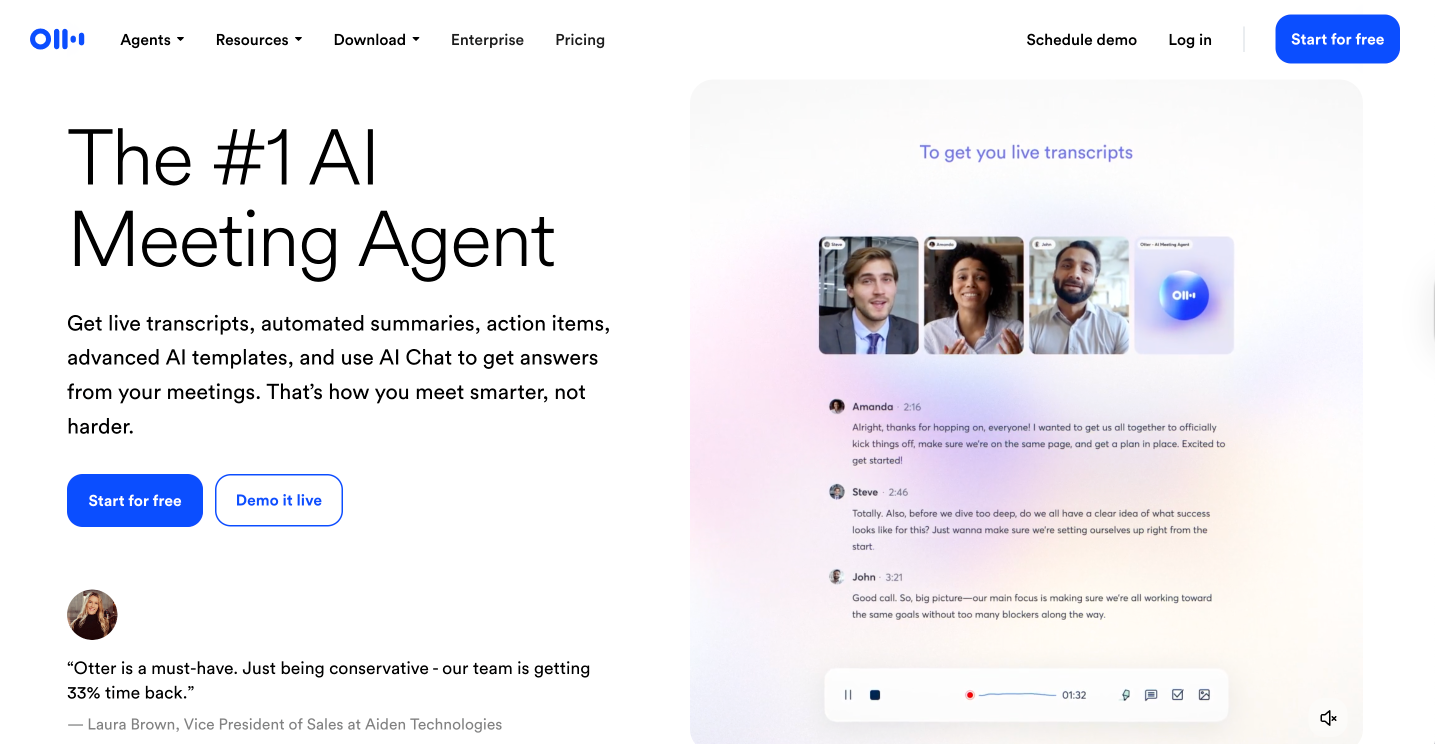
What Otter does better than most is the live experience. The transcript appears as people are talking and your team can follow along and comment during the call, and there is a desktop app that records without a bot on both Mac and Windows. Pro is $8.33 per user/month annually or $16.99 monthly, and Business is $19.99 or $30.
The catch is language coverage, and it is a big one. Otter's help centre lists 6 supported transcription languages: English, Spanish, French, German, Japanese and Chinese (Simplified). If your team spans more than that, this is where the shortlist ends.
The free plan gives you 300 minutes a month, with a 30 minute ceiling on any one conversation, and keeps only your 25 most recent. Video replay needs Business, data sits in AWS US West with no region choice, and HIPAA is an Enterprise add-on that requires a signed BAA.
For the plan-by-plan detail, have a look at the side-by-side with Otter.ai, or our breakdown of what Otter AI actually costs.
5. Grain

Best for turning calls into clips your team will actually watch.
Grain is built around highlights and clips that get pushed into a CRM, which suits sales teams who review calls rather than archive them.
The free plan covers 20 meetings, with a 45 minute limit per meeting if you signed up with a personal email address, and Starter is $19 per seat/month billed annually. Grain does not publish Business or Enterprise prices at all: its pricing page shows a demo request where the numbers would be, which we checked on August 18, 2026.
Video only gets recorded when the Grain bot joins the call. Its desktop recording mode gives you audio, a transcript and notes, but keeps no video. Grain publishes SOC 2 Type II and describes itself as complying with GDPR and HIPAA "where applicable", which is a phrase worth reading twice if compliance is the reason you are shopping. Everything is hosted on AWS in the USA.
Which One Should You Pick?
If tl;dv is working for you and the 2026 story has not changed how you feel about it, the better reason to move is more mundane than security. It is the 3 month retention on the free plan and the 30+ language coverage, and both of those are beaten elsewhere on this page.
If the story has changed how you feel about it, you only need two questions, and both have short answers. Which plan gives me a choice of storage region, and which plan gives me a retention policy in writing?
Out of the tools above, MeetGeek answers both on every plan, Fireflies answers the first one on Enterprise, and Fathom, Otter and Grain all store in the US only.
If you want to look wider than these five, our roundup of the best AI note takers compared puts 7 tools through transcription quality, summaries and pricing.
Key Takeaways
- tl;dv records unlimited video on every plan and transcribes in 30+ languages, with a 3 hour limit on any single recording;
- its free plan gives you unlimited storage but only keeps the data for up to 3 months, and stops writing AI notes after 10 meetings;
- Pro is €18 per seat/month billed annually and €29 billed monthly; Business is €29 and €39;
- a researcher report published in August 2026 found 181,874 meeting records that could be looked up across accounts, and tl;dv responded on August 5, 2026 that only metadata was reachable, that there had been two separate attack vectors, and that it is removing Firebase from its stack;
- the useful question to come out of all this is which plan gives you a choice of storage region and a retention policy in writing, rather than which vendor displays the most compliance badges.
Frequently Asked Questions
Is tl;dv Safe to Use?
tl;dv publishes SOC 2 Type II, GDPR and EU AI Act compliance, AES-256 encryption and EU hosting on its security page. In August 2026, a security researcher published a report showing that details about meetings could be looked up across accounts because of a misconfigured Firestore database. tl;dv responded on August 5, 2026. Its position is that only metadata was reachable rather than recordings or transcripts, that there had been two separate attack vectors and both are now fixed, and that it is removing Firebase from its stack.
Was tl;dv Hacked?
The report describes a misconfiguration rather than a break-in. The database was missing the rule that keeps one customer's records separate from another's, so anyone signed into a tl;dv account could look up meeting records belonging to other accounts. The researcher counted 181,874 records across 84,312 users and 35,003 domains. tl;dv says recordings, transcripts, AI notes, account details and billing data were never reachable.
Is tl;dv Free?
Yes. The free plan costs €0 and includes unlimited video recordings, unlimited storage, transcription in 30+ languages and the mobile app. AI notes stop after 10 meetings and Ask AI after 10 questions, web recording is limited to 40 a week, and your data is kept for up to 3 months.
What Does tl;dv Stand For?
It comes from the internet shorthand "too long; didn't view", which is a play on "too long; didn't read". The name is a description of the product's original job, which is getting you to the part of a recorded call you need without watching the whole thing.
How Much Does tl;dv Cost?
Pro is €18 per seat per month billed annually, or €29 billed monthly. Business is €29 billed annually, or €39 billed monthly. Enterprise pricing is custom. All prices are in euros, checked on August 18, 2026.
What Is the Best tl;dv Alternative?
It depends on what you are trying to solve. MeetGeek is our top pick for teams prioritising data residency, security controls and multilingual transcription. Fathom has the most generous free plan. Fireflies has the widest integration coverage. Otter is best for live collaboration in English. Grain is best if your team lives off clips from sales calls.




.avif)