


Image source: freepik on Freepik
Do you know what sets top sales performers apart from the rest? It’s all about motivation. Keeping your sales team motivated is key to pushing boundaries and reaching new heights.
That's why we've rounded up the best sales motivational quotes for this year. Whether you're using them to kick off your meetings or add some inspiration around the office, these quotes are perfect for getting your team ready to hit their goals.
How and Where Should You Use Sales Quotes?
Motivational quotes can be powerful tools in various aspects of sales, from meetings and training to overcoming challenges and closing deals.
Here’s how to use sales motivational quotes:
- Break the ice during sales meetings: Begin every sales meeting with a motivational quote to set a positive tone and get your team thinking big. It's a simple way to energize the room and engage everyone immediately.
- Support training sessions: Training sessions can sometimes be intense and information-heavy. Lighten the mood and summarize learning points by introducing relevant quotes that reinforce your message and make the process more memorable.
- Motivate in difficult times: The sales process can be tough at times, especially when the team faces rejection or falls short of targets. Strategic quotes can help the team to regain their confidence.
- Improve sales pitches: Encourage your team to use motivational quotes in their talk tracks and sales pitches. A well-timed, inspiring quote can resonate with clients, making the pitch more engaging and impactful.
- Highlight closing techniques: Use quotes that emphasize persistence, precision, and effectiveness to back up your key closing techniques during training or meetings. It’s a great way to underscore the importance of these skills in a memorable way.
- Create excellence: Quality performance starts with a positive attitude, dedication, and continuous improvement. Motivational quotes can serve as regular reminders for your team to strive for excellence in every interaction.
- Promote creative selling: Introducing quotes that focus on thinking outside the box and being different can boost creativity and innovation in selling. They inspire your team to find new ways to approach sales challenges and stand out in the market.
Learn How Your Team Runs Sales Meetings with MeetGeek!
To effectively manage your sales meetings and provide timely coaching without attending every call, you need to know how your team works. Look at their performance over the last month or quarter to get up-to-date data.
If you notice any deals moving unusually slowly or quickly, ask your team for more context. This helps you understand the details behind the numbers and gain better insights.
For a bird’s eye view of your sales process, MeetGeek offers a complete solution. MeetGeek is an AI sales assistant that automatically records, transcribes, summarizes, and follows up on each of your sales meetings.
Plus, it works great for teams, making it easy for sales reps to share insights and for managers to oversee the entire sales process.
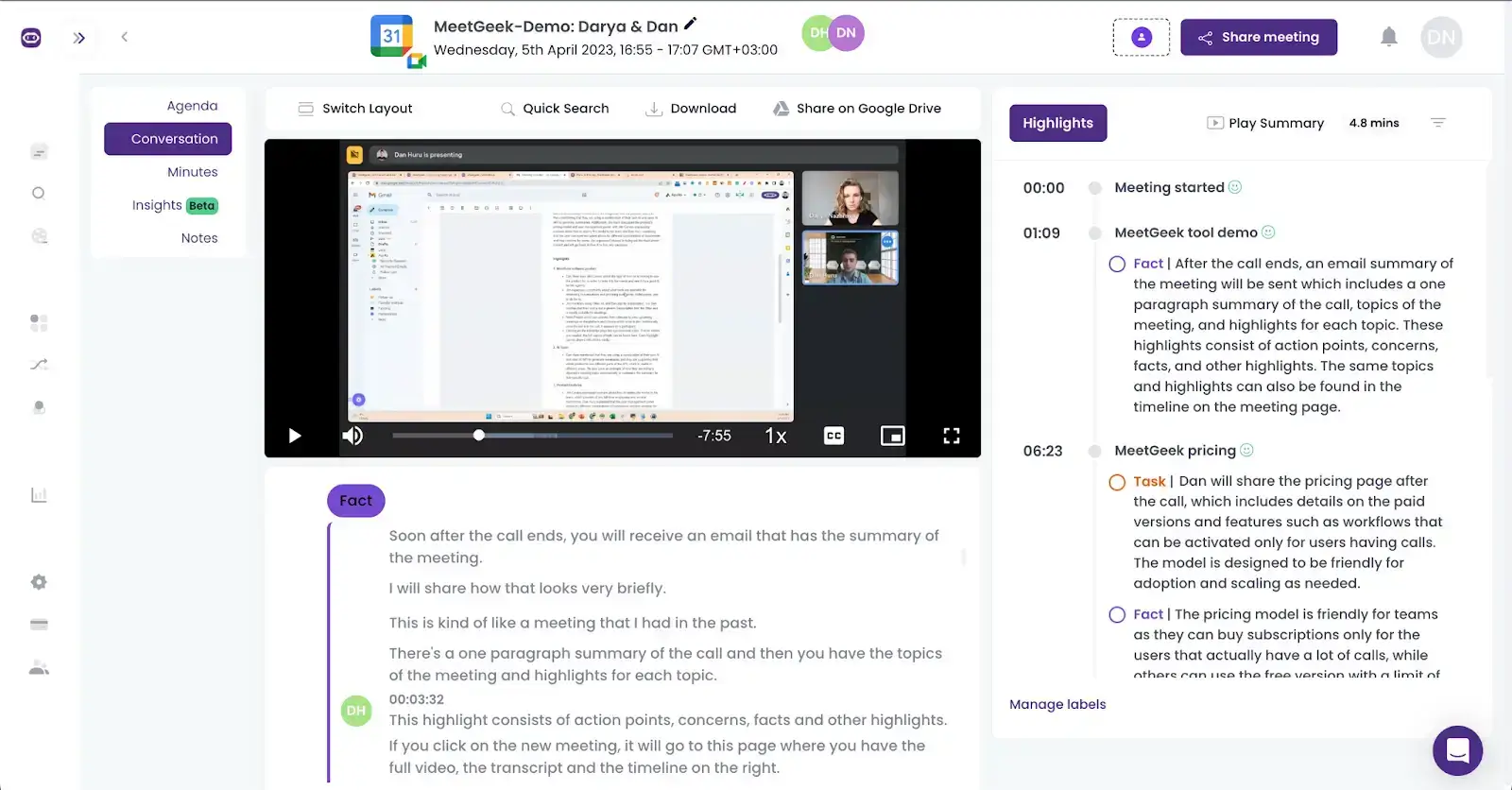
Here’s how MeetGeek can benefit sales teams:
- Automatic recording and transcription: MeetGeek captures every detail of sales calls in over 100 languages, allowing your team to focus fully on the interaction without worrying about note-taking.
- AI-powered analytics: MeetGeek leverages advanced machine learning to analyze sales calls, providing deep insights, behavioral trends, and sentiment analysis to help you measure your performance.
- Targeted coaching: Use the recorded data and detailed transcripts to pinpoint specific areas where sales reps could use extra support, such as product explanations or improving their negotiation tactics.
- Seamless integration: MeetGeek syncs effortlessly with major CRM platforms like Salesforce and HubSpot, ensuring that all deal updates are smoothly transferred into your CRM system.
- Collaborative workspace: The platform enables team members to access and collaborate on meeting notes, fostering effective teamwork even when not everyone can be present.
- Mobile functionality: MeetGeek’s mobile app makes it simple to record, transcribe, and summarize meetings on the go, perfect for face-to-face interactions.
- Centralized repository: Keep all your meeting-related documents and insights in one secure place, accessible to all team members whenever needed.
- Customizable meeting templates: MeetGeek’s customizable templates ensure that your sales meetings are consistently productive and tailored to your specific business needs.
Best 60+ Quotes for Your Sales Team
We've gathered over 60 motivational quotes that are perfect for energizing and inspiring your team. These quotes come from successful business leaders and thinkers, offering valuable insights that can help your team achieve their goals and enjoy their work.
A. Motivational Sales Quotes
1. “Today is always the most productive day of your week.” — Mark Hunter
Sales productivity begins with a structured plan and the drive to act on it. To ignite a proactive mindset for the week ahead, encourage your team to set daily goals and celebrate what they accomplish daily. It’s about making today count and not putting off things until the next day just because they’re not urgent.
2. “You either suffer the pain of discipline or the pain of regret.” — Jim Rohn
In sales, discipline might mean sticking to your prospecting schedule or consistently updating CRM entries: it’s not always exciting, but it needs to be done. In training sessions or performance reviews, bring this up to remind your team that short-term discipline prevents long-term regrets and missed opportunities.
3. “Motivation will almost always beat mere talent.” — Norman Ralph Augustine
Our greatest weakness lies in finding excuses. However, in sales, it’s your persistence that pays off. That’s why you need to create a space that values and encourages continuous learning and improvement, showing that everyone can contribute significantly through motivated action.
4. “Taking initiative pays off. It is hard to visualize someone as a leader if she is always waiting to be told what to do.” — Sheryl Sandberg
It’s never a good idea to micromanage your team. This may lead to burnout on your part and frustration on your sales reps’ end. Instead, encourage team members to take ownership and demonstrate leadership, no matter their role. Drop this quote when mentoring or during training to inspire proactive behavior.
5. “You will get all you want in life if you help enough other people get what they want.” — Zig Ziglar
If your team focuses on KPIs more than on helping customers, it’s time to reassess your overall sales strategy. Help your team expand their understanding of their clients' businesses and challenges. This creates room for personalized solutions that truly meet customer needs.
2. Inspirational Sales Quotes
6. “Confidence applied properly surpasses genius. There's nothing like confidence.” — Mike Tyson
Confidence can convince and persuade, but it also helps with building trust with customers. Have your team practice their pitches repeatedly; the more comfortable they feel with the material, the more their confidence will shine through during real interactions.
Additionally, create a set of talk tracks your team can refer to as needed. If you need help, check out our step-by-step guide on creating the perfect talk track.
7. “When you undervalue what you do, the world will undervalue who you are.” — Oprah Winfrey
If you don’t believe in the value of your products or services, neither will potential customers. As a manager, get your team to understand the benefits of your products, so they can communicate this value effectively to customers.
8. “If you can't do great things, do small things in a great way.” — Napoleon Hill
It's the everyday interactions, the small gestures of follow-up calls or personalized emails that build customer relationships and loyalty over grand, less frequent gestures. Excelling in these smaller tasks can lead to greater overall success and satisfaction for both the team and your clientele.
9. “Don’t watch the clock; do what it does. Keep going.” — Sam Levenson
Persistence is key, and your ability to persevere despite setbacks often determines success. Create resilience among your team by focusing on continual effort, rather than waiting for the perfect conditions for success.
10. “I fear not the man who has practiced 10,000 kicks once, but I fear the man who has practiced one kick 10,000 times.” — Bruce Lee
Deeply refine and master particular areas of the sales process. This could mean focusing on perfecting negotiation tactics or the ability to generate leads, turning these specific skills into powerful tools in your sales arsenal.
11. “There is no such thing as failure. There are only results.” — Tony Robbins
Each result, whether a win or a loss, provides valuable lessons. Create an environment where your team feels comfortable sharing what they've learned from less successful sales. Then, use all these insights to help them refine their approach moving forward.
12. “The secret to getting ahead is getting started.”
Procrastination is the easiest way to fail at completing any (and every) sales objective. Train your team to act promptly, whether that’s reaching out to a new lead or following up on a client question. This maintains momentum and keeps the opportunities flowing.
13. “Chasing perfection is like chasing the wind, it's highly futile.”
Perfection < progress. Focus on continuous improvement and learning from each interaction, rather than being paralyzed by the illusion of ‘the perfect sale’, which can lead to missed opportunities and frustration.
3. Sales Quotes for Sales Prospecting
14. “Selling is really about having conversations with people and helping improve their company or their life.” — Lori Richardson
At its core, sales prospecting is about having conversations that may significantly improve a client's business or personal life. In this phase, you must take the time to understand each potential customer's unique challenges and goals and tailor your pitch to show how your solution fits into their narrative.
15. “Be personal. Be relevant. Be specific.” — Seth Godin
Personalize your approach by using the prospect’s name, referencing specific challenges they might be facing, and offering tailored solutions to show you’re invested in their success. This increases the chances of engaging a prospect and sets the tone for a trust-based relationship.
16. “Every email is an opportunity to test a different benefit or angle.” — Heather R Morgan
Use each message you send to see how different selling points resonate with recipients. This makes emails a strategic experiment that refines your message and enhances engagement with potential clients.
17. “Before LinkedIn and other social networks, in the sales world, ABC stood for Always Be Closing. Now it means Always Be Connecting.” — Jill Rowley
In prospecting, connections matter more than closing deals. Contribute to discussions on LinkedIn, attend industry networking events, and participate in webinars. Building a network that can offer referrals and introductions expands your reach and potential client base.
18. “Don't sell the stage, sell the act!”
When talking to customers, focus on selling ideas and the benefits of your product or service, showing them how it can lead to positive outcomes. This helps them visualize how your product can make their life better, which is way more persuasive than just running through a list of features.
19. “Most salespeople throw darts in the dark, hoping something will hit.”
A scattergun approach can only result in lots of missed opportunities. That’s why sales teams should use targeted strategies based on research and data. Understand who your ideal customer persona is, what they need, and how they prefer to be approached before you move on to the next steps.
20. “Clarity is power.”
In the prospecting phase, clarity is essential for advancing the sales process. This starts with transparent internal communication within the sales team about target markets and sales strategies. As a direct result, everyone stays aligned and moving in the same direction.
4. Sales Success Quotes
21. “There is no such thing as failure. There are only results.” — Tony Robbins
Every outcome is a learning opportunity, not a setback. Use this mindset to push your team to continuously refine strategies based on what works, what doesn't, and what can improve future performance.
22. “Sales are contingent upon the attitude of the salesman, not the attitude of the prospect.” — William Clement Stone
Did you know that a salesperson's mindset can dramatically influence the outcome of a sales interaction? Sales success often stems from maintaining a positive, resilient, and customer-focused attitude, regardless of the prospect's initial disposition.
23. “The hours ordinary people waste, extraordinary people leverage.” — Robin Sharma
Effective time management can distinguish successful sales teams from others. Leverage every hour by prioritizing high-value, high-impact activities, like nurturing leads or closing deals, instead of getting stuck in administrative tasks.
Get an AI Meeting Assistant for your sales team like MeetGeek to record and transcribe your meetings, and integrate it with your CRM tool and your internal communication channels. This way, you save plenty of time and can focus on results.
24. “You don't rise to the occasion, you sink to the level of your training.”
Sales teams that invest in continuous training and skill development are more likely to handle challenging situations effectively. That’s because their response to pressing issues as well as ordinary tasks becomes automatic and doesn’t require additional effort.
25. “It is possible to commit no mistakes and still lose. That is not weakness. That is life.” — Jean Luc Picard
Even a perfectly pitched sale can end in a no-deal, so train your team to understand that some factors are beyond their control and that resilience is key to long-term success.
26. “Knowledge isn't power, applied knowledge is…” — Paul Chek
More often than not, potential customers won’t follow the script you envisioned during training. In those cases, what matters most is how you apply your knowledge to meet client needs in high-pressure environments.
27. “Doubt kills more dreams than failure ever will.”
Self-doubt has a paralyzing effect on most of us, and sales teams are no exception. When you’re facing a customer, confidence in yourself and your product is crucial. Promote a culture of confidence and belief in your team’s capabilities and strategies to prevent doubt from derailing their efforts.
28. “Success is nothing more than a few simple disciplines, practiced every day.” — Jim Rohn
Consistency in core sales activities, like prospecting, follow-ups, and client meetings, builds habits that lead to the achievement of sales goals. This routine makes high performance a daily standard within your team.
5. Sales Quotes to Improve Your People Skills
29. “Example isn't another way to teach, it is the only way to teach.” — Albert Einstein
Sales leaders must embody the behaviors and practices they want to instill in their team. When you demonstrate excellent communication, empathy, and ethical selling in every interaction, you can teach others more effectively than any training manual could.
30. “Start working with your prospects as if they’ve already hired you.” — Jill Konrath
When you do everything right, but your results don’t reflect that, it may be time to shift the dynamic from selling to consulting. Treat your leads like current clients to build trust and demonstrate your commitment and value upfront. This may lead to more sustained and fruitful relationships.
31. “Everything that irritates us about others can lead us to an understanding of ourselves.” — Carl Jung
What are your reactions to difficult clients or situations? Answering this can help you uncover personal biases or weaknesses in your people skills.
Once you identify the root cause of your emotional responses, you can adjust your approach more effectively and become more proficient in interacting with different contacts.
32. “I've learned that people will forget what you said, people will forget what you did, but people will never forget how you made them feel.” — Maya Angelou
We can’t stress this enough: grow your emotional intelligence. Strive to make prospects feel understood, respected, and valued, which is more impactful than the technical aspects of what you’re presenting. Ultimately, this can influence their decision to buy and build loyalty.
33. “Listen, smile, agree, and then do whatever you were gonna do anyway.” — Robert Downey Jr.
While it’s important to acknowledge and respect the viewpoints of others, staying true to your own convictions and strategy is also vital. This mindset can help your entire team navigate complex negotiations and maintain integrity.
34. “It's harder to be kind than clever.”
Building rapport with clients can create a stronger bond than impressing them with knowledge alone. That being said, try to connect with prospects on a personal level by understanding their pain points and showing empathy and solidarity.
35. “Appreciation is the currency you pay the universe with.”
You’ve probably heard countless times about the power of expressing gratitude. Recognize your clients’ time, consideration, or business to set the foundation for an ongoing relationship where they feel like their needs are met.
Make it a habit to follow up after every call or meeting to thank the prospect for their time and interest. Check out how to write a proper ‘thank you’ email after a customer interaction.
36. “Yes and No are equally good answers. It’s the Maybe that crushes startups.”
Whatever you do, aim for a clear commitment from prospects, whether positive or negative. Guide conversations towards definitive outcomes to enable efficient pipeline management and forecasting.
37. “All things being equal, people will do business with, and refer business to, those people they know, like, and trust.” — Bob Burg
Being friendly is a good strategy, but not enough for establishing trust. Strive to demonstrate reliability, expertise, and integrity. Salespeople who invest in these relationships see better engagement, more referrals, and ultimately, greater sales success.
6. Sales Quotes About Closing Deals
38. “Your job in sales is to create moments of truth!”
One of your core objectives should be to create pivotal interactions where potential customers make key decisions.
In these critical times, your ability to truthfully demonstrate the value of your product or service can decisively influence the outcome. Do your best to capitalize on these moments to effectively guide prospects toward a commitment.
39. “You don’t close a sale; you open a relationship if you want to build a long-term, successful enterprise.” — Patricia Fripp
The end of any sale can be the beginning of a relationship that can lead to repeated business and referrals. This perspective allows you to look beyond the immediate transaction and focus on building lasting connections that foster trust and loyalty.
40. “You don’t need a big close, as many sales reps believe. You risk losing your customers when you save all the good stuff for the end. Keep the customer actively involved throughout the presentation, and watch your results improve.” — Harvey MacKay
An engaging sales process matters more than relying solely on a strong closing pitch. Train your team to keep interactions interactive. This means asking questions, seeking direct feedback, and adapting presentations based on customer cues to keep them involved.
41. “You can't turn a no to a yes without a maybe in between.” — Francis Underwood
Few sales are straightforward; most of them require navigating uncertainties and objections. Use this mindset to remain patient and persistent, using maybe as an opportunity to address concerns and move the dialogue forward.
42. “Emails that never get sent close no deals.”
The first condition to succeed is to try, which also applies to sales. Implement a system that tracks follow-up tasks and deadlines to ensure your team nurtures potential deals from the get-go.
43. “You need to be willing to lose if you're truly committed to win.”
Sometimes, pushing too hard can lead to losses. Be willing to walk away to maintain integrity and position yourself more favorably in the eyes of potential customers. This can only enhance your chances of future success.
44. “You can't sell others if you aren't sold yourself first.”
Your whole team must genuinely believe in the value of their products or services to convincingly advocate for them. This inspires confidence in potential customers while also energizing and motivating sales reps, making them more effective and persuasive.
45. “Nothing happens until a sale is made.”
Every part of a business, from making the product to marketing it, is a step toward making sales happen. So, when you make a sale, you're actually driving the company forward. It's a big responsibility, but also a reminder of how important your role is.
Every call you make, and every deal you close, helps the entire team succeed.
46. “People are starving for decisiveness. If you give it to them, you will rule the world.”
In a world full of hesitations and vague responses, a decisive attitude can set your salespeople apart, making them leaders in the eyes of their customers and significantly boosting their effectiveness in closing deals.
47. “Coffee is for closers.”
For a humorous approach, consider using this line to recognize and celebrate the success of salespeople who convert opportunities into actual sales, reinforcing the value of persistence and skill in sales activities.
48. “I have never worked a day in my life without selling. If I believe in something, I sell it, and I sell it hard.” — Estée Lauder
Your enthusiasm can become contagious, making it easier to convince others. If you truly believe in your product, you'll be all in, giving every pitch your best shot because you know what you're offering is worthwhile.
7. Quotes from Business Experts
49. “Customers don’t care at all whether you close the deal or not. They care about improving their business.” — Aaron Ross
When you approach sales from the perspective of how you can help improve the customer's business, you align your goals with theirs, making it more likely that they'll see the value in what you're offering.
50. “It’s no longer about interrupting, pitching, and closing. It is about listening, diagnosing, and prescribing.” — Mark Roberge
Adopt a consultative style, where listening actively becomes the foundation of your sales interactions. This helps you tailor the customer issue diagnosis and provide informed solutions, which enhances trust and increases the likelihood of a sale.
8. Direct Sales Quotes
51. “Repetition is the key to mastery.”
Consistently practice your sales pitches, objection handling, and closing techniques. The more familiar you are with the nuances of your product and the common customer concerns, the more adept you become at navigating sales conversations and securing deals.
52. “You earn the right to tell your story when you start with theirs.” — Matt Heinz
Here’s a crucial aspect of effective salesmanship: listen before speaking. As a sales rep, your priority should be to understand your customers' stories: their needs, challenges, and goals. Once you know where they're coming from, you can share how your product or service can fit into their narrative, potentially solving their problems.
53. “If you can't explain it simply, you don't understand it well enough.” — Albert Einstein
Sales professionals should be able to distill complex features and benefits into simple, understandable terms. When you truly understand your product and its value, you can communicate more effectively, making it easier for the customer to see why they need you.
54. “Repetition is the key to mastery.”
Repeatedly engaging with different customers sharpens your ability to quickly relate to and empathize with various customer personas. Each interaction is an exercise in shaping your sales instincts and improving your ability to close deals effectively.
55. “Selling is really about having conversations with people and helping improve their company or their life.” — Lori Richardson
How much value do you *actually* provide to customers? When you approach sales from this angle, you’re more likely to build lasting relationships that benefit both you and your prospects. This turns transactions into partnerships and shifts your role from seller to advisor.
56. “Don't just work IN your business, work ON your business.”
Day-to-day sales activities are one thing, but strategizing for growth is another. Develop a deeper understanding of market trends, refine your sales pitch, and focus on the customer service experience. Then, create systems that ensure the sustainability and scalability of your sales efforts, rather than drowning in routine tasks.
9. Insightful Sales Quotes
57. “Hard training, easy fight!”
The more you prepare and practice your strategies and responses to potential objections, the more effectively you can navigate actual sales encounters. Regularly role-play scenarios that mimic real-life sales situations so that when it comes time to engage with a client, the process feels more natural and less daunting.
58. “People often say that motivation doesn't last. Well, neither does bathing—that's why we recommend it daily." — Zig Ziglar
Motivation is temporary, whereas drive requires ongoing effort. Find ways to keep your spirits high every day. Whether it's setting daily goals, celebrating small wins, or simply starting your day with a positive routine, staying motivated is crucial in the world of sales where rejections are frequent, and the pressure can be high.
10. Outstanding Quotes
59. “The hours ordinary people waste, extraordinary people leverage.” – Robin Sharma
Use time wisely. In sales, this can mean prioritizing tasks that directly impact goals, like prospecting and client sales calls over less productive activities. This often differentiates top performers from the rest.
60. “The best teachers are those who show you where to look, but don't tell you what to see.” — Alexandra K. Trenfor
Show team members potential strategies and tools, but allow them to adapt them to their personal style and sales situations. This creates a space where independence and innovation are encouraged, which allows reps to grow their sales career and learn from their own experiences, as well as from their mentors.
61. “Most people overestimate what they can do in one year and underestimate what they can do in ten years.” — Bill Gates
If you want to be a successful person in the sales industry, set realistic short-term goals while aiming for substantial long-term growth. This helps in managing expectations and pacing the workload, allowing for steady progress toward bigger objectives.
62. “It is more important to know where you are going than to get there quickly. Do not mistake activity for achievement.” — Socrates
Being busy isn't the same as being productive. Create a well-defined roadmap of where you want your sales efforts to lead. This can mean targeting the right prospects, nurturing those relationships thoughtfully, or taking the time to understand the unique needs of each client before proposing a solution. Rushing just to hit numbers can lead to shallow engagements that don’t build lasting customer relationships.
Motivate Your Sales Team with MeetGeek!
Each quote we've shared is a tool to inspire and energize your sales team, encouraging them to push beyond their limits and achieve greatness.
Now, take these quotes off the page and bring them to life in your daily sales practices. And if you’re looking for a way to keep your team consistently on top of their game, try MeetGeek.
With MeetGeek, you can record, summarize, and analyze your sales meetings, keeping your team motivated and focused on what truly matters—closing deals and building meaningful relationships.






.avif)