


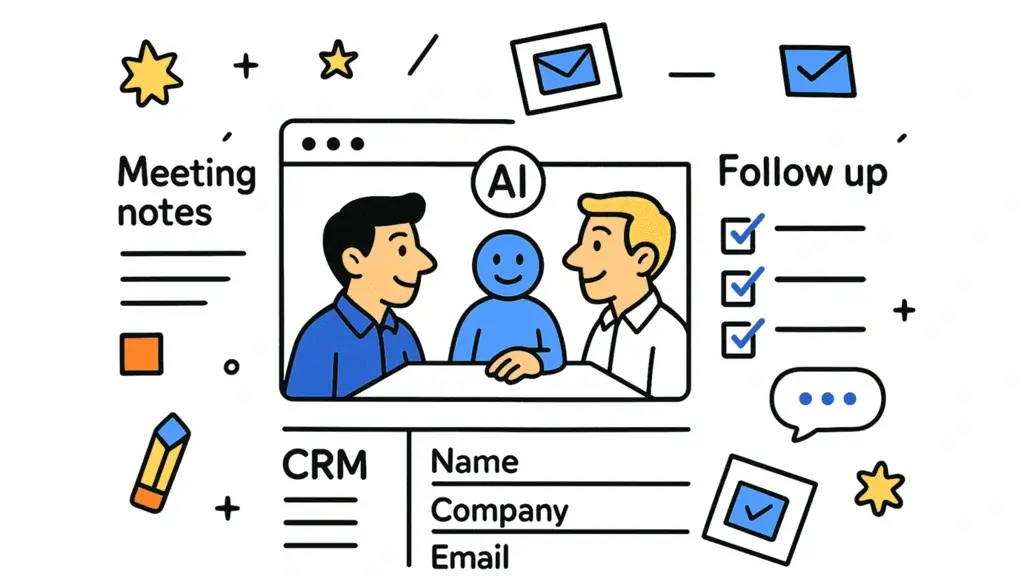

Sales professionals often spend more time in meetings, writing notes, and updating systems than actually selling. These tasks are necessary, but they reduce the time available for building relationships and closing deals.
In 2026, many teams are using artificial intelligence tools to manage these repetitive tasks. One of these tools is the AI meeting assistant. It captures, organizes, and summarizes meeting information automatically.
This article explains how AI meeting assistants work and how they help sales teams save time. It begins with why sales teams are starting to use them more often.
Why Sales Teams Are Turning To AI Meeting Assistants
Sales teams handle a high volume of meetings, from discovery calls to client check-ins. Each meeting creates follow-ups, notes, and updates that need to be completed right away. These tasks often take more time than the meetings themselves.
According to McKinsey, sales reps spend only about 35% of their time actually selling. The rest of their day is filled with writing notes, updating CRMs, and preparing for the next conversation.
An AI meeting assistant is a tool that uses artificial intelligence to record meetings, transcribe what was said, and generate summaries. It can also highlight key takeaways and action items. Some tools also connect with CRM platforms to help keep data organized.
Sales teams are turning to AI meeting assistants to reduce manual work and improve accuracy. These tools allow sales professionals to focus on conversations during meetings instead of typing or switching between apps.
Time Allocation for Sales Reps:
- Selling activities: Only 35% of time spent on actual sales conversations
- Administrative tasks: 65% of time consumed by note-taking, CRM updates, and other post-meeting tasks
- Potential improvement: AI meeting assistants can shift this balance significantly
What AI Meeting Assistants Do For Sales Pros
AI meeting assistants are designed to support specific tasks that occur during and after sales meetings. These tools use artificial intelligence to process and organize information from conversations.
Unlike standard meeting tools, which focus on hosting or scheduling, AI meeting assistants focus on capturing and analyzing what is said in meetings. In sales contexts, these assistants help record details, track follow-ups, and update systems without manual work from the salesperson.
Key capabilities include:
- Automated transcription: Captures every spoken word and converts it to text
- Meeting summaries: Creates concise overviews of main discussion points
- Action item extraction: Identifies tasks and commitments made during calls
- CRM integration: Automatically updates sales records with meeting data
- Conversation analytics: Tracks speaking time, questions, and engagement levels
These features work together to create a complete record of sales conversations that can be referenced, shared, and used to improve future interactions.
7 Ways Meeting Assistants Save Time And Boost Productivity
1. Automated meeting documentation
AI meeting assistants record and transcribe conversations during sales calls. This removes the need for sales representatives to take notes manually. On average, this saves about 10–15 minutes per call.
Full focus can be placed on listening and responding, improving the quality of discussions. While an automated transcription creates a written record that can be reviewed later.
This automation helps sales reps stay present in conversations instead of dividing their attention between listening and documenting.
2. Instant summaries and highlights
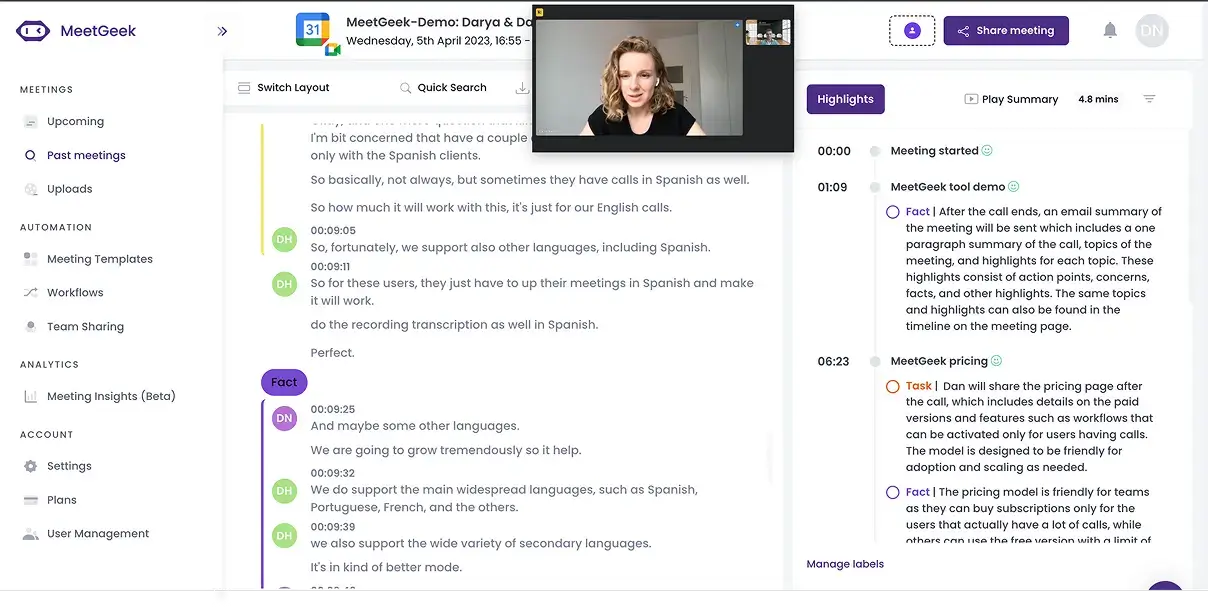
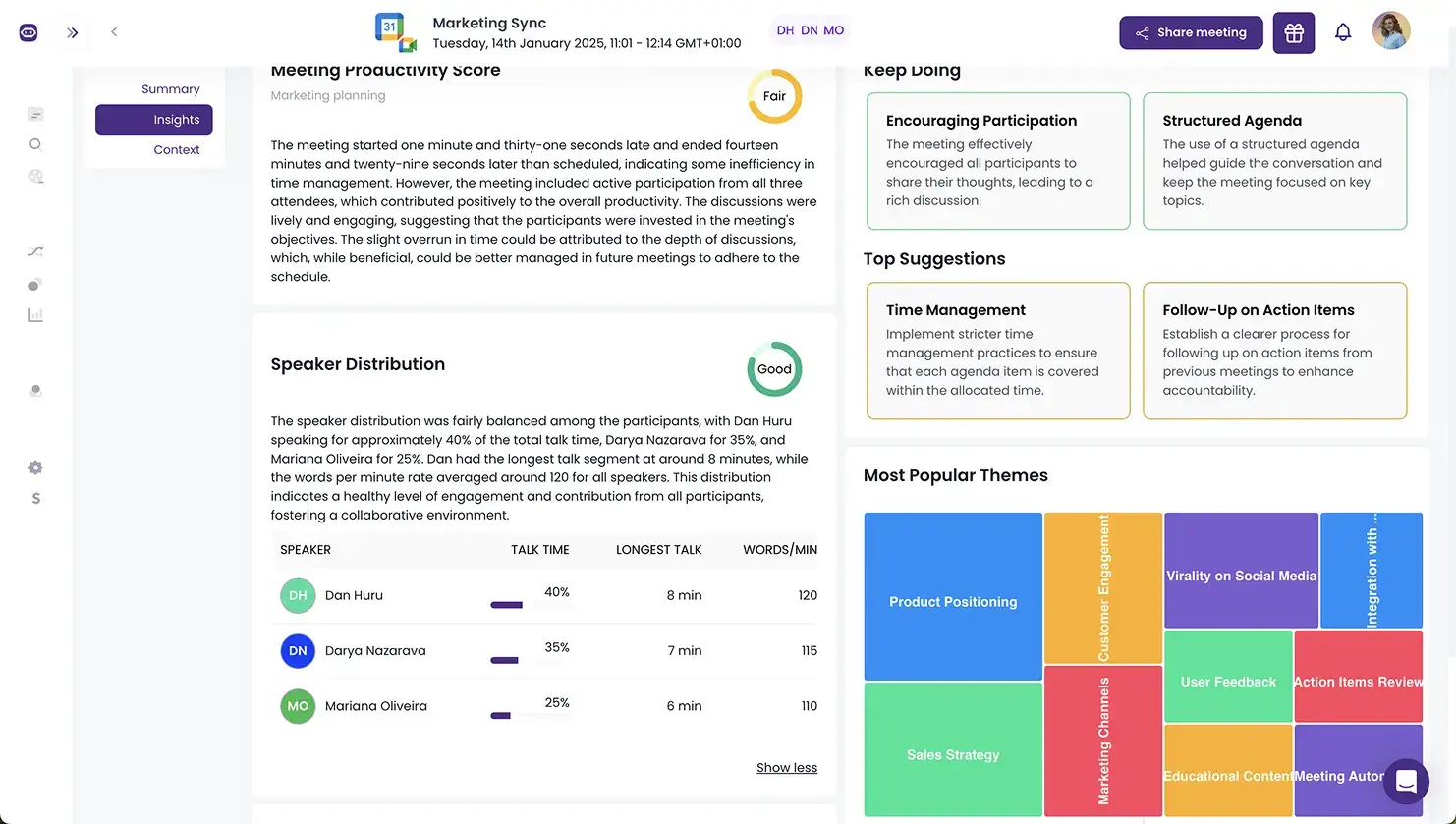
After a meeting ends, AI tools generate a summary that includes key points, objections raised, and opportunities discussed. This eliminates the need to rewatch recordings or read long transcripts.
These meeting notes can be shared with colleagues who did not attend the meeting. They provide a quick way to catch up on what happened without spending time watching the entire recording.
The AI identifies and highlights the most important parts of the conversation, making it easy to find relevant information quickly.
3. CRM integration without manual data entry
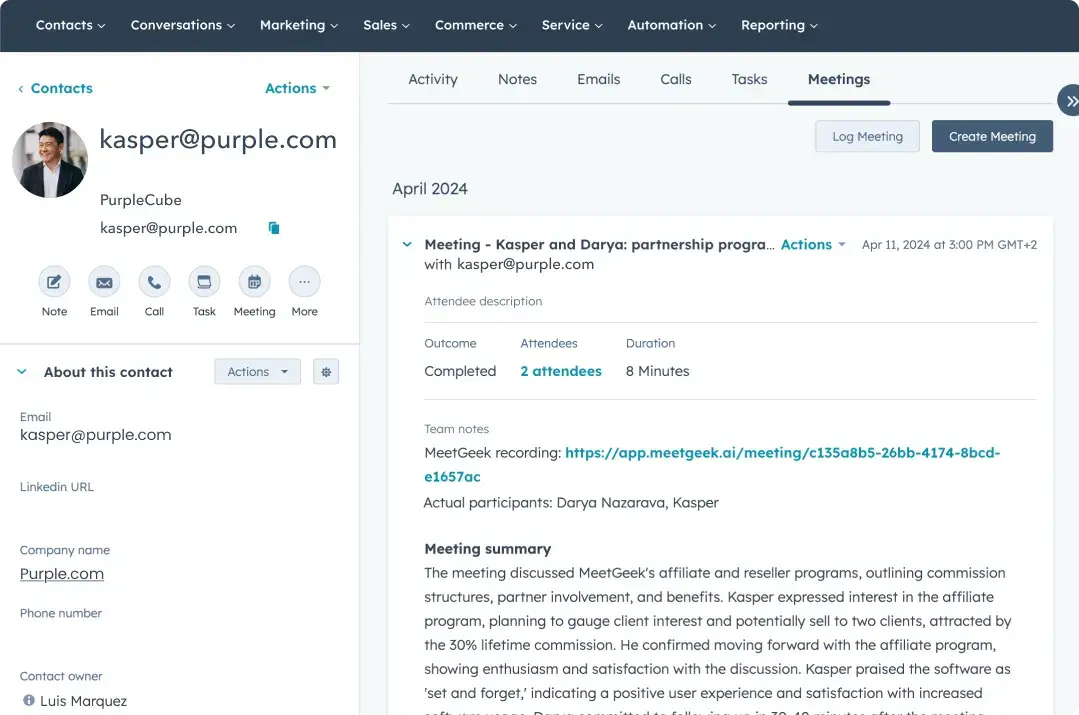
AI systems can automatically transfer meeting data to CRM tools. This includes updating deal or contact information, adding meeting outcomes, and syncing contact details.
Manual data entry is not required, which reduces errors and saves time. The information flows directly from the meeting to the CRM without the sales rep needing to copy and paste or retype anything.
Integration of meetings with your CRM ensures that customer records stay current and accurate with minimal effort from the sales team.
4. Smart follow-up reminders
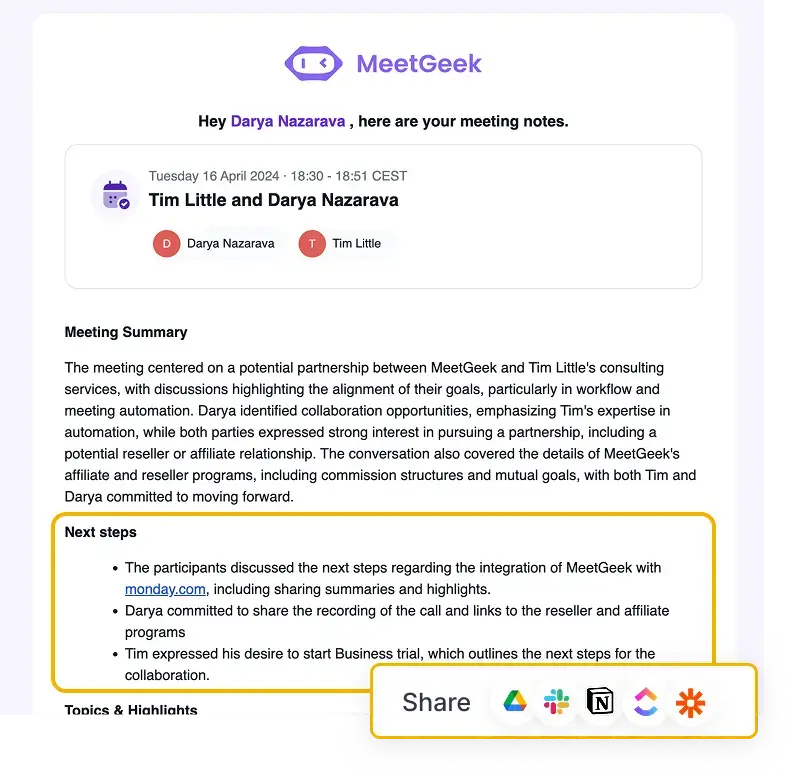
AI detects action items and promises made during calls. It then creates reminders or tasks for follow-up and connects them to task management tools.
This prevents missed deadlines and keeps deal progress on track. The system can identify statements like "I'll send you that proposal by Friday" and automatically create a task with the appropriate deadline.
Follow-up items are organized by priority and deadline, helping sales reps manage their time effectively.
5. Post-meeting insights
AI can analyze conversations after meetings to provide actionable insights. This includes identifying overall sentiment, topics discussed (like product details or pricing), and areas where reps might improve.
Sales reps get a clearer view of how their call with a prospect went and how to prepare for effective follow-ups.
These insights help teams refine messaging, address customer concerns more effectively, and continuously improve sales performance.
6. Cross team collaboration
Meeting data is stored and shared across departments. Sales, marketing, product, and customer success teams can access notes and summaries.
This avoids repeated meetings and keeps all teams aligned on customer needs. When a customer mentions a feature request during a sales call, the product team can see this information without requiring a separate meeting.
The shared knowledge base improves coordination between teams and ensures everyone has the same understanding of customer requirements.
7. Enhanced sales coaching
Managers can review meeting transcripts and recordings without joining live calls. AI identifies patterns in conversation, such as talk time or sentiment.
This helps managers provide feedback and support new team members more efficiently. They can see exactly how calls are handled and offer specific guidance on improving techniques.
New sales reps can also learn from successful calls by studying the transcripts and recordings of experienced team members.
Weekly Time Savings:
| Activity | Without AI | With AI | Time Saved |
|---|---|---|---|
| Note-taking | 5 hrs | 0.5 hrs | 4.5 hrs |
| CRM updates | 4 hrs | 1 hr | 3 hrs |
| Call preparation | 3 hrs | 1 hr | 2 hrs |
| Follow-ups | 2 hrs | 0.5 hrs | 1.5 hrs |
| Total | 14 hrs | 3 hrs | 11 hrs |
How To Integrate AI Meeting Tools With CRM And Collaboration Platforms
AI meeting tools connect with CRM and collaboration platforms through native integrations or third-party connectors. These integrations allow automatic syncing of meeting data such as transcripts, action items, and contact updates.
The integration process typically begins by connecting the AI meeting tool to the desired platform using an API or built-in integration feature. For example, connecting meeting notes to HubSpot may involve authorizing access, mapping meeting data fields to CRM fields, and setting up permissions.
For collaboration tools, like having AI meeting notes in Notion, the integration often involves linking the AI meeting tool to messaging or project management software. This allows summaries, follow-ups, and insights to appear in shared channels or task lists.
Integration benefits:
- Centralized information: All meeting data is stored in one place
- Automated workflows: Routine tasks are handled automatically
- Enhanced data quality: Reduces errors in customer records
- Improved visibility: Teams can track progress in real time
Real world impact on sales coaching and training
- AI meeting assistants record and transcribe sales calls automatically. These recordings allow managers to review conversations without being present in real time.
- New hires can listen to successful calls from experienced team members. This helps them learn what effective sales conversations sound like. They can study how objections are handled, how questions are asked, and how deals are moved forward.
- Managers can use AI-generated data to support coaching. Talk time, sentiment shifts, and key discussion points are tracked. This information helps coaches focus on specific areas like listening skills or clarity during pitch delivery.
- Training sessions can also use real calls as examples. Rather than relying on hypothetical scenarios, trainers use real customer conversations to illustrate points. This reduces preparation time and scales across larger teams.
Maximizing results with AI Meeting Assistants
AI meeting assistants help sales teams save time by automating tasks like note-taking, summarizing meetings, and updating CRMs. These tools support team collaboration, reduce manual work, and provide insights from conversations.
To use these tools effectively, sales teams can integrate them into existing workflows. This includes connecting with platforms like Salesforce, HubSpot, Google Calendar, Microsoft Teams, or Slack.
With consistent use, AI meeting assistants can help maintain accurate records, improve coaching, and reduce the time spent preparing for or following up on meetings.
MeetGeek offers an AI meeting assistant that includes transcription, summaries, action items, and integrations with sales platforms. Teams can use it for internal and client-facing meetings.
Sign up for free to start automating your meetings and improving productivity:
Frequently asked questions about AI Meeting Assistants
How do AI meeting assistants actually save time for sales teams?
AI meeting assistants automate note-taking, transcription, and follow-up task creation, saving sales reps up to 11 hours per week that can be redirected to selling activities.
Are AI meeting assistants accurate with technical sales terminology?
Modern AI transcription systems are trained on industry-specific datasets and can accurately recognize most technical terms, product names, and sales jargon.
Can AI meeting assistants integrate with my existing sales tools?
Most AI meeting assistants connect with common sales platforms including CRMs like Salesforce and HubSpot, as well as communication tools like Zoom, Teams, and Slack.
How quickly do sales teams see benefits after implementing an AI meeting assistant?
Most teams notice immediate time savings from automated documentation, with broader productivity improvements becoming apparent within 2-3 weeks of regular use.
After implementing MeetGeek, our client retention went up by three months and our refunds decreased by 30%.
- Jay Feldman, Co-Founder OtterPR
Is my sales conversation data secure with AI meeting assistants?
Reputable AI meeting assistants use encryption, comply with data protection regulations, and offer security controls to keep sensitive sales information protected.




.avif)