

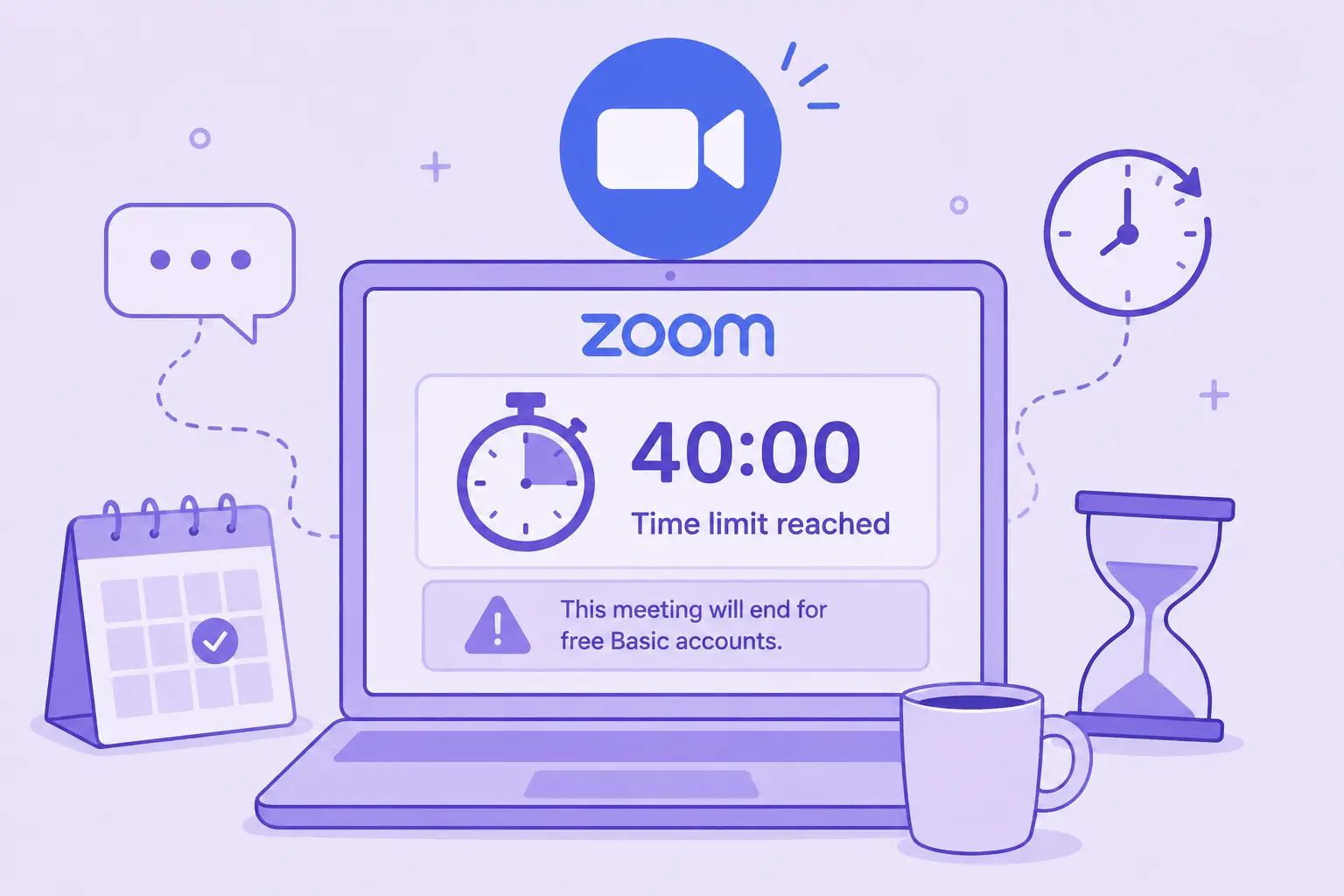

The Zoom time limit is 40 minutes for almost all meetings hosted by someone with Zoom Meetings Basic permissions. Paid Zoom users with an eligible meeting license can host sessions for up to 30 hours.
For occasional calls, 40 minutes may be enough. But for team meetings, interviews, classes, client calls, or longer working sessions, the cutoff can quickly become disruptive. You do not necessarily have to upgrade, though. You can restart a scheduled meeting using the same meeting link, while paid plans remove the recurring 40-minute interruption altogether.
Below, we'll break down exactly how the Zoom meeting time limit works, the free and paid ways to extend it, what happens when a meeting cuts off, and how to avoid losing your notes and action items when a conversation has to continue in another session.
TL;DR
- Zoom Basic meetings are limited to 40 minutes in almost all cases, including regular one-on-one meetings.
- The time limit follows the original host's Zoom license or meeting permissions, not the accounts of participants who join.
- Eligible paid Zoom plans allow meetings of up to 30 hours.
- A company can have a paid Zoom account while individual users still have Basic permissions and remain limited to 40 minutes.
- The easiest free workaround is to restart a scheduled meeting and have participants rejoin using the same meeting link.
- Transferring host controls does not reset the timer, and breakout rooms do not extend the meeting time.
- If a paid meeting still ends after 40 minutes, check which user account is signed in and whether the meeting license has actually been assigned.
- An AI note taker for Zoom can preserve the recording, transcript, notes, decisions, and action items when a longer conversation has to be split across multiple sessions.
Can I Use Zoom for 2 Hours?
For a single uninterrupted two-hour meeting, you need a paid plan. A licensed Zoom host can run a meeting for up to 30 hours, but a free Basic meeting ends after 40 minutes, even when only two people are on the call. To talk for two hours on a free account, you'll need to restart the meeting each time a 40-minute session ends.
If you remember free one-on-one Zoom calls lasting longer, you're right. Zoom previously allowed Basic users to hold longer 1:1 meetings, which is why you'll still find older advice saying the 40-minute limit only applies to group calls.
That changed on May 2, 2022, when Zoom introduced a 40-minute limit for 1:1 meetings hosted by Basic users on free accounts. The change brought one-on-one calls under the same 40-minute limit as group meetings.
Today, having only two people in the meeting does not extend the free limit. The maximum duration is determined by the original host's license, not by whether you're having a one-on-one or group call.
What Is the Zoom Meeting Time Limit?
The Zoom meeting time limit is the time after which your Zoom meeting will automatically end, and it depends primarily on the meeting permissions assigned to the host's user account, not on the licenses held by the participants who join.
For a user with Zoom Meetings Basic permissions:
- Maximum meeting time: 40 minutes
- Participants: up to 100 on Workplace Basic
- Meetings affected: almost all meetings with a host and at least one participant
- Device: the same limit applies whether the meeting is started from the Zoom app or by phone
For a paid, licensed Zoom Meetings user:
- Maximum meeting time: up to 30 hours
- Workplace Pro: up to 100 participants
- Workplace Business: up to 300 participants
- Cloud meeting recordings: available to licensed users on eligible paid accounts
Zoom's own time-limit documentation states that the rules depend on account permissions, participant count, and activity rather than simply whether the company pays for Zoom.
That distinction matters for businesses. A company can have a paid Zoom account while an individual employee still has Meetings Basic permissions. In that case, meetings hosted by that person remain limited to 40 minutes until an administrator assigns them a paid Zoom Workplace license.
Zoom Time Limits by Plan
| Zoom plan or license | Host license | Maximum meeting time | Default participant limit | With Large Meeting add-on |
|---|---|---|---|---|
| Zoom Workplace Basic | Basic | 40 minutes | 100 | Not available without an eligible paid license |
| Basic user on a Pro account | Basic | 40 minutes | 100 | Requires a paid license |
| Basic user on a Business account | Basic | 40 minutes | 300 | Requires a paid license |
| Basic user on an Enterprise account | Basic | 40 minutes | 500 | Requires a paid license |
| Zoom Workplace Pro | Licensed | 30 hours | 100 | Up to 5,000, depending on add-on purchased |
| Zoom Workplace Business | Licensed | 30 hours | 300 | Up to 5,000, depending on add-on purchased |
| Zoom Workplace Enterprise | Licensed | 30 hours | 500 | Up to 5,000, depending on add-on purchased |
| Paid Zoom Meetings + Large Meeting add-on | Licensed | 30 hours | 500, 1,000, 3,000 or 5,000, depending on the Large Meeting capacity purchased | 500, 1,000, 3,000, or 5,000 |
Table last updated: August 28, 2026.
What Happens When a Free Zoom Meeting Reaches 40 Minutes?
When a Basic meeting reaches its limit, Zoom ends the session.
Everyone has to leave the current session before continuing. There is no setting in the Zoom web portal that turns a free 40-minute meeting into a longer session, and changing your computer, browser, phone, or camera does not reset the timer.
The good news is that the same meeting link can usually be reused after the interruption.
A scheduled Zoom meeting ID does not become useless just because one session ended. Zoom states that scheduled meeting IDs can be restarted and reused, while recurring meeting IDs can remain valid for future occurrences.
So the free workaround is not to create an entirely new meeting every 40 minutes, but to restart the scheduled meeting and have attendees rejoin through the same link.
How to Extend the Zoom Time Limit Without Paying
You cannot remove Zoom's 40-minute limit from a Basic account for free. What you can do is either restart the meeting, structure the meeting to fit within 40 minutes, or use a different free video conferencing platform with a longer limit.
1. Restart the Same Meeting After 40 Minutes
This is the simplest workaround if you want to stay on Zoom.
Schedule the meeting in advance so you have a reusable meeting ID and link. When the first 40-minute session ends, start the scheduled meeting again and ask participants to rejoin using the same meeting link.
There is no need to create a new meeting or send another invitation. Zoom allows scheduled meeting IDs to be restarted, so the original link remains useful.
If you know the meeting will run long, tell attendees beforehand that there will be a short break at the 40-minute mark. Put the most important decisions before the cutoff and use the final few minutes to finish the current topic.
The downside is the break in continuity. Every restart creates another session, which can split meeting recordings, notes, and the flow of the conversation.
2. Keep the Meeting Within the 40-Minute Limit
If restarting would be disruptive, the alternative is to design the meeting around the limit rather than trying to extend it.
This works particularly well for recurring team meetings and one-on-ones where the same group meets frequently anyway. It is less practical for workshops, interviews, training sessions, and complex client meetings that genuinely need longer sessions.
A few habits make 40 minutes go further:
- Schedule the important discussion first. Put decisions and topics requiring live debate at the beginning. Status updates and information that can be shared asynchronously belong later.
- Give agenda items a time limit. A 40-minute meeting with five agenda items cannot afford three 15-minute discussions.
- Keep setup outside the meeting. Send documents and links in advance so the first five minutes are not spent finding files or fixing access.
- Confirm action items before the final minutes. Decide who is doing what and by when while everyone is still present.
- Keep a record of the discussion. Meeting recordings, transcripts or an AI note taker make an unexpected cutoff much easier to recover from.
3. Switch to a Free Platform With a Longer Meeting Limit
If 40 minutes consistently isn't enough but you do not want a paid Zoom plan, another option is to move longer meetings elsewhere.
Google Meet allows free group meetings of up to 60 minutes, and Microsoft Teams Free also caps group meetings at 60 minutes. For one-on-one calls the gap is bigger: free Google Meet calls between two people can run up to 24 hours, and Teams Free allows 1:1 calls of up to 30 hours. That makes either one a real alternative for long two-person calls, although you will need to weigh that against the inconvenience of moving participants to another platform.
See our guides to the Google Meet time limit and Microsoft Teams time limit for the differences.
If you regularly need substantially more than an hour, switching between free platforms only postpones the same problem. At that point, upgrading Zoom or choosing another paid video conferencing plan is the cleaner solution.
How to Get More Out of Zoom's Free Plan
Zoom's free plan works well for video calls, but when you are switching between back-to-back meetings, trying to remember what was said or sending follow-ups to your team, it is easy for things to slip. That is where MeetGeek's Zoom AI notetaker comes in.
MeetGeek is an AI meeting automation and collaboration platform that works with Zoom to automatically record, transcribe, and summarize your meetings. Its AI Voice Agents can also attend meetings on your behalf when you cannot make them.
%20(2).webp)
After the meeting, you get an AI meeting summary with action items and key points, so you do not have to rely on memory or take notes alone.
On top of that, everything is saved in a searchable meeting library, which means you can go back anytime just by typing a keyword. Missed a meeting? You will still know exactly what happened, who said what, and when.
.webp)
MeetGeek also has native integrations with tools such as Slack, Notion and HubSpot, plus 10,000+ connected apps through Zapier, Make and n8n, so your meeting notes can flow automatically into your workflow.
MeetGeek keeps your meeting history consistent across Zoom, Google Meet and Microsoft Teams, while the mobile app can capture in-person conversations and lets you access your meeting history on the go.
You can try MeetGeek for free and see how it stacks up against other free AI meeting note takers. If you need more features down the line, paid plans start at just $9.99/user per month billed annually, an affordable way to get more value from your Zoom meetings, without upgrading your Zoom account.
Can Changing the Host Extend a Free Zoom Meeting?
No, not within the same meeting.
Zoom says the meeting duration continues to follow the license of the original host even if that host transfers host controls to another participant and leaves. If the original host is a Basic user, the meeting remains subject to the 40-minute limit.
This also means you cannot simply assign another person as host at minute 39 and expect the timer to restart.
You may see advice recommending alternative hosts as a free workaround. That does not work for two free Zoom accounts. Zoom requires both the meeting owner and the alternative host to be licensed paid users, generally on the same account.
Two people could technically create separate free meetings under separate accounts and switch to a new meeting link, but at that point restarting the existing scheduled meeting is considerably simpler.
Do Breakout Rooms Reset the 40-Minute Timer?
No. Breakout rooms divide participants into smaller groups inside the same Zoom meeting; they do not create a fresh meeting or reset the original meeting time.
They can still help you use the available 40 minutes more efficiently, particularly during workshops or training sessions, but they are not a way to extend the Zoom meeting time limit.
How to Remove the Zoom 40-Minute Limit With a Paid Plan
The permanent way to extend Zoom meetings is to give the host a paid Zoom Meetings license.
To upgrade:
- Sign in to your Zoom account.
- Open the Zoom Workplace plans and pricing section.
- Choose an eligible paid plan such as Workplace Pro or Business.
- Complete the purchase.
- If the account belongs to an organization, confirm that the paid license has actually been assigned to your user account.
That last step is easy to miss.
A business may purchase multiple Zoom licenses without assigning one to every user immediately. Zoom administrators can check assignments from User Management in the Zoom web portal, while individual users can check their own license and permissions from their Profile page.
If you want to learn more about the platform's plans, check out our article about Zoom pricing.
What Do You Get by Upgrading Zoom?
Removing the 40-minute limit is only one difference between Basic and Zoom's paid plans.
Longer Meetings
Zoom Workplace Pro allows meetings of up to 30 hours, compared with 40 minutes on Workplace Basic.
Cloud Meeting Recordings
Computer recording is available to both free and paid Zoom users on supported desktop systems, but cloud recording requires an eligible paid license. Cloud recordings can then be managed from the Zoom web portal.
Higher Participant Capacity
Workplace Pro supports up to 100 participants by default, while Workplace Business supports up to 300. Zoom also sells capacity options such as Large Meetings for organizations that need more attendees.
More Business Features
Depending on the plan and license, paid users can also get additional cloud storage, administrative controls, AI features, support options, and access to products or add-ons that are not available to Meetings Basic users.
Is Upgrading Zoom Worth It Just for Longer Meetings?
It depends on how often the 40-minute limit affects you.
For occasional personal use, restarting a meeting with the same link may be enough. You spend a short time reconnecting and avoid another subscription.
Upgrading starts to make more sense when the interruption itself has a cost, for example:
- Client or sales calls where reconnecting looks unprofessional;
- Interviews where breaking the conversation affects the candidate experience;
- Classes, workshops or training sessions that routinely run longer than 40 minutes;
- Team meetings with enough participants that getting everyone back into the same meeting takes time;
- Presentations or collaborative sessions where people are sharing screens, files or detailed context;
- Webinars, large meetings, or business events that need capabilities beyond the Basic plan.
The decision is less about whether 40 minutes is objectively enough and more about how expensive the interruption becomes for the meetings you run.
Extend the Call Without Losing the Conversation
Zoom's 40-minute limit is straightforward once you separate the meeting plan from the host's actual license.
A Basic host gets 40 minutes for almost all meetings. A paid licensed host gets up to 30 hours. If you want a free workaround, schedule the meeting and restart it using the same meeting ID and link. If you do this regularly, upgrading removes the interruption.
But extending Zoom time and preserving meeting context are different problems.
When one conversation becomes two sessions, MeetGeek keeps the recordings, transcripts, summaries, decisions and action items available in a searchable meeting library. It works across Zoom, Google Meet and Microsoft Teams, so your meeting record does not depend on which platform or plan hosted the call.
Try MeetGeek for free and keep the conversation accessible even after the Zoom timer runs out.
Key Takeaways
- Stay on Zoom Basic if the cutoff is occasional. Restarting the same scheduled meeting is free and reasonably painless when longer calls are the exception.
- Upgrade when the interruption costs more than the license. Client calls, interviews, training, workshops, and large meetings are the strongest cases for removing the 40-minute break.
- Check your license before blaming your plan. Being part of a paid Zoom account does not necessarily make you a licensed paid user, which is why some employees still encounter the Basic time limit.
- Don't rely on workarounds that do not actually reset the timer. Changing hosts and opening breakout rooms leave the original meeting limit in place.
- Treat meeting duration and meeting continuity as separate problems. A paid Zoom plan solves the first. Recording, transcription, and an AI note taker help solve the second when meetings are interrupted or split into multiple sessions.
Frequently Asked Questions
Does Zoom Have a Time Limit?
Yes. Zoom meetings hosted by a free Basic user generally have a 40-minute time limit, whether the meeting has two people or a larger group. Meetings hosted by eligible paid users can last up to 30 hours. The limit is determined by the host's license rather than the number of participants.
Does Zoom Have a 40-Minute Limit If I'm Alone in the Meeting?
No. If you start a Zoom meeting with a Basic account and no other participants are present, Zoom says the meeting is not restricted to 40 minutes as long as it remains active.
This is an exception for meetings where the host is alone. It does not apply to a one-on-one call with two people. Once a Basic meeting has a host and at least one participant, the standard 40-minute limit applies.
Why Is My Paid Zoom Account Still Limited to 40 Minutes?
The most likely reason is that your individual user account still has Meetings Basic permissions. A company can pay for Zoom without assigning a paid license to every user.
Check your profile in the Zoom web portal to confirm your license, and if you are part of an organization, ask an administrator to check your assignment under User Management. It is also worth confirming that the Zoom app is signed into the same account that holds the paid license. If the license was assigned recently, sign out of the Zoom app and back in so it picks up the new license status.
Can a Paid Zoom Meeting End Before 30 Hours?
Yes. 30 hours is the maximum duration, not a guarantee that every meeting will remain open that long.
The meeting also ends earlier if the host ends it for everyone or all participants leave. If a paid meeting is reduced to a single remaining participant after others leave, Zoom ends the meeting 40 minutes later if no one else rejoins.
Does Joining From a Zoom Room Remove the 40-Minute Limit?
It can. Zoom documents an exception where a meeting scheduled by a Basic user is no longer restricted to 40 minutes for the current session when a paid Zoom Room joins it.
However, this does not apply to a Zoom Room free trial or a Zoom for Home device. It is therefore an edge case for organizations that already use licensed Zoom Rooms, rather than a practical free workaround for most users.
Does Zoom's Time Limit Start When the Host Joins?
Not necessarily. If join before host is enabled, the session can start with participants only, and Zoom still applies the host's time limit to it. A free meeting that participants open early can therefore run out before the host has used much of it.
If you are working with a strict 40-minute window, avoid opening the meeting unnecessarily early and make sure attendees know when the scheduled discussion actually begins.





.avif)